

In this chapter, dynamic covalent gels are classified into two general catalogues
according to the nature of gelators and the interactions between gelators: gelation
by discrete molecules and gelation by dynamic covalent polymers.
4.1 Discrete Gelators
Dynamic covalent bonding can be involved to form low molecular weight gelators,
and discrete gelators self-assemble to form gels through multiple non-covalent
interactions such as hydrogen bonding, p–p stacking, hydrophobic and other
supramolecular weak interactions. In such gels, supramolecular weak interactions
may be readily broken by applying external stimuli (e.g. heating), and thus the gels
are thermoreversible.
4.1.1 Imine/Acylhydrazone Gels
Based on imine chemistry, reversible and pH-responsible self-assembly systems
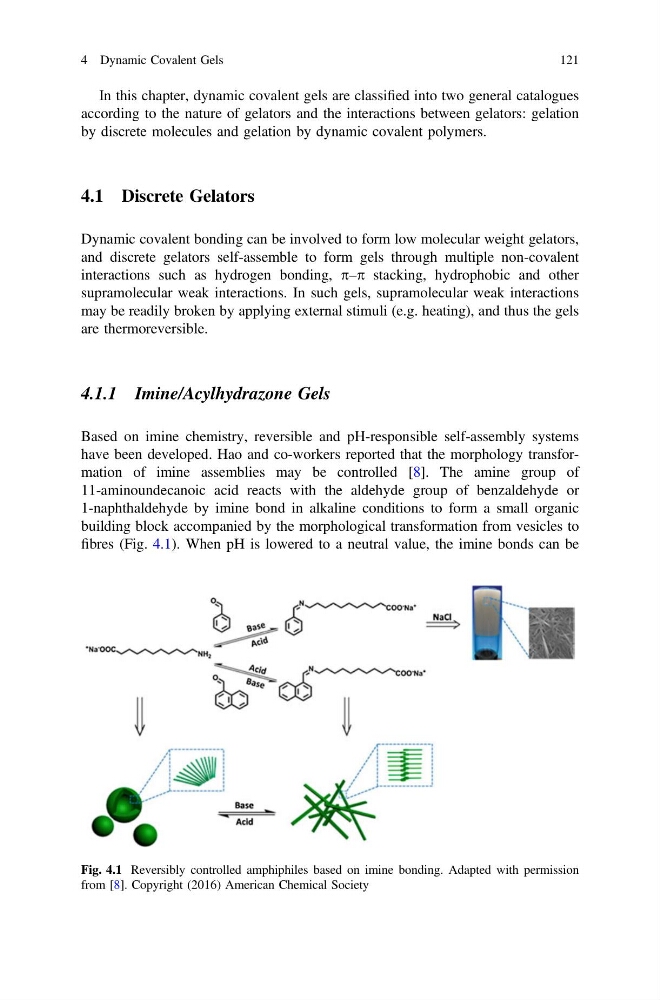
have been developed. Hao and co-workers reported that the morphology transformation of imine assemblies may be controlled [8]. The amine group of
11-aminoundecanoic acid reacts with the aldehyde group of benzaldehyde or
1-naphthaldehyde by imine bond in alkaline conditions to form a small organic
building block accompanied by the morphological transformation from vesicles to
fibres (Fig. 4.1). When pH is lowered to a neutral value, the imine bonds can be
Fig. 4.1 Reversibly controlled amphiphiles based on imine bonding. Adapted with permission
from [8]. Copyright (2016) American Chemical Society
4 Dynamic Covalent Gels
121
according to the nature of gelators and the interactions between gelators: gelation
by discrete molecules and gelation by dynamic covalent polymers.
4.1 Discrete Gelators
Dynamic covalent bonding can be involved to form low molecular weight gelators,
and discrete gelators self-assemble to form gels through multiple non-covalent
interactions such as hydrogen bonding, p–p stacking, hydrophobic and other
supramolecular weak interactions. In such gels, supramolecular weak interactions
may be readily broken by applying external stimuli (e.g. heating), and thus the gels
are thermoreversible.
4.1.1 Imine/Acylhydrazone Gels
Based on imine chemistry, reversible and pH-responsible self-assembly systems
have been developed. Hao and co-workers reported that the morphology transformation of imine assemblies may be controlled [8]. The amine group of
11-aminoundecanoic acid reacts with the aldehyde group of benzaldehyde or
1-naphthaldehyde by imine bond in alkaline conditions to form a small organic
building block accompanied by the morphological transformation from vesicles to
fibres (Fig. 4.1). When pH is lowered to a neutral value, the imine bonds can be
Fig. 4.1 Reversibly controlled amphiphiles based on imine bonding. Adapted with permission
from [8]. Copyright (2016) American Chemical Society
4 Dynamic Covalent Gels
121