

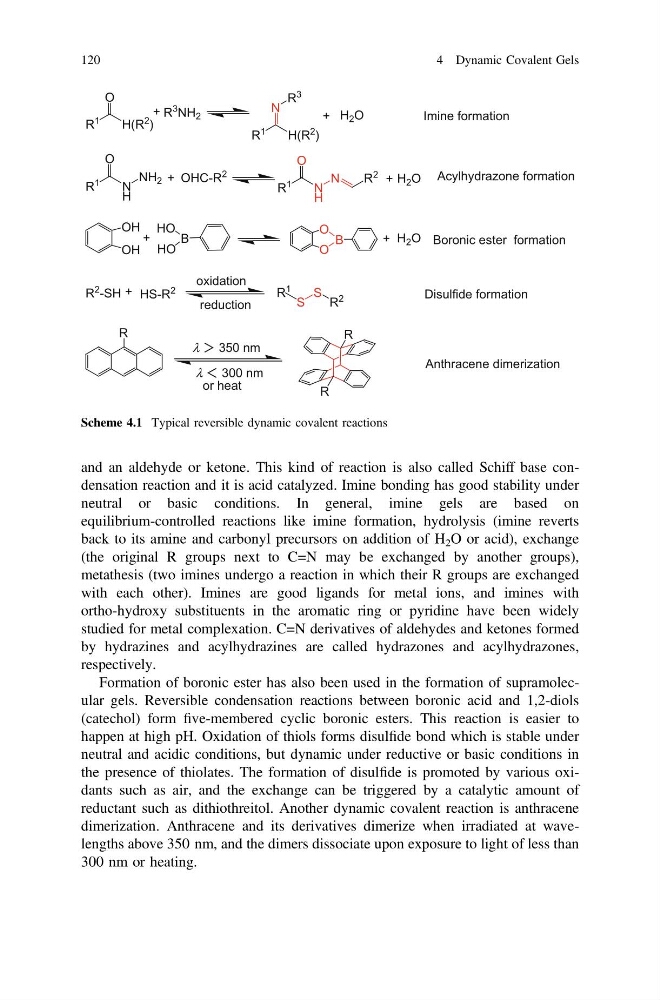
and an aldehyde or ketone. This kind of reaction is also called Schiff base condensation reaction and it is acid catalyzed. Imine bonding has good stability under
neutral or basic conditions. In general, imine gels are based on
equilibrium-controlled reactions like imine formation, hydrolysis (imine reverts
back to its amine and carbonyl precursors on addition of H 2 O or acid), exchange
(the original R groups next to C=N may be exchanged by another groups),
metathesis (two imines undergo a reaction in which their R groups are exchanged
with each other). Imines are good ligands for metal ions, and imines with
ortho-hydroxy substituents in the aromatic ring or pyridine have been widely
studied for metal complexation. C=N derivatives of aldehydes and ketones formed
by hydrazines and acylhydrazines are called hydrazones and acylhydrazones,
respectively.
Formation of boronic ester has also been used in the formation of supramolecular gels. Reversible condensation reactions between boronic acid and 1,2-diols
(catechol) form five-membered cyclic boronic esters. This reaction is easier to
happen at high pH. Oxidation of thiols forms disulfide bond which is stable under
neutral and acidic conditions, but dynamic under reductive or basic conditions in
the presence of thiolates. The formation of disulfide is promoted by various oxidants such as air, and the exchange can be triggered by a catalytic amount of
reductant such as dithiothreitol. Another dynamic covalent reaction is anthracene
dimerization. Anthracene and its derivatives dimerize when irradiated at wavelengths above 350 nm, and the dimers dissociate upon exposure to light of less than
300 nm or heating.
R
1
H(R
2 )
O
+ R
3
NH 2
R
1
H(R
2 )
N
R
3
R
1
N
H
NH 2
O
+ OHC-R
2
R
1
N
H
N
O
R
2 + H 2 O
Imine formation
Acylhydrazone formation
OH
OH
+
O
B
O
+ H 2 O Boronic ester formation
+ H 2 O
B
HO
HO
HS-R
2
+
R
2 -SH
oxidation
reduction
R
1
S
S
R
2
Disulfide formation
R
R
R
λ > 350 nm
λ < 300 nm
or heat
Anthracene dimerization
Scheme 4.1 Typical reversible dynamic covalent reactions
120
4 Dynamic Covalent Gels
neutral or basic conditions. In general, imine gels are based on
equilibrium-controlled reactions like imine formation, hydrolysis (imine reverts
back to its amine and carbonyl precursors on addition of H 2 O or acid), exchange
(the original R groups next to C=N may be exchanged by another groups),
metathesis (two imines undergo a reaction in which their R groups are exchanged
with each other). Imines are good ligands for metal ions, and imines with
ortho-hydroxy substituents in the aromatic ring or pyridine have been widely
studied for metal complexation. C=N derivatives of aldehydes and ketones formed
by hydrazines and acylhydrazines are called hydrazones and acylhydrazones,
respectively.
Formation of boronic ester has also been used in the formation of supramolecular gels. Reversible condensation reactions between boronic acid and 1,2-diols
(catechol) form five-membered cyclic boronic esters. This reaction is easier to
happen at high pH. Oxidation of thiols forms disulfide bond which is stable under
neutral and acidic conditions, but dynamic under reductive or basic conditions in
the presence of thiolates. The formation of disulfide is promoted by various oxidants such as air, and the exchange can be triggered by a catalytic amount of
reductant such as dithiothreitol. Another dynamic covalent reaction is anthracene
dimerization. Anthracene and its derivatives dimerize when irradiated at wavelengths above 350 nm, and the dimers dissociate upon exposure to light of less than
300 nm or heating.
R
1
H(R
2 )
O
+ R
3
NH 2
R
1
H(R
2 )
N
R
3
R
1
N
H
NH 2
O
+ OHC-R
2
R
1
N
H
N
O
R
2 + H 2 O
Imine formation
Acylhydrazone formation
OH
OH
+
O
B
O
+ H 2 O Boronic ester formation
+ H 2 O
B
HO
HO
HS-R
2
+
R
2 -SH
oxidation
reduction
R
1
S
S
R
2
Disulfide formation
R
R
R
λ > 350 nm
λ < 300 nm
or heat
Anthracene dimerization
Scheme 4.1 Typical reversible dynamic covalent reactions
120
4 Dynamic Covalent Gels