

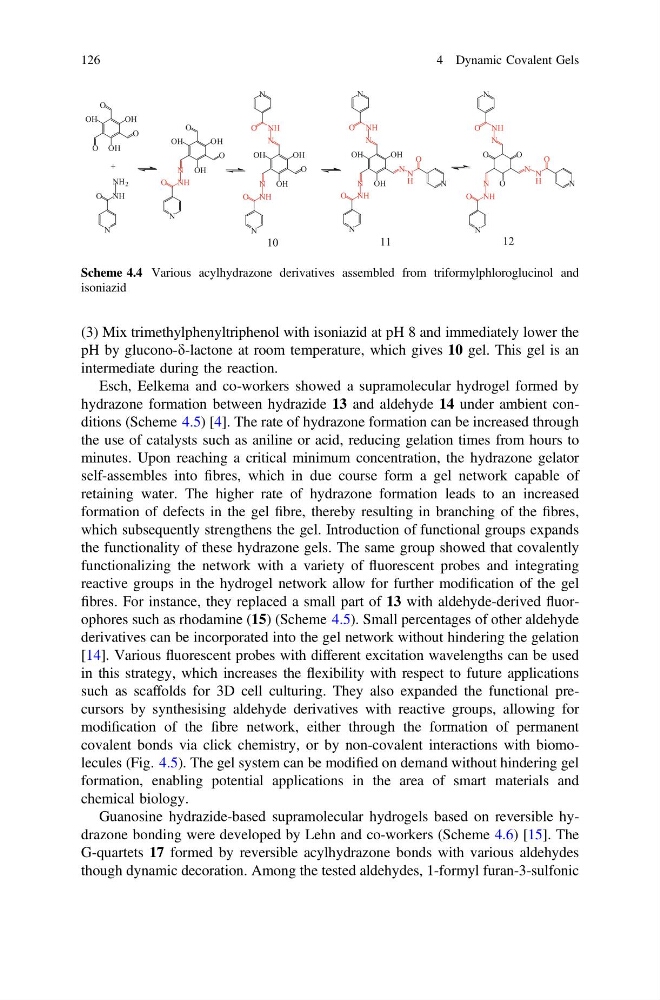
(3) Mix trimethylphenyltriphenol with isoniazid at pH 8 and immediately lower the
pH by glucono-d-lactone at room temperature, which gives 10 gel. This gel is an
intermediate during the reaction.
Esch, Eelkema and co-workers showed a supramolecular hydrogel formed by
hydrazone formation between hydrazide 13 and aldehyde 14 under ambient conditions (Scheme 4.5) [4]. The rate of hydrazone formation can be increased through
the use of catalysts such as aniline or acid, reducing gelation times from hours to
minutes. Upon reaching a critical minimum concentration, the hydrazone gelator
self-assembles into fibres, which in due course form a gel network capable of
retaining water. The higher rate of hydrazone formation leads to an increased
formation of defects in the gel fibre, thereby resulting in branching of the fibres,
which subsequently strengthens the gel. Introduction of functional groups expands
the functionality of these hydrazone gels. The same group showed that covalently
functionalizing the network with a variety of fluorescent probes and integrating
reactive groups in the hydrogel network allow for further modification of the gel
fibres. For instance, they replaced a small part of 13 with aldehyde-derived fluorophores such as rhodamine (15) (Scheme 4.5). Small percentages of other aldehyde
derivatives can be incorporated into the gel network without hindering the gelation
[14]. Various fluorescent probes with different excitation wavelengths can be used
in this strategy, which increases the flexibility with respect to future applications
such as scaffolds for 3D cell culturing. They also expanded the functional precursors by synthesising aldehyde derivatives with reactive groups, allowing for
modification of the fibre network, either through the formation of permanent
covalent bonds via click chemistry, or by non-covalent interactions with biomolecules (Fig. 4.5). The gel system can be modified on demand without hindering gel
formation, enabling potential applications in the area of smart materials and
chemical biology.
Guanosine hydrazide-based supramolecular hydrogels based on reversible hydrazone bonding were developed by Lehn and co-workers (Scheme 4.6) [15]. The
G-quartets 17 formed by reversible acylhydrazone bonds with various aldehydes
though dynamic decoration. Among the tested aldehydes, 1-formyl furan-3-sulfonic
OH
OH
OH
O
O
O
N
O NH
NH 2
+
OH
OH
OH
O
N
O
NH
O
N
OH
OH
OH
N
N
O
NH
O
N
NH
O
N
OH
OH
OH
N
N
N
NH
O
N
NH
O
N
N
H
O
N
O
O
O
N
N
N
NH
O
N
NH
O
N
N
H
O
N
10
11
12
Scheme 4.4 Various acylhydrazone derivatives assembled from triformylphloroglucinol and
isoniazid
126
4 Dynamic Covalent Gels
pH by glucono-d-lactone at room temperature, which gives 10 gel. This gel is an
intermediate during the reaction.
Esch, Eelkema and co-workers showed a supramolecular hydrogel formed by
hydrazone formation between hydrazide 13 and aldehyde 14 under ambient conditions (Scheme 4.5) [4]. The rate of hydrazone formation can be increased through
the use of catalysts such as aniline or acid, reducing gelation times from hours to
minutes. Upon reaching a critical minimum concentration, the hydrazone gelator
self-assembles into fibres, which in due course form a gel network capable of
retaining water. The higher rate of hydrazone formation leads to an increased
formation of defects in the gel fibre, thereby resulting in branching of the fibres,
which subsequently strengthens the gel. Introduction of functional groups expands
the functionality of these hydrazone gels. The same group showed that covalently
functionalizing the network with a variety of fluorescent probes and integrating
reactive groups in the hydrogel network allow for further modification of the gel
fibres. For instance, they replaced a small part of 13 with aldehyde-derived fluorophores such as rhodamine (15) (Scheme 4.5). Small percentages of other aldehyde
derivatives can be incorporated into the gel network without hindering the gelation
[14]. Various fluorescent probes with different excitation wavelengths can be used
in this strategy, which increases the flexibility with respect to future applications
such as scaffolds for 3D cell culturing. They also expanded the functional precursors by synthesising aldehyde derivatives with reactive groups, allowing for
modification of the fibre network, either through the formation of permanent
covalent bonds via click chemistry, or by non-covalent interactions with biomolecules (Fig. 4.5). The gel system can be modified on demand without hindering gel
formation, enabling potential applications in the area of smart materials and
chemical biology.
Guanosine hydrazide-based supramolecular hydrogels based on reversible hydrazone bonding were developed by Lehn and co-workers (Scheme 4.6) [15]. The
G-quartets 17 formed by reversible acylhydrazone bonds with various aldehydes
though dynamic decoration. Among the tested aldehydes, 1-formyl furan-3-sulfonic
OH
OH
OH
O
O
O
N
O NH
NH 2
+
OH
OH
OH
O
N
O
NH
O
N
OH
OH
OH
N
N
O
NH
O
N
NH
O
N
OH
OH
OH
N
N
N
NH
O
N
NH
O
N
N
H
O
N
O
O
O
N
N
N
NH
O
N
NH
O
N
N
H
O
N
10
11
12
Scheme 4.4 Various acylhydrazone derivatives assembled from triformylphloroglucinol and
isoniazid
126
4 Dynamic Covalent Gels