

Metal–organic gels may also be post-functionalized for catalysis after incorporation of catalytically active centres. For example, Fe
3+
gels of
5-diphenylphosphanylisophthalic acid (91, Scheme 3.20) are produced in alcohols
or DMF [134]. Based on the hard and soft acids and bases theory, carboxyl groups
in the gel are in strong binding with Fe
3+ , while coordination of –PPh 2 unit is weak.
The phosphine-functionalized gel is post-modified with Pd
2+ , showing efficient
catalytic applications in Suzuki–Miyaura cross-coupling reaction with recyclibility.
As a special feature of metal–organic gels, dynamic coordination bond present in
metallogels can be used for post-modification. The bifunctional ligand 5-1H-benzo
[d]imidazole-1,3-dicarboxylic acid 92 (Scheme 3.20) forms metal–organic gels
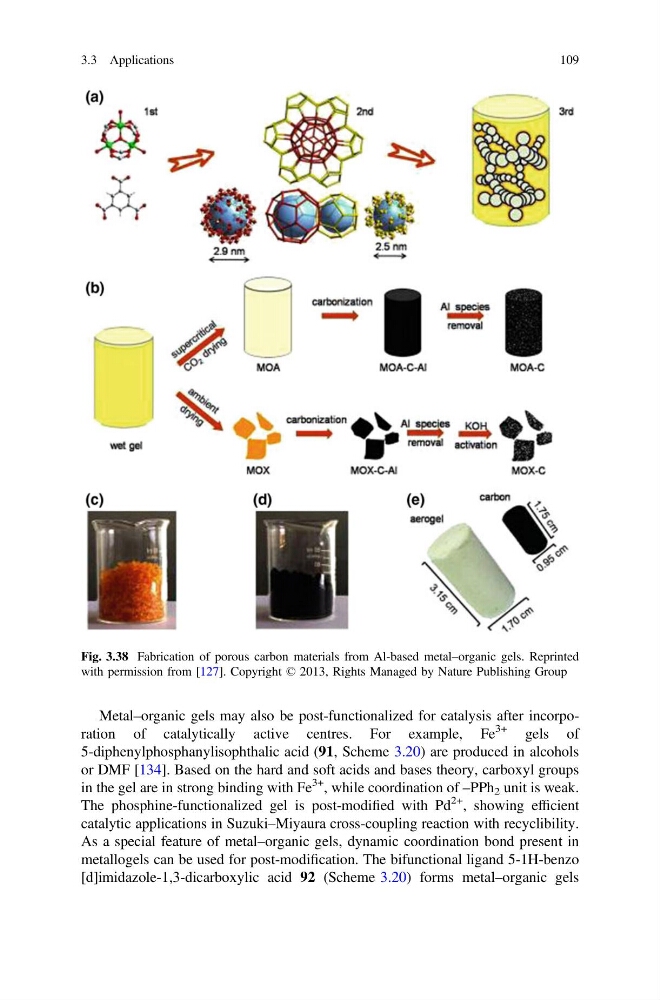
Fig. 3.38 Fabrication of porous carbon materials from Al-based metal–organic gels. Reprinted
with permission from [127]. Copyright © 2013, Rights Managed by Nature Publishing Group
3.3 Applications
109
3+
gels of
5-diphenylphosphanylisophthalic acid (91, Scheme 3.20) are produced in alcohols
or DMF [134]. Based on the hard and soft acids and bases theory, carboxyl groups
in the gel are in strong binding with Fe
3+ , while coordination of –PPh 2 unit is weak.
The phosphine-functionalized gel is post-modified with Pd
2+ , showing efficient
catalytic applications in Suzuki–Miyaura cross-coupling reaction with recyclibility.
As a special feature of metal–organic gels, dynamic coordination bond present in
metallogels can be used for post-modification. The bifunctional ligand 5-1H-benzo
[d]imidazole-1,3-dicarboxylic acid 92 (Scheme 3.20) forms metal–organic gels
Fig. 3.38 Fabrication of porous carbon materials from Al-based metal–organic gels. Reprinted
with permission from [127]. Copyright © 2013, Rights Managed by Nature Publishing Group
3.3 Applications
109