

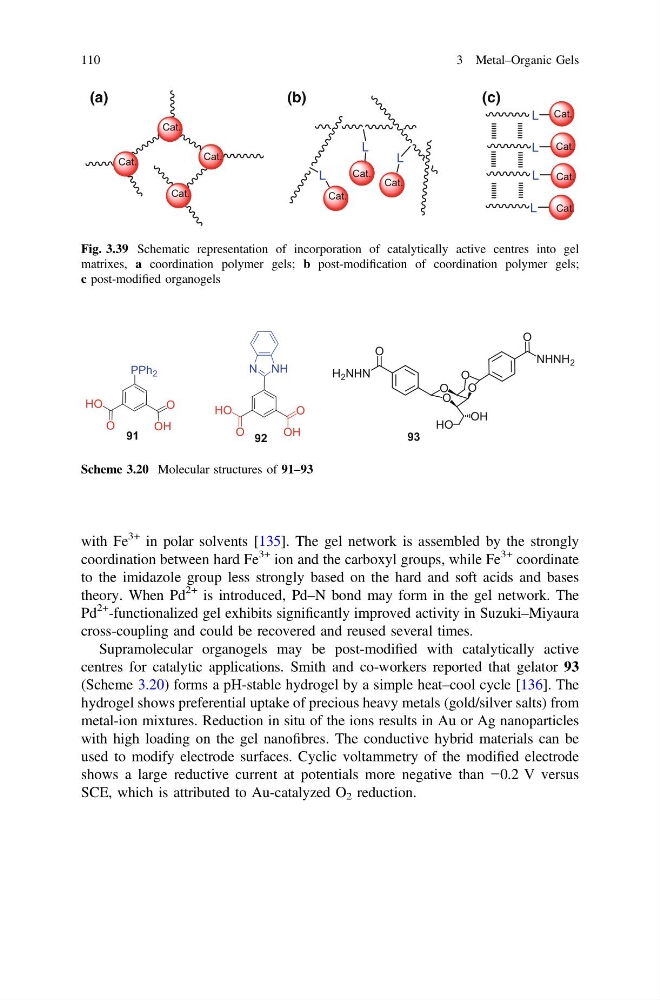
with Fe
3+ in polar solvents [135]. The gel network is assembled by the strongly
coordination between hard Fe
3+ ion and the carboxyl groups, while Fe
3+ coordinate
to the imidazole group less strongly based on the hard and soft acids and bases
theory. When Pd
2+ is introduced, Pd–N bond may form in the gel network. The
Pd
2+ -functionalized gel exhibits significantly improved activity in Suzuki–Miyaura
cross-coupling and could be recovered and reused several times.
Supramolecular organogels may be post-modified with catalytically active
centres for catalytic applications. Smith and co-workers reported that gelator 93
(Scheme 3.20) forms a pH-stable hydrogel by a simple heat–cool cycle [136]. The
hydrogel shows preferential uptake of precious heavy metals (gold/silver salts) from
metal-ion mixtures. Reduction in situ of the ions results in Au or Ag nanoparticles
with high loading on the gel nanofibres. The conductive hybrid materials can be
used to modify electrode surfaces. Cyclic voltammetry of the modified electrode
shows a large reductive current at potentials more negative than −0.2 V versus
SCE, which is attributed to Au-catalyzed O 2 reduction.
L
L
L
L
Cat.
Cat.
Cat.
Cat.
Cat.
Cat.
Cat.
Cat.
Cat.
L
L
L
Cat.
Cat.
(a)
(b)
(c)
Fig. 3.39 Schematic representation of incorporation of catalytically active centres into gel
matrixes, a coordination polymer gels; b post-modification of coordination polymer gels;
c post-modified organogels
PPh 2
NH
N
91
92
OH
O
O
HO
OH
O
O
HO
H 2 NHN
O
O
O
O
O
HO
OH
NHNH 2
O
93
Scheme 3.20 Molecular structures of 91–93
110
3 Metal–Organic Gels
3+ in polar solvents [135]. The gel network is assembled by the strongly
coordination between hard Fe
3+ ion and the carboxyl groups, while Fe
3+ coordinate
to the imidazole group less strongly based on the hard and soft acids and bases
theory. When Pd
2+ is introduced, Pd–N bond may form in the gel network. The
Pd
2+ -functionalized gel exhibits significantly improved activity in Suzuki–Miyaura
cross-coupling and could be recovered and reused several times.
Supramolecular organogels may be post-modified with catalytically active
centres for catalytic applications. Smith and co-workers reported that gelator 93
(Scheme 3.20) forms a pH-stable hydrogel by a simple heat–cool cycle [136]. The
hydrogel shows preferential uptake of precious heavy metals (gold/silver salts) from
metal-ion mixtures. Reduction in situ of the ions results in Au or Ag nanoparticles
with high loading on the gel nanofibres. The conductive hybrid materials can be
used to modify electrode surfaces. Cyclic voltammetry of the modified electrode
shows a large reductive current at potentials more negative than −0.2 V versus
SCE, which is attributed to Au-catalyzed O 2 reduction.
L
L
L
L
Cat.
Cat.
Cat.
Cat.
Cat.
Cat.
Cat.
Cat.
Cat.
L
L
L
Cat.
Cat.
(a)
(b)
(c)
Fig. 3.39 Schematic representation of incorporation of catalytically active centres into gel
matrixes, a coordination polymer gels; b post-modification of coordination polymer gels;
c post-modified organogels
PPh 2
NH
N
91
92
OH
O
O
HO
OH
O
O
HO
H 2 NHN
O
O
O
O
O
HO
OH
NHNH 2
O
93
Scheme 3.20 Molecular structures of 91–93
110
3 Metal–Organic Gels