

specifically capture glycoproteins, showing a higher selectivity and better dynamic
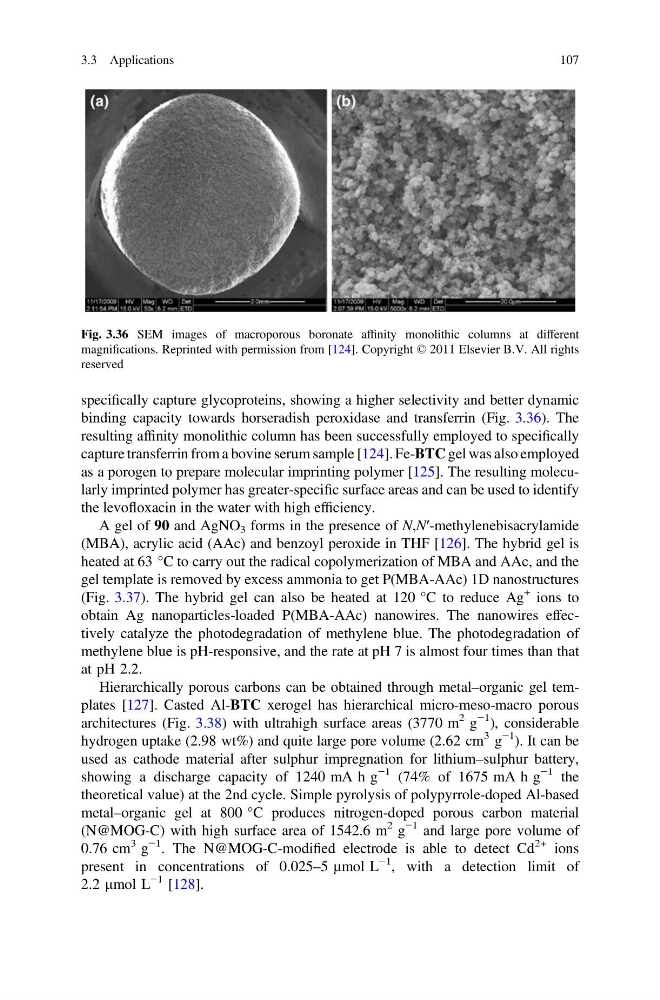
binding capacity towards horseradish peroxidase and transferrin (Fig. 3.36). The
resulting affinity monolithic column has been successfully employed to specifically
capture transferrin from a bovine serum sample [124]. Fe-BTC gel was also employed
as a porogen to prepare molecular imprinting polymer [125]. The resulting molecularly imprinted polymer has greater-specific surface areas and can be used to identify
the levofloxacin in the water with high efficiency.
A gel of 90 and AgNO 3 forms in the presence of N,N′-methylenebisacrylamide
(MBA), acrylic acid (AAc) and benzoyl peroxide in THF [126]. The hybrid gel is
heated at 63 °C to carry out the radical copolymerization of MBA and AAc, and the
gel template is removed by excess ammonia to get P(MBA-AAc) 1D nanostructures
(Fig. 3.37). The hybrid gel can also be heated at 120 °C to reduce Ag
+ ions to
obtain Ag nanoparticles-loaded P(MBA-AAc) nanowires. The nanowires effectively catalyze the photodegradation of methylene blue. The photodegradation of
methylene blue is pH-responsive, and the rate at pH 7 is almost four times than that
at pH 2.2.
Hierarchically porous carbons can be obtained through metal–organic gel templates [127]. Casted Al-BTC xerogel has hierarchical micro-meso-macro porous
architectures (Fig. 3.38) with ultrahigh surface areas (3770 m
2 g
−1
), considerable
hydrogen uptake (2.98 wt%) and quite large pore volume (2.62 cm
3 g
−1 ). It can be
used as cathode material after sulphur impregnation for lithium–sulphur battery,
showing a discharge capacity of 1240 mA h g
−1 (74% of 1675 mA h g
−1 the
theoretical value) at the 2nd cycle. Simple pyrolysis of polypyrrole-doped Al-based
metal–organic gel at 800 °C produces nitrogen-doped porous carbon material
(N@MOG-C) with high surface area of 1542.6 m
2 g
−1 and large pore volume of
0.76 cm
3 g
−1 . The N@MOG-C-modified electrode is able to detect Cd
2+ ions
present in concentrations of 0.025–5 lmol L
−1 , with a detection limit of
2.2 lmol L
−1 [128].
Fig. 3.36 SEM images of macroporous boronate affinity monolithic columns at different
magnifications. Reprinted with permission from [124]. Copyright © 2011 Elsevier B.V. All rights
reserved
3.3 Applications
107
binding capacity towards horseradish peroxidase and transferrin (Fig. 3.36). The
resulting affinity monolithic column has been successfully employed to specifically
capture transferrin from a bovine serum sample [124]. Fe-BTC gel was also employed
as a porogen to prepare molecular imprinting polymer [125]. The resulting molecularly imprinted polymer has greater-specific surface areas and can be used to identify
the levofloxacin in the water with high efficiency.
A gel of 90 and AgNO 3 forms in the presence of N,N′-methylenebisacrylamide
(MBA), acrylic acid (AAc) and benzoyl peroxide in THF [126]. The hybrid gel is
heated at 63 °C to carry out the radical copolymerization of MBA and AAc, and the
gel template is removed by excess ammonia to get P(MBA-AAc) 1D nanostructures
(Fig. 3.37). The hybrid gel can also be heated at 120 °C to reduce Ag
+ ions to
obtain Ag nanoparticles-loaded P(MBA-AAc) nanowires. The nanowires effectively catalyze the photodegradation of methylene blue. The photodegradation of
methylene blue is pH-responsive, and the rate at pH 7 is almost four times than that
at pH 2.2.
Hierarchically porous carbons can be obtained through metal–organic gel templates [127]. Casted Al-BTC xerogel has hierarchical micro-meso-macro porous
architectures (Fig. 3.38) with ultrahigh surface areas (3770 m
2 g
−1
), considerable
hydrogen uptake (2.98 wt%) and quite large pore volume (2.62 cm
3 g
−1 ). It can be
used as cathode material after sulphur impregnation for lithium–sulphur battery,
showing a discharge capacity of 1240 mA h g
−1 (74% of 1675 mA h g
−1 the
theoretical value) at the 2nd cycle. Simple pyrolysis of polypyrrole-doped Al-based
metal–organic gel at 800 °C produces nitrogen-doped porous carbon material
(N@MOG-C) with high surface area of 1542.6 m
2 g
−1 and large pore volume of
0.76 cm
3 g
−1 . The N@MOG-C-modified electrode is able to detect Cd
2+ ions
present in concentrations of 0.025–5 lmol L
−1 , with a detection limit of
2.2 lmol L
−1 [128].
Fig. 3.36 SEM images of macroporous boronate affinity monolithic columns at different
magnifications. Reprinted with permission from [124]. Copyright © 2011 Elsevier B.V. All rights
reserved
3.3 Applications
107