

A series of metallogels through spontaneous self-assembly of unsubstituted
nucleobases with Ag
+ ions were reported by Pathak, Sarma and co-workers [109].
The metallohydrogels with 3D fibrous networks are obtained by simple introduction
of Ag
+ to a deprotonated solution of adenine, cytosine, thymine or uracil. Ag
+
-
induced hydrogelation of guanine only occurs under acidic conditions. However,
gelation of guanine induced by Ag
+ only occurs under acidic conditions through the
self-assembly of nanoscale metal–organic particles. The resulting metallogels
exhibits in situ reduction of Ag salts to yield Ag
+ nanoparticles decorated with the
gel nanofibres, which may be used in recognition and catalysis area. The hydrogels
show excellent antimicrobial properties against gram-positive and gram-negative
bacteria using basic biological building units.
A class of Hg
2+ metal–organic gels form based on aminothiazole ligands (84–86,
Scheme 3.17) with Hg(OAc) 2 [110]. Suitable positioning of the methyl group in 85
on the thiazole moiety enhances the gelation behaviour because of additional
participation of methyl protons in hydrogen bonding besides the thiazole ring
proton. The methyl functional group plays a key role in controlling and enhancing
the gelation behaviour. So 85-Hg gel has better strength than 84-Hg gel. 84 and 85
can remove and visually detect mercury in polluted water because mercury forms
stable metallogels with them and then the resulting metallogels can be easily separated by skimming off or filtering from contaminated water. Once
mercury-polluted water is treated with a 1 wt% (w/v) solution of 85 in chloroform
at room temperature, a metallogel is formed at the interface. The detection limits
can be as low as 0.1 ppm with visual observation in a biphasic system of H 2 O–
CHCl 3 . Both 84 and 85 are able to remove almost quantitative of Hg
2+ ions from
polluted water.
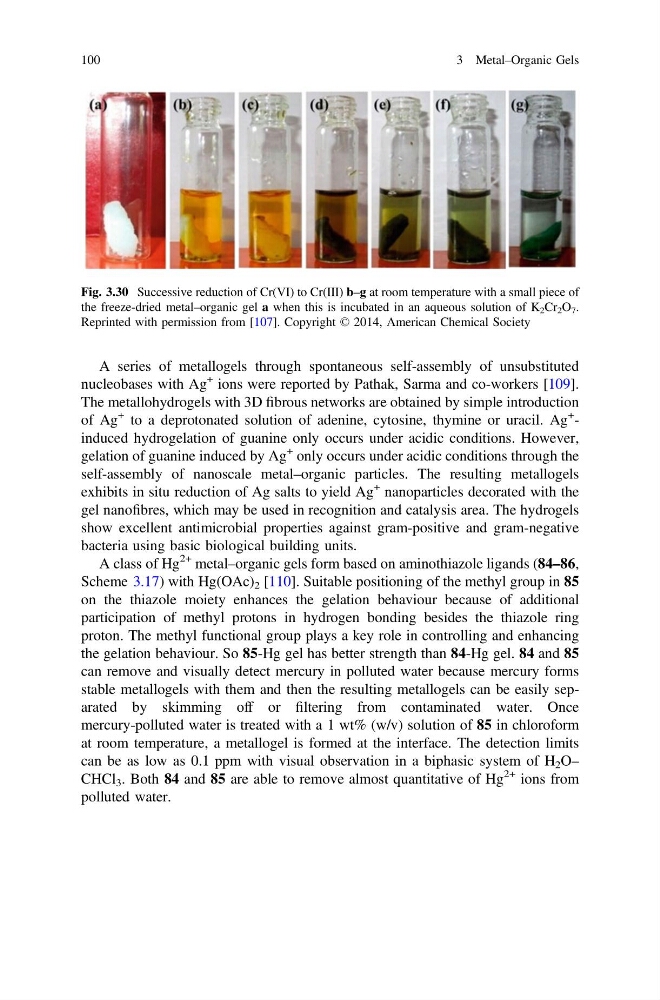
Fig. 3.30 Successive reduction of Cr(VI) to Cr(III) b–g at room temperature with a small piece of
the freeze-dried metal–organic gel a when this is incubated in an aqueous solution of K 2 Cr 2 O 7 .
Reprinted with permission from [107]. Copyright © 2014, American Chemical Society
100
3 Metal–Organic Gels
nucleobases with Ag
+ ions were reported by Pathak, Sarma and co-workers [109].
The metallohydrogels with 3D fibrous networks are obtained by simple introduction
of Ag
+ to a deprotonated solution of adenine, cytosine, thymine or uracil. Ag
+
-
induced hydrogelation of guanine only occurs under acidic conditions. However,
gelation of guanine induced by Ag
+ only occurs under acidic conditions through the
self-assembly of nanoscale metal–organic particles. The resulting metallogels
exhibits in situ reduction of Ag salts to yield Ag
+ nanoparticles decorated with the
gel nanofibres, which may be used in recognition and catalysis area. The hydrogels
show excellent antimicrobial properties against gram-positive and gram-negative
bacteria using basic biological building units.
A class of Hg
2+ metal–organic gels form based on aminothiazole ligands (84–86,
Scheme 3.17) with Hg(OAc) 2 [110]. Suitable positioning of the methyl group in 85
on the thiazole moiety enhances the gelation behaviour because of additional
participation of methyl protons in hydrogen bonding besides the thiazole ring
proton. The methyl functional group plays a key role in controlling and enhancing
the gelation behaviour. So 85-Hg gel has better strength than 84-Hg gel. 84 and 85
can remove and visually detect mercury in polluted water because mercury forms
stable metallogels with them and then the resulting metallogels can be easily separated by skimming off or filtering from contaminated water. Once
mercury-polluted water is treated with a 1 wt% (w/v) solution of 85 in chloroform
at room temperature, a metallogel is formed at the interface. The detection limits
can be as low as 0.1 ppm with visual observation in a biphasic system of H 2 O–
CHCl 3 . Both 84 and 85 are able to remove almost quantitative of Hg
2+ ions from
polluted water.
Fig. 3.30 Successive reduction of Cr(VI) to Cr(III) b–g at room temperature with a small piece of
the freeze-dried metal–organic gel a when this is incubated in an aqueous solution of K 2 Cr 2 O 7 .
Reprinted with permission from [107]. Copyright © 2014, American Chemical Society
100
3 Metal–Organic Gels