

3.3 Applications
3.3.1 Gels as Crystallization Media
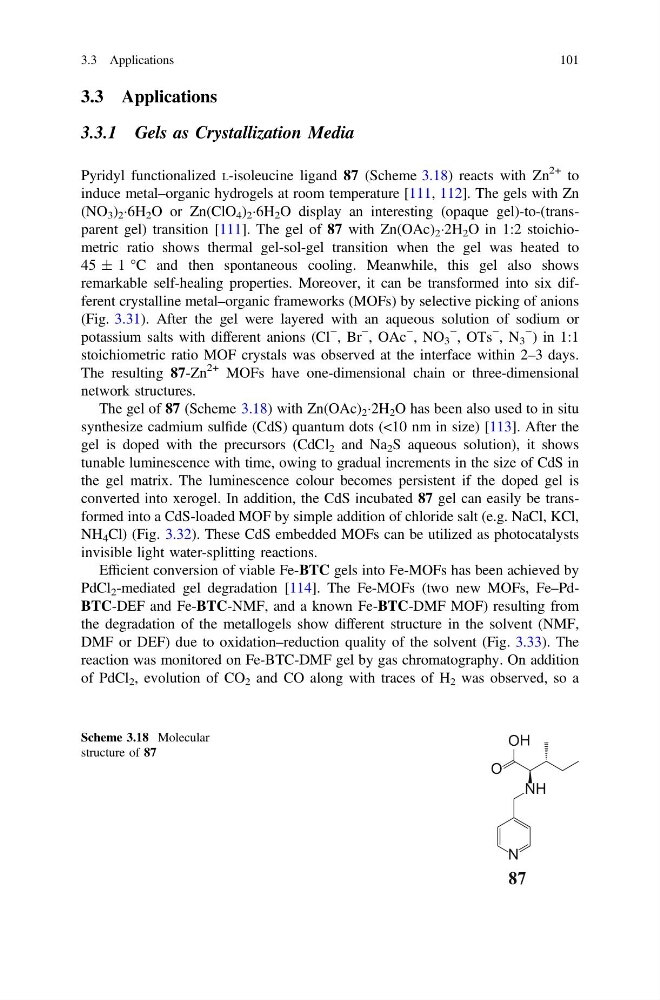
Pyridyl functionalized L-isoleucine ligand 87 (Scheme 3.18) reacts with Zn
2+ to
induce metal–organic hydrogels at room temperature [111, 112]. The gels with Zn
(NO 3 ) 2 Á6H 2 O or Zn(ClO 4 ) 2 Á6H 2 O display an interesting (opaque gel)-to-(transparent gel) transition [111]. The gel of 87 with Zn(OAc) 2 Á2H 2 O in 1:2 stoichiometric ratio shows thermal gel-sol-gel transition when the gel was heated to
45 ± 1 °C and then spontaneous cooling. Meanwhile, this gel also shows
remarkable self-healing properties. Moreover, it can be transformed into six different crystalline metal–organic frameworks (MOFs) by selective picking of anions
(Fig. 3.31). After the gel were layered with an aqueous solution of sodium or
potassium salts with different anions (Cl
− , Br
− , OAc
− , NO 3
− , OTs
− , N 3
− ) in 1:1
stoichiometric ratio MOF crystals was observed at the interface within 2–3 days.
The resulting 87-Zn
2+ MOFs have one-dimensional chain or three-dimensional
network structures.
The gel of 87 (Scheme 3.18) with Zn(OAc) 2 Á2H 2 O has been also used to in situ
synthesize cadmium sulfide (CdS) quantum dots (<10 nm in size) [113]. After the
gel is doped with the precursors (CdCl 2 and Na 2 S aqueous solution), it shows
tunable luminescence with time, owing to gradual increments in the size of CdS in
the gel matrix. The luminescence colour becomes persistent if the doped gel is
converted into xerogel. In addition, the CdS incubated 87 gel can easily be transformed into a CdS-loaded MOF by simple addition of chloride salt (e.g. NaCl, KCl,
NH 4 Cl) (Fig. 3.32). These CdS embedded MOFs can be utilized as photocatalysts
invisible light water-splitting reactions.
Efficient conversion of viable Fe-BTC gels into Fe-MOFs has been achieved by
PdCl 2 -mediated gel degradation [114]. The Fe-MOFs (two new MOFs, Fe–PdBTC-DEF and Fe-BTC-NMF, and a known Fe-BTC-DMF MOF) resulting from
the degradation of the metallogels show different structure in the solvent (NMF,
DMF or DEF) due to oxidation–reduction quality of the solvent (Fig. 3.33). The
reaction was monitored on Fe-BTC-DMF gel by gas chromatography. On addition
of PdCl 2 , evolution of CO 2 and CO along with traces of H 2 was observed, so a
N
NH
O
OH
87
Scheme 3.18 Molecular
structure of 87
3.3 Applications
101
3.3.1 Gels as Crystallization Media
Pyridyl functionalized L-isoleucine ligand 87 (Scheme 3.18) reacts with Zn
2+ to
induce metal–organic hydrogels at room temperature [111, 112]. The gels with Zn
(NO 3 ) 2 Á6H 2 O or Zn(ClO 4 ) 2 Á6H 2 O display an interesting (opaque gel)-to-(transparent gel) transition [111]. The gel of 87 with Zn(OAc) 2 Á2H 2 O in 1:2 stoichiometric ratio shows thermal gel-sol-gel transition when the gel was heated to
45 ± 1 °C and then spontaneous cooling. Meanwhile, this gel also shows
remarkable self-healing properties. Moreover, it can be transformed into six different crystalline metal–organic frameworks (MOFs) by selective picking of anions
(Fig. 3.31). After the gel were layered with an aqueous solution of sodium or
potassium salts with different anions (Cl
− , Br
− , OAc
− , NO 3
− , OTs
− , N 3
− ) in 1:1
stoichiometric ratio MOF crystals was observed at the interface within 2–3 days.
The resulting 87-Zn
2+ MOFs have one-dimensional chain or three-dimensional
network structures.
The gel of 87 (Scheme 3.18) with Zn(OAc) 2 Á2H 2 O has been also used to in situ
synthesize cadmium sulfide (CdS) quantum dots (<10 nm in size) [113]. After the
gel is doped with the precursors (CdCl 2 and Na 2 S aqueous solution), it shows
tunable luminescence with time, owing to gradual increments in the size of CdS in
the gel matrix. The luminescence colour becomes persistent if the doped gel is
converted into xerogel. In addition, the CdS incubated 87 gel can easily be transformed into a CdS-loaded MOF by simple addition of chloride salt (e.g. NaCl, KCl,
NH 4 Cl) (Fig. 3.32). These CdS embedded MOFs can be utilized as photocatalysts
invisible light water-splitting reactions.
Efficient conversion of viable Fe-BTC gels into Fe-MOFs has been achieved by
PdCl 2 -mediated gel degradation [114]. The Fe-MOFs (two new MOFs, Fe–PdBTC-DEF and Fe-BTC-NMF, and a known Fe-BTC-DMF MOF) resulting from
the degradation of the metallogels show different structure in the solvent (NMF,
DMF or DEF) due to oxidation–reduction quality of the solvent (Fig. 3.33). The
reaction was monitored on Fe-BTC-DMF gel by gas chromatography. On addition
of PdCl 2 , evolution of CO 2 and CO along with traces of H 2 was observed, so a
N
NH
O
OH
87
Scheme 3.18 Molecular
structure of 87
3.3 Applications
101