

hydrogen bonds throughout the whole structure. To operate between the 82
molecules as the molecules keep packed in the gel matrix, p−p stacking interaction
is also needed. In brief, these interactions make the supramolecular gel assembly.
This gel exhibited stimuli-responsive behaviour towards various chemical stimuli
(pH, selective metal ions and anions, selective complexing agents, etc.). The Cu(I)
metal centre provides this gel with an excellent opportunity to remove Cr(VI) ions
from aqueous solution effectively (Fig. 3.30). The removal capacity could reach at
*331 mg g
−1 at pH *2.7.
A green-light-emitting metal–organic gel has been prepared with Tb
3+ and hydrazide-functionalized benzimidazole ligand 83 (Scheme 3.17) [108]. Different
luminescence is observed in the gel state and xerogel due to the different amount of
water. In the xerogel, the luminescence of Tb
3+ is sensitized because of the high
energy transfer efficiency from 83 to Tb
3+ in the absence of excess water. However,
in the wet gel state, the luminescence of Tb
3+ is quenched by water. The obtained
quantum yields of the wet gel state and xerogel were 34.6 and 14.2%, respectively.
The lower quantum yield of the xerogel is ascribed to the less efficient
non-radioactive relaxation processes.
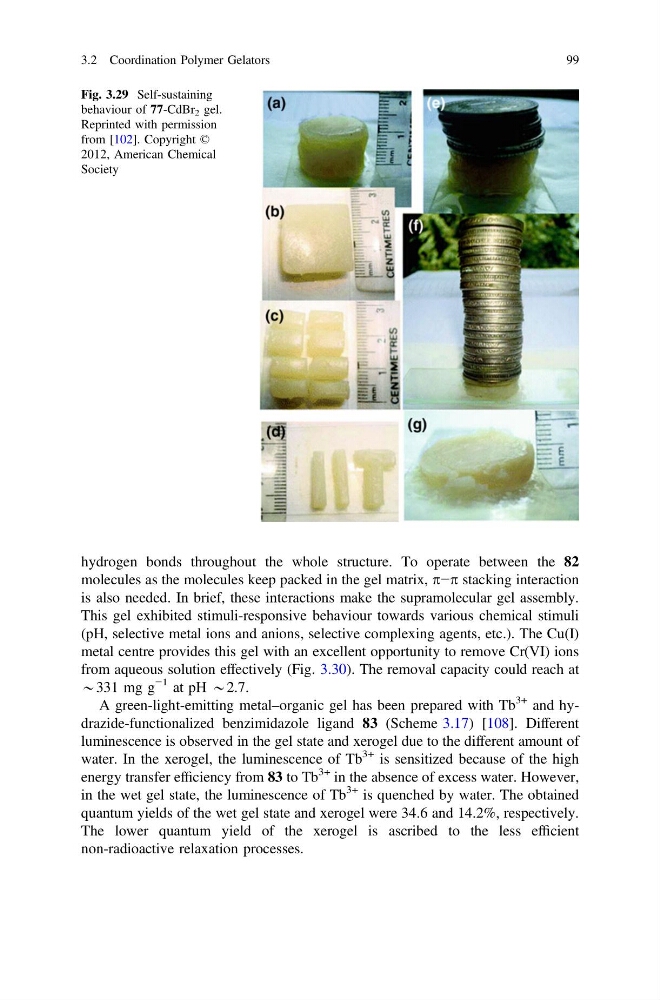
Fig. 3.29 Self-sustaining
behaviour of 77-CdBr 2 gel.
Reprinted with permission
from [102]. Copyright ©
2012, American Chemical
Society
3.2 Coordination Polymer Gelators
99
molecules as the molecules keep packed in the gel matrix, p−p stacking interaction
is also needed. In brief, these interactions make the supramolecular gel assembly.
This gel exhibited stimuli-responsive behaviour towards various chemical stimuli
(pH, selective metal ions and anions, selective complexing agents, etc.). The Cu(I)
metal centre provides this gel with an excellent opportunity to remove Cr(VI) ions
from aqueous solution effectively (Fig. 3.30). The removal capacity could reach at
*331 mg g
−1 at pH *2.7.
A green-light-emitting metal–organic gel has been prepared with Tb
3+ and hydrazide-functionalized benzimidazole ligand 83 (Scheme 3.17) [108]. Different
luminescence is observed in the gel state and xerogel due to the different amount of
water. In the xerogel, the luminescence of Tb
3+ is sensitized because of the high
energy transfer efficiency from 83 to Tb
3+ in the absence of excess water. However,
in the wet gel state, the luminescence of Tb
3+ is quenched by water. The obtained
quantum yields of the wet gel state and xerogel were 34.6 and 14.2%, respectively.
The lower quantum yield of the xerogel is ascribed to the less efficient
non-radioactive relaxation processes.
Fig. 3.29 Self-sustaining
behaviour of 77-CdBr 2 gel.
Reprinted with permission
from [102]. Copyright ©
2012, American Chemical
Society
3.2 Coordination Polymer Gelators
99