

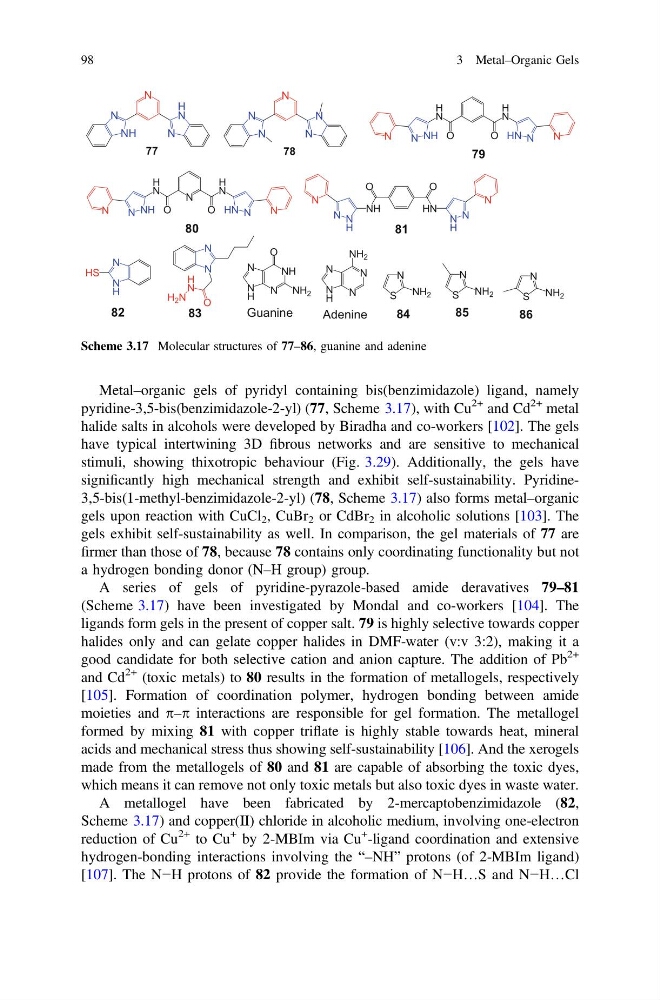
Metal–organic gels of pyridyl containing bis(benzimidazole) ligand, namely
pyridine-3,5-bis(benzimidazole-2-yl) (77, Scheme 3.17), with Cu
2+ and Cd
2+ metal
halide salts in alcohols were developed by Biradha and co-workers [102]. The gels
have typical intertwining 3D fibrous networks and are sensitive to mechanical
stimuli, showing thixotropic behaviour (Fig. 3.29). Additionally, the gels have
significantly high mechanical strength and exhibit self-sustainability. Pyridine3,5-bis(1-methyl-benzimidazole-2-yl) (78, Scheme 3.17) also forms metal–organic
gels upon reaction with CuCl 2 , CuBr 2 or CdBr 2 in alcoholic solutions [103]. The
gels exhibit self-sustainability as well. In comparison, the gel materials of 77 are
firmer than those of 78, because 78 contains only coordinating functionality but not
a hydrogen bonding donor (N–H group) group.
A series of gels of pyridine-pyrazole-based amide deravatives 79–81
(Scheme 3.17) have been investigated by Mondal and co-workers [104]. The
ligands form gels in the present of copper salt. 79 is highly selective towards copper
halides only and can gelate copper halides in DMF-water (v:v 3:2), making it a
good candidate for both selective cation and anion capture. The addition of Pb
2+
and Cd
2+ (toxic metals) to 80 results in the formation of metallogels, respectively
[105]. Formation of coordination polymer, hydrogen bonding between amide
moieties and p–p interactions are responsible for gel formation. The metallogel
formed by mixing 81 with copper triflate is highly stable towards heat, mineral
acids and mechanical stress thus showing self-sustainability [106]. And the xerogels
made from the metallogels of 80 and 81 are capable of absorbing the toxic dyes,
which means it can remove not only toxic metals but also toxic dyes in waste water.
A metallogel have been fabricated by 2-mercaptobenzimidazole (82,
Scheme 3.17) and copper(II) chloride in alcoholic medium, involving one-electron
reduction of Cu
2+ to Cu
+ by 2-MBIm via Cu
+ -ligand coordination and extensive
hydrogen-bonding interactions involving the “–NH” protons (of 2-MBIm ligand)
[107]. The N−H protons of 82 provide the formation of N−H…S and N−H…Cl
N
NH
N
N
H
O
NH 2
N
N
N
N
H
NH 2
Guanine
Adenine
N
N
H
HS
82
N
S
NH 2
N
N
O
H
N
H 2 N
83
O
NH
N N
H
N
HN
O
N
H
N
N
O
H
N
O
H
N
HN N
N NH
N
N
79
81
N
S
NH 2
N
S
NH 2
84
85
86
N
O
H
N
O
H
N
HN N
N NH
N
N
80
77
N
N
NH
N
H
N
78
N
N
N
N
N
Scheme 3.17 Molecular structures of 77–86, guanine and adenine
98
3 Metal–Organic Gels
pyridine-3,5-bis(benzimidazole-2-yl) (77, Scheme 3.17), with Cu
2+ and Cd
2+ metal
halide salts in alcohols were developed by Biradha and co-workers [102]. The gels
have typical intertwining 3D fibrous networks and are sensitive to mechanical
stimuli, showing thixotropic behaviour (Fig. 3.29). Additionally, the gels have
significantly high mechanical strength and exhibit self-sustainability. Pyridine3,5-bis(1-methyl-benzimidazole-2-yl) (78, Scheme 3.17) also forms metal–organic
gels upon reaction with CuCl 2 , CuBr 2 or CdBr 2 in alcoholic solutions [103]. The
gels exhibit self-sustainability as well. In comparison, the gel materials of 77 are
firmer than those of 78, because 78 contains only coordinating functionality but not
a hydrogen bonding donor (N–H group) group.
A series of gels of pyridine-pyrazole-based amide deravatives 79–81
(Scheme 3.17) have been investigated by Mondal and co-workers [104]. The
ligands form gels in the present of copper salt. 79 is highly selective towards copper
halides only and can gelate copper halides in DMF-water (v:v 3:2), making it a
good candidate for both selective cation and anion capture. The addition of Pb
2+
and Cd
2+ (toxic metals) to 80 results in the formation of metallogels, respectively
[105]. Formation of coordination polymer, hydrogen bonding between amide
moieties and p–p interactions are responsible for gel formation. The metallogel
formed by mixing 81 with copper triflate is highly stable towards heat, mineral
acids and mechanical stress thus showing self-sustainability [106]. And the xerogels
made from the metallogels of 80 and 81 are capable of absorbing the toxic dyes,
which means it can remove not only toxic metals but also toxic dyes in waste water.
A metallogel have been fabricated by 2-mercaptobenzimidazole (82,
Scheme 3.17) and copper(II) chloride in alcoholic medium, involving one-electron
reduction of Cu
2+ to Cu
+ by 2-MBIm via Cu
+ -ligand coordination and extensive
hydrogen-bonding interactions involving the “–NH” protons (of 2-MBIm ligand)
[107]. The N−H protons of 82 provide the formation of N−H…S and N−H…Cl
N
NH
N
N
H
O
NH 2
N
N
N
N
H
NH 2
Guanine
Adenine
N
N
H
HS
82
N
S
NH 2
N
N
O
H
N
H 2 N
83
O
NH
N N
H
N
HN
O
N
H
N
N
O
H
N
O
H
N
HN N
N NH
N
N
79
81
N
S
NH 2
N
S
NH 2
84
85
86
N
O
H
N
O
H
N
HN N
N NH
N
N
80
77
N
N
NH
N
H
N
78
N
N
N
N
N
Scheme 3.17 Molecular structures of 77–86, guanine and adenine
98
3 Metal–Organic Gels