

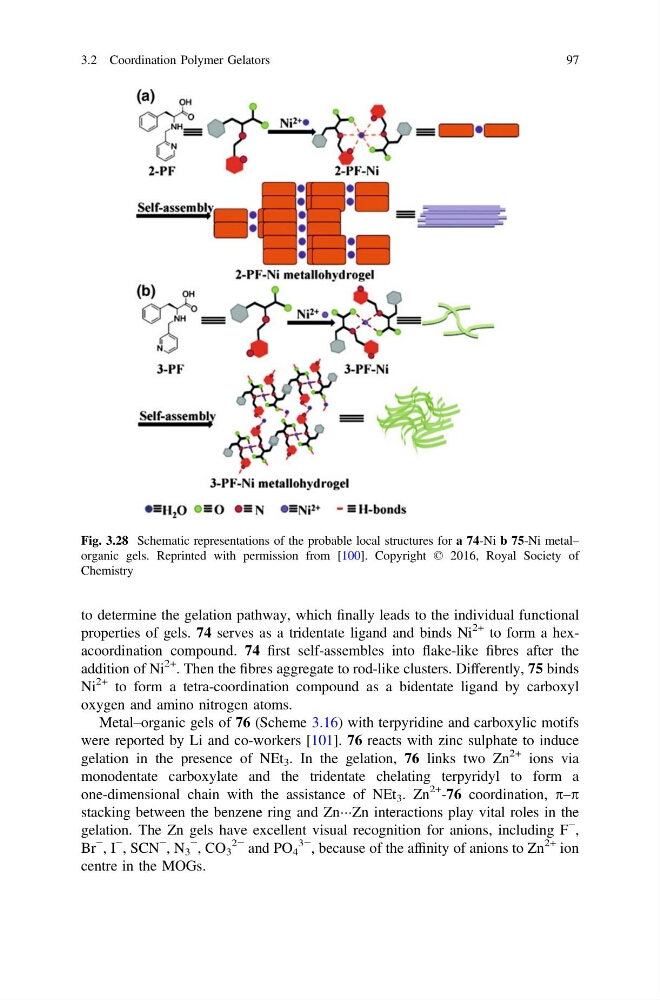
to determine the gelation pathway, which finally leads to the individual functional
properties of gels. 74 serves as a tridentate ligand and binds Ni
2+ to form a hexacoordination compound. 74 first self-assembles into flake-like fibres after the
addition of Ni
2+ . Then the fibres aggregate to rod-like clusters. Differently, 75 binds
Ni
2+ to form a tetra-coordination compound as a bidentate ligand by carboxyl
oxygen and amino nitrogen atoms.
Metal–organic gels of 76 (Scheme 3.16) with terpyridine and carboxylic motifs
were reported by Li and co-workers [101]. 76 reacts with zinc sulphate to induce
gelation in the presence of NEt 3 . In the gelation, 76 links two Zn
2+ ions via
monodentate carboxylate and the tridentate chelating terpyridyl to form a
one-dimensional chain with the assistance of NEt 3 . Zn
2+ -76 coordination, p–p
stacking between the benzene ring and ZnÁÁÁZn interactions play vital roles in the
gelation. The Zn gels have excellent visual recognition for anions, including F
− ,
Br
− , I
− , SCN
− , N 3
− , CO 3
2− and PO 4
3− , because of the affinity of anions to Zn
2+ ion
centre in the MOGs.
Fig. 3.28 Schematic representations of the probable local structures for a 74-Ni b 75-Ni metal–
organic gels. Reprinted with permission from [100]. Copyright © 2016, Royal Society of
Chemistry
3.2 Coordination Polymer Gelators
97
properties of gels. 74 serves as a tridentate ligand and binds Ni
2+ to form a hexacoordination compound. 74 first self-assembles into flake-like fibres after the
addition of Ni
2+ . Then the fibres aggregate to rod-like clusters. Differently, 75 binds
Ni
2+ to form a tetra-coordination compound as a bidentate ligand by carboxyl
oxygen and amino nitrogen atoms.
Metal–organic gels of 76 (Scheme 3.16) with terpyridine and carboxylic motifs
were reported by Li and co-workers [101]. 76 reacts with zinc sulphate to induce
gelation in the presence of NEt 3 . In the gelation, 76 links two Zn
2+ ions via
monodentate carboxylate and the tridentate chelating terpyridyl to form a
one-dimensional chain with the assistance of NEt 3 . Zn
2+ -76 coordination, p–p
stacking between the benzene ring and ZnÁÁÁZn interactions play vital roles in the
gelation. The Zn gels have excellent visual recognition for anions, including F
− ,
Br
− , I
− , SCN
− , N 3
− , CO 3
2− and PO 4
3− , because of the affinity of anions to Zn
2+ ion
centre in the MOGs.
Fig. 3.28 Schematic representations of the probable local structures for a 74-Ni b 75-Ni metal–
organic gels. Reprinted with permission from [100]. Copyright © 2016, Royal Society of
Chemistry
3.2 Coordination Polymer Gelators
97