

coordinate to carboxylate groups to aggregate to coordination polymers leading to
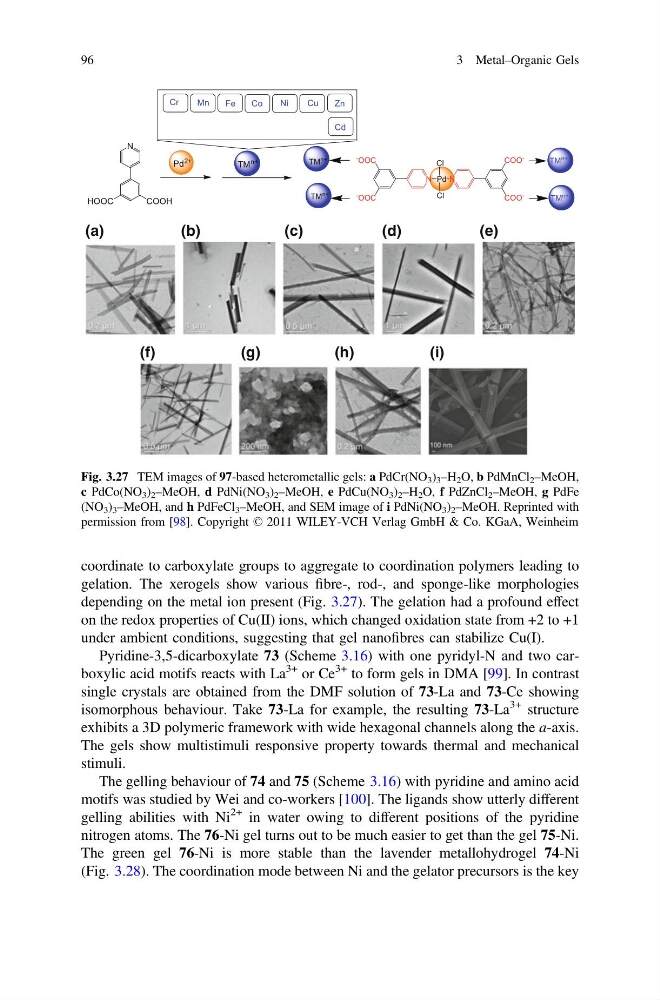
gelation. The xerogels show various fibre-, rod-, and sponge-like morphologies
depending on the metal ion present (Fig. 3.27). The gelation had a profound effect
on the redox properties of Cu(II) ions, which changed oxidation state from +2 to +1
under ambient conditions, suggesting that gel nanofibres can stabilize Cu(I).
Pyridine-3,5-dicarboxylate 73 (Scheme 3.16) with one pyridyl-N and two carboxylic acid motifs reacts with La
3+ or Ce
3+ to form gels in DMA [99]. In contrast
single crystals are obtained from the DMF solution of 73-La and 73-Ce showing
isomorphous behaviour. Take 73-La for example, the resulting 73-La
3+ structure
exhibits a 3D polymeric framework with wide hexagonal channels along the a-axis.
The gels show multistimuli responsive property towards thermal and mechanical
stimuli.
The gelling behaviour of 74 and 75 (Scheme 3.16) with pyridine and amino acid
motifs was studied by Wei and co-workers [100]. The ligands show utterly different
gelling abilities with Ni
2+ in water owing to different positions of the pyridine
nitrogen atoms. The 76-Ni gel turns out to be much easier to get than the gel 75-Ni.
The green gel 76-Ni is more stable than the lavender metallohydrogel 74-Ni
(Fig. 3.28). The coordination mode between Ni and the gelator precursors is the key
Cr
Mn
Fe
Co
Ni
Cu
Zn
Cd
N
HOOC
COOH
Pd
2+
TM
n+
N Pd
- OOC
- OOC
N
COO -
COO -
TM n+
TM n+
TM n+
Cl
Cl
TM n+
(a)
(b)
(f)
(g)
(h)
(i)
(c)
(d)
(e)
Fig. 3.27 TEM images of 97-based heterometallic gels: a PdCr(NO 3 ) 3 –H 2 O, b PdMnCl 2 –MeOH,
c PdCo(NO 3 ) 2 –MeOH, d PdNi(NO 3 ) 2 –MeOH, e PdCu(NO 3 ) 2 –H 2 O, f PdZnCl 2 –MeOH, g PdFe
(NO 3 ) 3 –MeOH, and h PdFeCl 3 –MeOH, and SEM image of i PdNi(NO 3 ) 2 –MeOH. Reprinted with
permission from [98]. Copyright © 2011 WILEY-VCH Verlag GmbH & Co. KGaA, Weinheim
96
3 Metal–Organic Gels
gelation. The xerogels show various fibre-, rod-, and sponge-like morphologies
depending on the metal ion present (Fig. 3.27). The gelation had a profound effect
on the redox properties of Cu(II) ions, which changed oxidation state from +2 to +1
under ambient conditions, suggesting that gel nanofibres can stabilize Cu(I).
Pyridine-3,5-dicarboxylate 73 (Scheme 3.16) with one pyridyl-N and two carboxylic acid motifs reacts with La
3+ or Ce
3+ to form gels in DMA [99]. In contrast
single crystals are obtained from the DMF solution of 73-La and 73-Ce showing
isomorphous behaviour. Take 73-La for example, the resulting 73-La
3+ structure
exhibits a 3D polymeric framework with wide hexagonal channels along the a-axis.
The gels show multistimuli responsive property towards thermal and mechanical
stimuli.
The gelling behaviour of 74 and 75 (Scheme 3.16) with pyridine and amino acid
motifs was studied by Wei and co-workers [100]. The ligands show utterly different
gelling abilities with Ni
2+ in water owing to different positions of the pyridine
nitrogen atoms. The 76-Ni gel turns out to be much easier to get than the gel 75-Ni.
The green gel 76-Ni is more stable than the lavender metallohydrogel 74-Ni
(Fig. 3.28). The coordination mode between Ni and the gelator precursors is the key
Cr
Mn
Fe
Co
Ni
Cu
Zn
Cd
N
HOOC
COOH
Pd
2+
TM
n+
N Pd
- OOC
- OOC
N
COO -
COO -
TM n+
TM n+
TM n+
Cl
Cl
TM n+
(a)
(b)
(f)
(g)
(h)
(i)
(c)
(d)
(e)
Fig. 3.27 TEM images of 97-based heterometallic gels: a PdCr(NO 3 ) 3 –H 2 O, b PdMnCl 2 –MeOH,
c PdCo(NO 3 ) 2 –MeOH, d PdNi(NO 3 ) 2 –MeOH, e PdCu(NO 3 ) 2 –H 2 O, f PdZnCl 2 –MeOH, g PdFe
(NO 3 ) 3 –MeOH, and h PdFeCl 3 –MeOH, and SEM image of i PdNi(NO 3 ) 2 –MeOH. Reprinted with
permission from [98]. Copyright © 2011 WILEY-VCH Verlag GmbH & Co. KGaA, Weinheim
96
3 Metal–Organic Gels