

between Ni
2+ ion and nitrogen atom of terpyridine and cyclam, thus brand
stretching to form polymers structure.
The self-assembly properties of C 3 -symmetric tripodal terpyridine ligand 70
(Scheme 3.15) with lanthanide ions or d-block ions were investigated by
Gunnlaugsson and co-workers [95, 96]. The gelation with d-block ions, such as Fe
(II), Ni(II), Cu(II), Zn(II) and Ru(III) in MeOH, was investigated by monitoring the
changes in the ligand-centred absorbance and the fluorescence. 70 formed 1D
helical gel in H 2 O–MeOH solution itself through hydrogen bonding and p–p interactions. After the addition of metal ions (M) such as Fe(II), Ni(II), Cu(II), Zn(II)
and Ru(III), these gels further cross-link into 3D metallogels. Through threefold
hydrogen bonding between benzene-1,3,5-tricarboxamide core and the interaction
between terpyridine and d-metal ions, the coloured or colourless gels are formed
and all of them retain their fibrous nature. Only the addition of Zn(II), which has a
filled d orbital, results in the formation of fluorescent gels while the other metal ions
quench fluorescence of 70.
Luminescence metal–organic gel of tetrapodal terpyridine ligand 71
(Scheme 3.15) with Eu
3+ ions was reported by Maji and co-workers [97]. 71 reacts
with Eu
3+ (1:2 eq.) in CHCl 3 -THF (v:v 1:2) to form gels with nanotubular structure. The gel shows enhanced mechanical stability along with tunable emission
properties. The gel is solution-processable and made into transparent films. The gel
shows matrix coordination-induced emission (MCIE) and aggregation-induced
emission (AIE), which can be attributed to the combined effect of metal
coordination.
3.2.3 Coordination Polymer Gels with Hybrid Donors
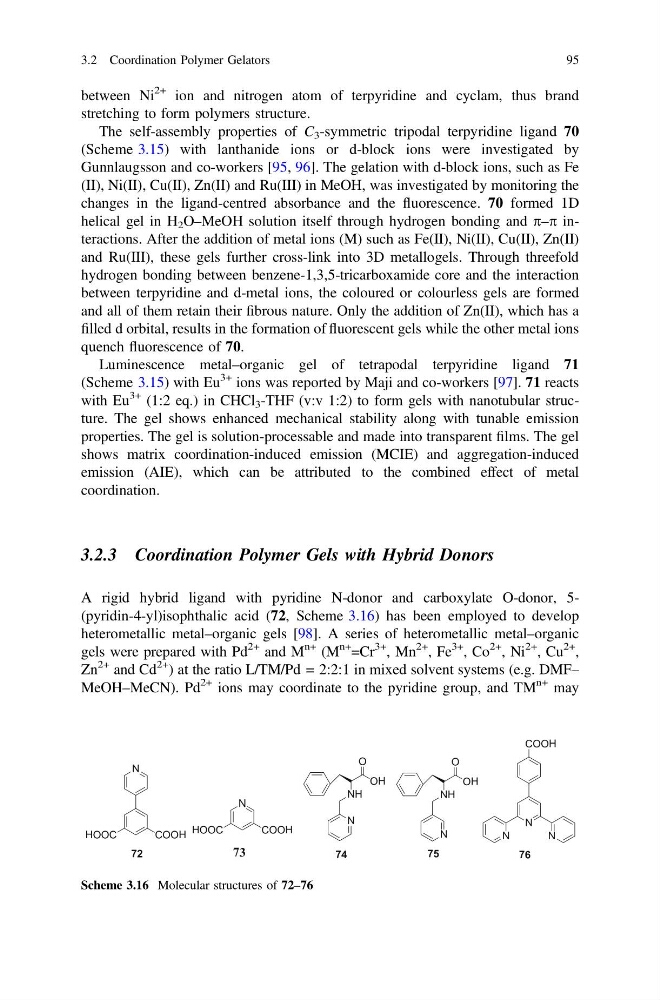
A rigid hybrid ligand with pyridine N-donor and carboxylate O-donor, 5(pyridin-4-yl)isophthalic acid (72, Scheme 3.16) has been employed to develop
heterometallic metal–organic gels [98]. A series of heterometallic metal–organic
gels were prepared with Pd
2+ and M
n+ (M
n+ =Cr
3+ , Mn
2+ , Fe
3+ , Co
2+ , Ni
2+ , Cu
2+ ,
Zn
2+ and Cd
2+ ) at the ratio L/TM/Pd = 2:2:1 in mixed solvent systems (e.g. DMF–
MeOH–MeCN). Pd
2+ ions may coordinate to the pyridine group, and TM
n+ may
73
NH
O
OH
N
NH
O
OH
N
74
75
N
N
N
COOH
76
COOH
HOOC
N
72
N
COOH
HOOC
Scheme 3.16 Molecular structures of 72–76
3.2 Coordination Polymer Gelators
95
2+ ion and nitrogen atom of terpyridine and cyclam, thus brand
stretching to form polymers structure.
The self-assembly properties of C 3 -symmetric tripodal terpyridine ligand 70
(Scheme 3.15) with lanthanide ions or d-block ions were investigated by
Gunnlaugsson and co-workers [95, 96]. The gelation with d-block ions, such as Fe
(II), Ni(II), Cu(II), Zn(II) and Ru(III) in MeOH, was investigated by monitoring the
changes in the ligand-centred absorbance and the fluorescence. 70 formed 1D
helical gel in H 2 O–MeOH solution itself through hydrogen bonding and p–p interactions. After the addition of metal ions (M) such as Fe(II), Ni(II), Cu(II), Zn(II)
and Ru(III), these gels further cross-link into 3D metallogels. Through threefold
hydrogen bonding between benzene-1,3,5-tricarboxamide core and the interaction
between terpyridine and d-metal ions, the coloured or colourless gels are formed
and all of them retain their fibrous nature. Only the addition of Zn(II), which has a
filled d orbital, results in the formation of fluorescent gels while the other metal ions
quench fluorescence of 70.
Luminescence metal–organic gel of tetrapodal terpyridine ligand 71
(Scheme 3.15) with Eu
3+ ions was reported by Maji and co-workers [97]. 71 reacts
with Eu
3+ (1:2 eq.) in CHCl 3 -THF (v:v 1:2) to form gels with nanotubular structure. The gel shows enhanced mechanical stability along with tunable emission
properties. The gel is solution-processable and made into transparent films. The gel
shows matrix coordination-induced emission (MCIE) and aggregation-induced
emission (AIE), which can be attributed to the combined effect of metal
coordination.
3.2.3 Coordination Polymer Gels with Hybrid Donors
A rigid hybrid ligand with pyridine N-donor and carboxylate O-donor, 5(pyridin-4-yl)isophthalic acid (72, Scheme 3.16) has been employed to develop
heterometallic metal–organic gels [98]. A series of heterometallic metal–organic
gels were prepared with Pd
2+ and M
n+ (M
n+ =Cr
3+ , Mn
2+ , Fe
3+ , Co
2+ , Ni
2+ , Cu
2+ ,
Zn
2+ and Cd
2+ ) at the ratio L/TM/Pd = 2:2:1 in mixed solvent systems (e.g. DMF–
MeOH–MeCN). Pd
2+ ions may coordinate to the pyridine group, and TM
n+ may
73
NH
O
OH
N
NH
O
OH
N
74
75
N
N
N
COOH
76
COOH
HOOC
N
72
N
COOH
HOOC
Scheme 3.16 Molecular structures of 72–76
3.2 Coordination Polymer Gelators
95