

4.5.1 TiO 2–x Doped with Nonmetal Elements
Nitrogen is one of the most investigated elements for the doping of TiO 2 . As a
nonmetal element, nitrogen is beneficial for the bandgap narrowing and enhanced
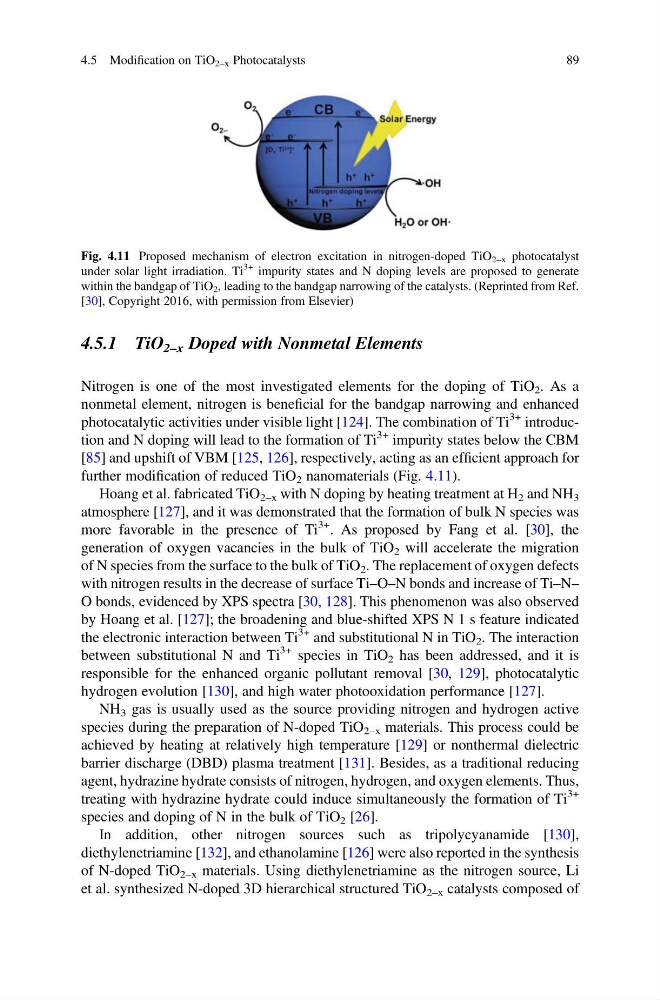
photocatalytic activities under visible light [124]. The combination of Ti
3+ introduction and N doping will lead to the formation of Ti
3+ impurity states below the CBM
[85] and upshift of VBM [125, 126], respectively, acting as an efficient approach for
further modification of reduced TiO 2 nanomaterials (Fig. 4.11).
Hoang et al. fabricated TiO 2–x with N doping by heating treatment at H 2 and NH 3
atmosphere [127], and it was demonstrated that the formation of bulk N species was
more favorable in the presence of Ti
3+ . As proposed by Fang et al. [30], the
generation of oxygen vacancies in the bulk of TiO 2 will accelerate the migration
of N species from the surface to the bulk of TiO 2 . The replacement of oxygen defects
with nitrogen results in the decrease of surface Ti–O–N bonds and increase of Ti–N–
O bonds, evidenced by XPS spectra [30, 128]. This phenomenon was also observed
by Hoang et al. [127]; the broadening and blue-shifted XPS N 1 s feature indicated
the electronic interaction between Ti
3+ and substitutional N in TiO 2 . The interaction
between substitutional N and Ti
3+ species in TiO 2 has been addressed, and it is
responsible for the enhanced organic pollutant removal [30, 129], photocatalytic
hydrogen evolution [130], and high water photooxidation performance [127].
NH 3 gas is usually used as the source providing nitrogen and hydrogen active
species during the preparation of N-doped TiO 2–x materials. This process could be
achieved by heating at relatively high temperature [129] or nonthermal dielectric
barrier discharge (DBD) plasma treatment [131]. Besides, as a traditional reducing
agent, hydrazine hydrate consists of nitrogen, hydrogen, and oxygen elements. Thus,
treating with hydrazine hydrate could induce simultaneously the formation of Ti
3+
species and doping of N in the bulk of TiO 2 [26].
In addition, other nitrogen sources such as tripolycyanamide [130],
diethylenetriamine [132], and ethanolamine [126] were also reported in the synthesis
of N-doped TiO 2–x materials. Using diethylenetriamine as the nitrogen source, Li
et al. synthesized N-doped 3D hierarchical structured TiO 2–x catalysts composed of
Fig. 4.11 Proposed mechanism of electron excitation in nitrogen-doped TiO 2–x photocatalyst
under solar light irradiation. Ti
3+ impurity states and N doping levels are proposed to generate
within the bandgap of TiO 2 , leading to the bandgap narrowing of the catalysts. (Reprinted from Ref.
[30], Copyright 2016, with permission from Elsevier)
4.5 Modification on TiO 2–x Photocatalysts
89
Nitrogen is one of the most investigated elements for the doping of TiO 2 . As a
nonmetal element, nitrogen is beneficial for the bandgap narrowing and enhanced
photocatalytic activities under visible light [124]. The combination of Ti
3+ introduction and N doping will lead to the formation of Ti
3+ impurity states below the CBM
[85] and upshift of VBM [125, 126], respectively, acting as an efficient approach for
further modification of reduced TiO 2 nanomaterials (Fig. 4.11).
Hoang et al. fabricated TiO 2–x with N doping by heating treatment at H 2 and NH 3
atmosphere [127], and it was demonstrated that the formation of bulk N species was
more favorable in the presence of Ti
3+ . As proposed by Fang et al. [30], the
generation of oxygen vacancies in the bulk of TiO 2 will accelerate the migration
of N species from the surface to the bulk of TiO 2 . The replacement of oxygen defects
with nitrogen results in the decrease of surface Ti–O–N bonds and increase of Ti–N–
O bonds, evidenced by XPS spectra [30, 128]. This phenomenon was also observed
by Hoang et al. [127]; the broadening and blue-shifted XPS N 1 s feature indicated
the electronic interaction between Ti
3+ and substitutional N in TiO 2 . The interaction
between substitutional N and Ti
3+ species in TiO 2 has been addressed, and it is
responsible for the enhanced organic pollutant removal [30, 129], photocatalytic
hydrogen evolution [130], and high water photooxidation performance [127].
NH 3 gas is usually used as the source providing nitrogen and hydrogen active
species during the preparation of N-doped TiO 2–x materials. This process could be
achieved by heating at relatively high temperature [129] or nonthermal dielectric
barrier discharge (DBD) plasma treatment [131]. Besides, as a traditional reducing
agent, hydrazine hydrate consists of nitrogen, hydrogen, and oxygen elements. Thus,
treating with hydrazine hydrate could induce simultaneously the formation of Ti
3+
species and doping of N in the bulk of TiO 2 [26].
In addition, other nitrogen sources such as tripolycyanamide [130],
diethylenetriamine [132], and ethanolamine [126] were also reported in the synthesis
of N-doped TiO 2–x materials. Using diethylenetriamine as the nitrogen source, Li
et al. synthesized N-doped 3D hierarchical structured TiO 2–x catalysts composed of
Fig. 4.11 Proposed mechanism of electron excitation in nitrogen-doped TiO 2–x photocatalyst
under solar light irradiation. Ti
3+ impurity states and N doping levels are proposed to generate
within the bandgap of TiO 2 , leading to the bandgap narrowing of the catalysts. (Reprinted from Ref.
[30], Copyright 2016, with permission from Elsevier)
4.5 Modification on TiO 2–x Photocatalysts
89