

ultrathin nanosheets, which not only supply high surface area for the adsorption of
the pollutants but also promote multi-reflection of the light [132]. Except for
nitrogen source, tripolycyanamide also acted as structure-directing agent, leading
to the formation of flower-like hierarchical architecture of the obtained N-doped
TiO 2–x nanoplates [130].
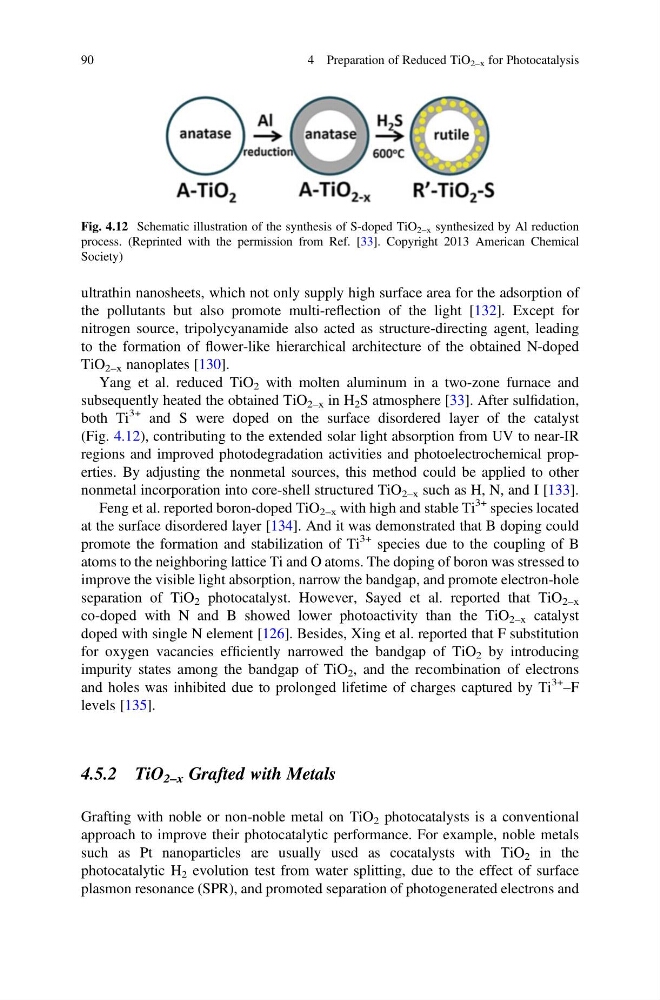
Yang et al. reduced TiO 2 with molten aluminum in a two-zone furnace and
subsequently heated the obtained TiO 2–x in H 2 S atmosphere [33]. After sulfidation,
both Ti
3+ and S were doped on the surface disordered layer of the catalyst
(Fig. 4.12), contributing to the extended solar light absorption from UV to near-IR
regions and improved photodegradation activities and photoelectrochemical properties. By adjusting the nonmetal sources, this method could be applied to other
nonmetal incorporation into core-shell structured TiO 2–x such as H, N, and I [133].
Feng et al. reported boron-doped TiO 2–x with high and stable Ti
3+ species located
at the surface disordered layer [134]. And it was demonstrated that B doping could
promote the formation and stabilization of Ti
3+ species due to the coupling of B
atoms to the neighboring lattice Ti and O atoms. The doping of boron was stressed to
improve the visible light absorption, narrow the bandgap, and promote electron-hole
separation of TiO 2 photocatalyst. However, Sayed et al. reported that TiO 2–x
co-doped with N and B showed lower photoactivity than the TiO 2–x catalyst
doped with single N element [126]. Besides, Xing et al. reported that F substitution
for oxygen vacancies efficiently narrowed the bandgap of TiO 2 by introducing
impurity states among the bandgap of TiO 2 , and the recombination of electrons
and holes was inhibited due to prolonged lifetime of charges captured by Ti
3+ –F
levels [135].
4.5.2 TiO 2–x Grafted with Metals
Grafting with noble or non-noble metal on TiO 2 photocatalysts is a conventional
approach to improve their photocatalytic performance. For example, noble metals
such as Pt nanoparticles are usually used as cocatalysts with TiO 2 in the
photocatalytic H 2 evolution test from water splitting, due to the effect of surface
plasmon resonance (SPR), and promoted separation of photogenerated electrons and
Fig. 4.12 Schematic illustration of the synthesis of S-doped TiO 2–x synthesized by Al reduction
process. (Reprinted with the permission from Ref. [33]. Copyright 2013 American Chemical
Society)
90
4 Preparation of Reduced TiO 2–x for Photocatalysis
the pollutants but also promote multi-reflection of the light [132]. Except for
nitrogen source, tripolycyanamide also acted as structure-directing agent, leading
to the formation of flower-like hierarchical architecture of the obtained N-doped
TiO 2–x nanoplates [130].
Yang et al. reduced TiO 2 with molten aluminum in a two-zone furnace and
subsequently heated the obtained TiO 2–x in H 2 S atmosphere [33]. After sulfidation,
both Ti
3+ and S were doped on the surface disordered layer of the catalyst
(Fig. 4.12), contributing to the extended solar light absorption from UV to near-IR
regions and improved photodegradation activities and photoelectrochemical properties. By adjusting the nonmetal sources, this method could be applied to other
nonmetal incorporation into core-shell structured TiO 2–x such as H, N, and I [133].
Feng et al. reported boron-doped TiO 2–x with high and stable Ti
3+ species located
at the surface disordered layer [134]. And it was demonstrated that B doping could
promote the formation and stabilization of Ti
3+ species due to the coupling of B
atoms to the neighboring lattice Ti and O atoms. The doping of boron was stressed to
improve the visible light absorption, narrow the bandgap, and promote electron-hole
separation of TiO 2 photocatalyst. However, Sayed et al. reported that TiO 2–x
co-doped with N and B showed lower photoactivity than the TiO 2–x catalyst
doped with single N element [126]. Besides, Xing et al. reported that F substitution
for oxygen vacancies efficiently narrowed the bandgap of TiO 2 by introducing
impurity states among the bandgap of TiO 2 , and the recombination of electrons
and holes was inhibited due to prolonged lifetime of charges captured by Ti
3+ –F
levels [135].
4.5.2 TiO 2–x Grafted with Metals
Grafting with noble or non-noble metal on TiO 2 photocatalysts is a conventional
approach to improve their photocatalytic performance. For example, noble metals
such as Pt nanoparticles are usually used as cocatalysts with TiO 2 in the
photocatalytic H 2 evolution test from water splitting, due to the effect of surface
plasmon resonance (SPR), and promoted separation of photogenerated electrons and
Fig. 4.12 Schematic illustration of the synthesis of S-doped TiO 2–x synthesized by Al reduction
process. (Reprinted with the permission from Ref. [33]. Copyright 2013 American Chemical
Society)
90
4 Preparation of Reduced TiO 2–x for Photocatalysis