

holes. Most semiconductor photocatalysts do not exhibit a good photocatalytic
performance without the loading of suitable noble metal cocatalyst.
It is reported that the loaded noble metals act as active sites for trapping electrons
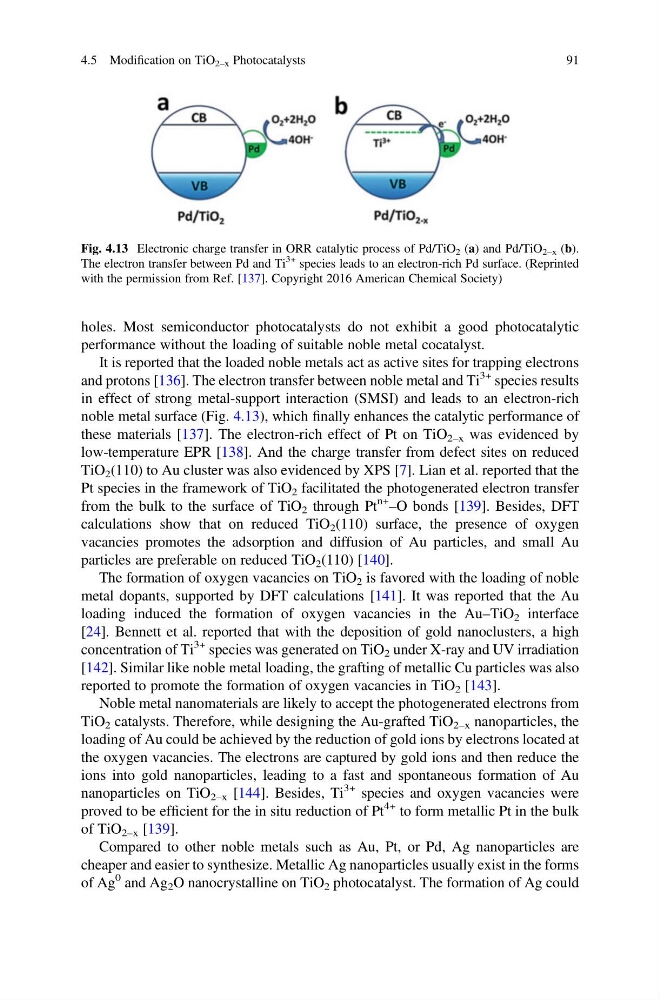
and protons [136]. The electron transfer between noble metal and Ti
3+ species results
in effect of strong metal-support interaction (SMSI) and leads to an electron-rich
noble metal surface (Fig. 4.13), which finally enhances the catalytic performance of
these materials [137]. The electron-rich effect of Pt on TiO 2–x was evidenced by
low-temperature EPR [138]. And the charge transfer from defect sites on reduced
TiO 2 (110) to Au cluster was also evidenced by XPS [7]. Lian et al. reported that the
Pt species in the framework of TiO 2 facilitated the photogenerated electron transfer
from the bulk to the surface of TiO 2 through Pt
n+
–O bonds [139]. Besides, DFT
calculations show that on reduced TiO 2 (110) surface, the presence of oxygen
vacancies promotes the adsorption and diffusion of Au particles, and small Au
particles are preferable on reduced TiO 2 (110) [140].
The formation of oxygen vacancies on TiO 2 is favored with the loading of noble
metal dopants, supported by DFT calculations [141]. It was reported that the Au
loading induced the formation of oxygen vacancies in the Au–TiO 2 interface
[24]. Bennett et al. reported that with the deposition of gold nanoclusters, a high
concentration of Ti
3+ species was generated on TiO 2 under X-ray and UV irradiation
[142]. Similar like noble metal loading, the grafting of metallic Cu particles was also
reported to promote the formation of oxygen vacancies in TiO 2 [143].
Noble metal nanomaterials are likely to accept the photogenerated electrons from
TiO 2 catalysts. Therefore, while designing the Au-grafted TiO 2–x nanoparticles, the
loading of Au could be achieved by the reduction of gold ions by electrons located at
the oxygen vacancies. The electrons are captured by gold ions and then reduce the
ions into gold nanoparticles, leading to a fast and spontaneous formation of Au
nanoparticles on TiO 2–x [144]. Besides, Ti
3+ species and oxygen vacancies were
proved to be efficient for the in situ reduction of Pt
4+ to form metallic Pt in the bulk
of TiO 2–x [139].
Compared to other noble metals such as Au, Pt, or Pd, Ag nanoparticles are
cheaper and easier to synthesize. Metallic Ag nanoparticles usually exist in the forms
of Ag
0 and Ag 2 O nanocrystalline on TiO 2 photocatalyst. The formation of Ag could
Fig. 4.13 Electronic charge transfer in ORR catalytic process of Pd/TiO 2 (a) and Pd/TiO 2–x (b).
The electron transfer between Pd and Ti
3+ species leads to an electron-rich Pd surface. (Reprinted
with the permission from Ref. [137]. Copyright 2016 American Chemical Society)
4.5 Modification on TiO 2–x Photocatalysts
91
performance without the loading of suitable noble metal cocatalyst.
It is reported that the loaded noble metals act as active sites for trapping electrons
and protons [136]. The electron transfer between noble metal and Ti
3+ species results
in effect of strong metal-support interaction (SMSI) and leads to an electron-rich
noble metal surface (Fig. 4.13), which finally enhances the catalytic performance of
these materials [137]. The electron-rich effect of Pt on TiO 2–x was evidenced by
low-temperature EPR [138]. And the charge transfer from defect sites on reduced
TiO 2 (110) to Au cluster was also evidenced by XPS [7]. Lian et al. reported that the
Pt species in the framework of TiO 2 facilitated the photogenerated electron transfer
from the bulk to the surface of TiO 2 through Pt
n+
–O bonds [139]. Besides, DFT
calculations show that on reduced TiO 2 (110) surface, the presence of oxygen
vacancies promotes the adsorption and diffusion of Au particles, and small Au
particles are preferable on reduced TiO 2 (110) [140].
The formation of oxygen vacancies on TiO 2 is favored with the loading of noble
metal dopants, supported by DFT calculations [141]. It was reported that the Au
loading induced the formation of oxygen vacancies in the Au–TiO 2 interface
[24]. Bennett et al. reported that with the deposition of gold nanoclusters, a high
concentration of Ti
3+ species was generated on TiO 2 under X-ray and UV irradiation
[142]. Similar like noble metal loading, the grafting of metallic Cu particles was also
reported to promote the formation of oxygen vacancies in TiO 2 [143].
Noble metal nanomaterials are likely to accept the photogenerated electrons from
TiO 2 catalysts. Therefore, while designing the Au-grafted TiO 2–x nanoparticles, the
loading of Au could be achieved by the reduction of gold ions by electrons located at
the oxygen vacancies. The electrons are captured by gold ions and then reduce the
ions into gold nanoparticles, leading to a fast and spontaneous formation of Au
nanoparticles on TiO 2–x [144]. Besides, Ti
3+ species and oxygen vacancies were
proved to be efficient for the in situ reduction of Pt
4+ to form metallic Pt in the bulk
of TiO 2–x [139].
Compared to other noble metals such as Au, Pt, or Pd, Ag nanoparticles are
cheaper and easier to synthesize. Metallic Ag nanoparticles usually exist in the forms
of Ag
0 and Ag 2 O nanocrystalline on TiO 2 photocatalyst. The formation of Ag could
Fig. 4.13 Electronic charge transfer in ORR catalytic process of Pd/TiO 2 (a) and Pd/TiO 2–x (b).
The electron transfer between Pd and Ti
3+ species leads to an electron-rich Pd surface. (Reprinted
with the permission from Ref. [137]. Copyright 2016 American Chemical Society)
4.5 Modification on TiO 2–x Photocatalysts
91