

4.2.1.3 Metal Reduction
Wang et al. reported an aluminum reduction method through high-temperature
thermal treatment for the synthesis of TiO 2–x photocatalyst [32]. The process was
operated in a two-zone furnace and post-annealing at Ar atmosphere. As a result, a
unique core-shell structured TiO 2 /TiO 2–x was formed, with wild solar light absorption and efficient H 2 generation from water splitting. Yang et al. treated pristine TiO 2
samples with the same process however with post-annealing at H 2 S atmosphere, in
order to introduce Ti
3+ and surface S dopants simultaneously [33]. Cui et al.
synthesized TiO 2 nanotube arrays by electrochemical anodization process and
subsequently reduced the as-prepared TiO 2 nanomaterials by this two-zone thermal
treatment using aluminum as the reductant [34]. Zheng et al. directly mixed TiO 2
nanosheets and metallic Al nanoparticles together and then treated the mixture at
500
C for 3 h under nitrogen protection [35]. The Al nanoparticles not only act as
the reductant of Ti(IV) species but also lead to the stabilization of the obtained Ti
3+
species and oxygen vacancies on the surface of TiO 2 through Al–O bonds.
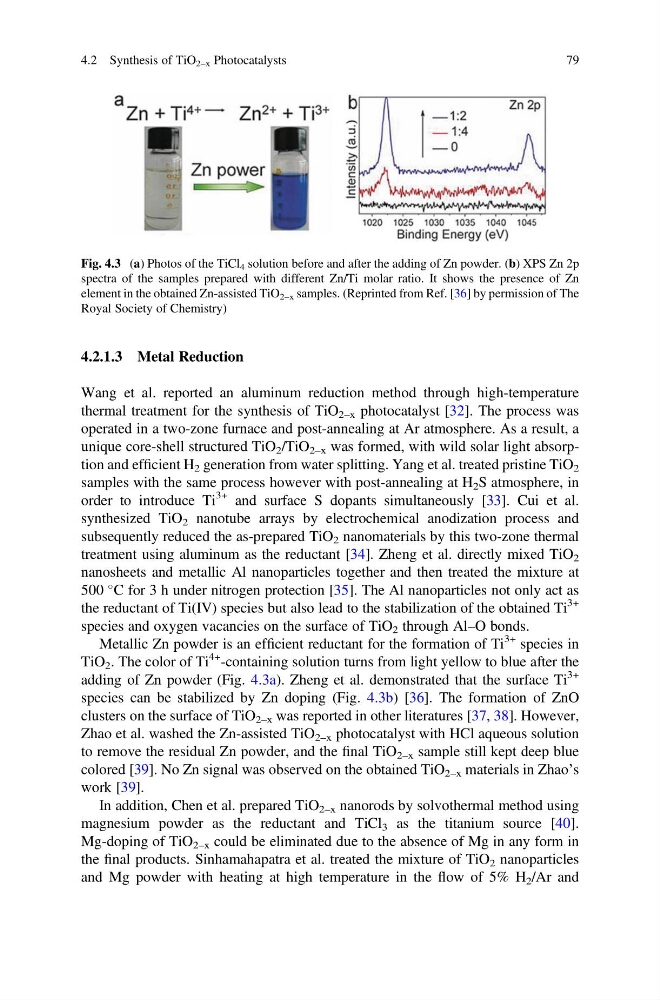
Metallic Zn powder is an efficient reductant for the formation of Ti
3+ species in
TiO 2 . The color of Ti
4+ -containing solution turns from light yellow to blue after the
adding of Zn powder (Fig. 4.3a). Zheng et al. demonstrated that the surface Ti
3+
species can be stabilized by Zn doping (Fig. 4.3b) [36]. The formation of ZnO
clusters on the surface of TiO 2–x was reported in other literatures [37, 38]. However,
Zhao et al. washed the Zn-assisted TiO 2–x photocatalyst with HCl aqueous solution
to remove the residual Zn powder, and the final TiO 2–x sample still kept deep blue
colored [39]. No Zn signal was observed on the obtained TiO 2–x materials in Zhao’s
work [39].
In addition, Chen et al. prepared TiO 2–x nanorods by solvothermal method using
magnesium powder as the reductant and TiCl 3 as the titanium source [40].
Mg-doping of TiO 2–x could be eliminated due to the absence of Mg in any form in
the final products. Sinhamahapatra et al. treated the mixture of TiO 2 nanoparticles
and Mg powder with heating at high temperature in the flow of 5% H 2 /Ar and
Fig. 4.3 (a) Photos of the TiCl 4 solution before and after the adding of Zn powder. (b) XPS Zn 2p
spectra of the samples prepared with different Zn/Ti molar ratio. It shows the presence of Zn
element in the obtained Zn-assisted TiO 2–x samples. (Reprinted from Ref. [36] by permission of The
Royal Society of Chemistry)
4.2 Synthesis of TiO 2–x Photocatalysts
79
Wang et al. reported an aluminum reduction method through high-temperature
thermal treatment for the synthesis of TiO 2–x photocatalyst [32]. The process was
operated in a two-zone furnace and post-annealing at Ar atmosphere. As a result, a
unique core-shell structured TiO 2 /TiO 2–x was formed, with wild solar light absorption and efficient H 2 generation from water splitting. Yang et al. treated pristine TiO 2
samples with the same process however with post-annealing at H 2 S atmosphere, in
order to introduce Ti
3+ and surface S dopants simultaneously [33]. Cui et al.
synthesized TiO 2 nanotube arrays by electrochemical anodization process and
subsequently reduced the as-prepared TiO 2 nanomaterials by this two-zone thermal
treatment using aluminum as the reductant [34]. Zheng et al. directly mixed TiO 2
nanosheets and metallic Al nanoparticles together and then treated the mixture at
500
C for 3 h under nitrogen protection [35]. The Al nanoparticles not only act as
the reductant of Ti(IV) species but also lead to the stabilization of the obtained Ti
3+
species and oxygen vacancies on the surface of TiO 2 through Al–O bonds.
Metallic Zn powder is an efficient reductant for the formation of Ti
3+ species in
TiO 2 . The color of Ti
4+ -containing solution turns from light yellow to blue after the
adding of Zn powder (Fig. 4.3a). Zheng et al. demonstrated that the surface Ti
3+
species can be stabilized by Zn doping (Fig. 4.3b) [36]. The formation of ZnO
clusters on the surface of TiO 2–x was reported in other literatures [37, 38]. However,
Zhao et al. washed the Zn-assisted TiO 2–x photocatalyst with HCl aqueous solution
to remove the residual Zn powder, and the final TiO 2–x sample still kept deep blue
colored [39]. No Zn signal was observed on the obtained TiO 2–x materials in Zhao’s
work [39].
In addition, Chen et al. prepared TiO 2–x nanorods by solvothermal method using
magnesium powder as the reductant and TiCl 3 as the titanium source [40].
Mg-doping of TiO 2–x could be eliminated due to the absence of Mg in any form in
the final products. Sinhamahapatra et al. treated the mixture of TiO 2 nanoparticles
and Mg powder with heating at high temperature in the flow of 5% H 2 /Ar and
Fig. 4.3 (a) Photos of the TiCl 4 solution before and after the adding of Zn powder. (b) XPS Zn 2p
spectra of the samples prepared with different Zn/Ti molar ratio. It shows the presence of Zn
element in the obtained Zn-assisted TiO 2–x samples. (Reprinted from Ref. [36] by permission of The
Royal Society of Chemistry)
4.2 Synthesis of TiO 2–x Photocatalysts
79