

washed the residual Mg away by acid treatment [41]. The obtained TiO 2–x
photocatalyst showed an excellent H 2 production rate from water splitting.
4.2.1.4 Plasma Reduction
The in-flight reduction of TiO 2 by H 2 plasma was early reported two decades ago
[42]. Compared to the conventional thermal processing, plasma provides improved
thermodynamics and kinetics [43]. And the obtained highly active species such as
atomic hydrogen in the process are well-suited to the reduction of metal oxides
[44]. Therefore, under H 2 plasma treatment, metallic state or the suboxides are
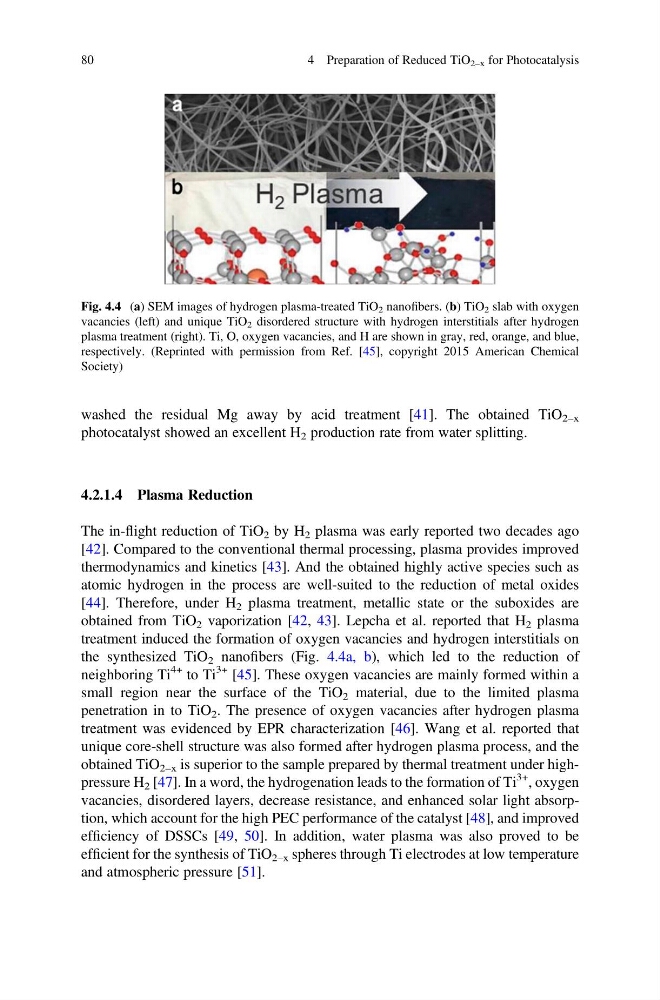
obtained from TiO 2 vaporization [42, 43]. Lepcha et al. reported that H 2 plasma
treatment induced the formation of oxygen vacancies and hydrogen interstitials on
the synthesized TiO 2 nanofibers (Fig. 4.4a, b), which led to the reduction of
neighboring Ti
4+ to Ti
3+ [45]. These oxygen vacancies are mainly formed within a
small region near the surface of the TiO 2 material, due to the limited plasma
penetration in to TiO 2 . The presence of oxygen vacancies after hydrogen plasma
treatment was evidenced by EPR characterization [46]. Wang et al. reported that
unique core-shell structure was also formed after hydrogen plasma process, and the
obtained TiO 2–x is superior to the sample prepared by thermal treatment under highpressure H 2 [47]. In a word, the hydrogenation leads to the formation of Ti
3+ , oxygen
vacancies, disordered layers, decrease resistance, and enhanced solar light absorption, which account for the high PEC performance of the catalyst [48], and improved
efficiency of DSSCs [49, 50]. In addition, water plasma was also proved to be
efficient for the synthesis of TiO 2–x spheres through Ti electrodes at low temperature
and atmospheric pressure [51].
Fig. 4.4 (a) SEM images of hydrogen plasma-treated TiO 2 nanofibers. (b) TiO 2 slab with oxygen
vacancies (left) and unique TiO 2 disordered structure with hydrogen interstitials after hydrogen
plasma treatment (right). Ti, O, oxygen vacancies, and H are shown in gray, red, orange, and blue,
respectively. (Reprinted with permission from Ref. [45], copyright 2015 American Chemical
Society)
80
4 Preparation of Reduced TiO 2–x for Photocatalysis
photocatalyst showed an excellent H 2 production rate from water splitting.
4.2.1.4 Plasma Reduction
The in-flight reduction of TiO 2 by H 2 plasma was early reported two decades ago
[42]. Compared to the conventional thermal processing, plasma provides improved
thermodynamics and kinetics [43]. And the obtained highly active species such as
atomic hydrogen in the process are well-suited to the reduction of metal oxides
[44]. Therefore, under H 2 plasma treatment, metallic state or the suboxides are
obtained from TiO 2 vaporization [42, 43]. Lepcha et al. reported that H 2 plasma
treatment induced the formation of oxygen vacancies and hydrogen interstitials on
the synthesized TiO 2 nanofibers (Fig. 4.4a, b), which led to the reduction of
neighboring Ti
4+ to Ti
3+ [45]. These oxygen vacancies are mainly formed within a
small region near the surface of the TiO 2 material, due to the limited plasma
penetration in to TiO 2 . The presence of oxygen vacancies after hydrogen plasma
treatment was evidenced by EPR characterization [46]. Wang et al. reported that
unique core-shell structure was also formed after hydrogen plasma process, and the
obtained TiO 2–x is superior to the sample prepared by thermal treatment under highpressure H 2 [47]. In a word, the hydrogenation leads to the formation of Ti
3+ , oxygen
vacancies, disordered layers, decrease resistance, and enhanced solar light absorption, which account for the high PEC performance of the catalyst [48], and improved
efficiency of DSSCs [49, 50]. In addition, water plasma was also proved to be
efficient for the synthesis of TiO 2–x spheres through Ti electrodes at low temperature
and atmospheric pressure [51].
Fig. 4.4 (a) SEM images of hydrogen plasma-treated TiO 2 nanofibers. (b) TiO 2 slab with oxygen
vacancies (left) and unique TiO 2 disordered structure with hydrogen interstitials after hydrogen
plasma treatment (right). Ti, O, oxygen vacancies, and H are shown in gray, red, orange, and blue,
respectively. (Reprinted with permission from Ref. [45], copyright 2015 American Chemical
Society)
80
4 Preparation of Reduced TiO 2–x for Photocatalysis