

of Ni
2+ doped porous TiO 2–x [22], 3D mesoporous black TiO 2 /MoS 2 /TiO 2
nanosheets [23], and gold grafted TiO 2 sphere [24].
The fabrication of TiO 2–x photocatalysts by thermal treatment under other reducing atmospheres was also employed. Zuo et al. reduced the pristine TiO 2 by CO and
NO gases which were released from the oxidative decomposition of
2-ethylimidazole. Besides, hydrazine hydrate was proved to be efficient to promote
the formation of Ti
3+ species in TiO 2 catalysts [25, 26]. In addition, the reduction of
TiO 2 can also be realized by the reducing species released from the decomposition of
C 3 N 4 at high temperature [27].
4.2.1.2 Vacuum Activation Treatment
Xing et al. developed a simple approach for the generation of Ti
3+ species into
commercial TiO 2 nanomaterials (Evonik P25), and the obtained TiO 2–x showed
enhanced solar light absorption, improved photodegradation of methyl orange, and
promoted photocatalytic hydrogen evolution from water splitting [28]. Electron
paramagnetic resonance (EPR) confirmed the generation of Ti
3+ and oxygen vacancies in the bulk of TiO 2 , and the obtained Ti
3+ and oxygen defects were demonstrated to be responsible for the high photocatalytic performance of the reduced TiO 2
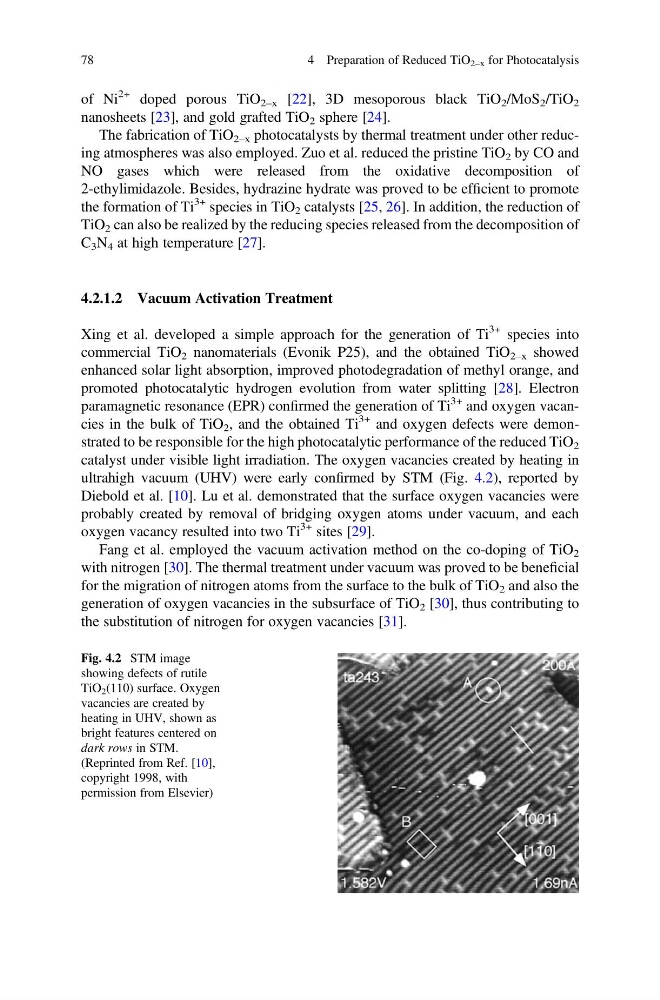
catalyst under visible light irradiation. The oxygen vacancies created by heating in
ultrahigh vacuum (UHV) were early confirmed by STM (Fig. 4.2), reported by
Diebold et al. [10]. Lu et al. demonstrated that the surface oxygen vacancies were
probably created by removal of bridging oxygen atoms under vacuum, and each
oxygen vacancy resulted into two Ti
3+ sites [29].
Fang et al. employed the vacuum activation method on the co-doping of TiO 2
with nitrogen [30]. The thermal treatment under vacuum was proved to be beneficial
for the migration of nitrogen atoms from the surface to the bulk of TiO 2 and also the
generation of oxygen vacancies in the subsurface of TiO 2 [30], thus contributing to
the substitution of nitrogen for oxygen vacancies [31].
Fig. 4.2 STM image
showing defects of rutile
TiO 2 (110) surface. Oxygen
vacancies are created by
heating in UHV, shown as
bright features centered on
dark rows in STM.
(Reprinted from Ref. [10],
copyright 1998, with
permission from Elsevier)
78
4 Preparation of Reduced TiO 2–x for Photocatalysis
2+ doped porous TiO 2–x [22], 3D mesoporous black TiO 2 /MoS 2 /TiO 2
nanosheets [23], and gold grafted TiO 2 sphere [24].
The fabrication of TiO 2–x photocatalysts by thermal treatment under other reducing atmospheres was also employed. Zuo et al. reduced the pristine TiO 2 by CO and
NO gases which were released from the oxidative decomposition of
2-ethylimidazole. Besides, hydrazine hydrate was proved to be efficient to promote
the formation of Ti
3+ species in TiO 2 catalysts [25, 26]. In addition, the reduction of
TiO 2 can also be realized by the reducing species released from the decomposition of
C 3 N 4 at high temperature [27].
4.2.1.2 Vacuum Activation Treatment
Xing et al. developed a simple approach for the generation of Ti
3+ species into
commercial TiO 2 nanomaterials (Evonik P25), and the obtained TiO 2–x showed
enhanced solar light absorption, improved photodegradation of methyl orange, and
promoted photocatalytic hydrogen evolution from water splitting [28]. Electron
paramagnetic resonance (EPR) confirmed the generation of Ti
3+ and oxygen vacancies in the bulk of TiO 2 , and the obtained Ti
3+ and oxygen defects were demonstrated to be responsible for the high photocatalytic performance of the reduced TiO 2
catalyst under visible light irradiation. The oxygen vacancies created by heating in
ultrahigh vacuum (UHV) were early confirmed by STM (Fig. 4.2), reported by
Diebold et al. [10]. Lu et al. demonstrated that the surface oxygen vacancies were
probably created by removal of bridging oxygen atoms under vacuum, and each
oxygen vacancy resulted into two Ti
3+ sites [29].
Fang et al. employed the vacuum activation method on the co-doping of TiO 2
with nitrogen [30]. The thermal treatment under vacuum was proved to be beneficial
for the migration of nitrogen atoms from the surface to the bulk of TiO 2 and also the
generation of oxygen vacancies in the subsurface of TiO 2 [30], thus contributing to
the substitution of nitrogen for oxygen vacancies [31].
Fig. 4.2 STM image
showing defects of rutile
TiO 2 (110) surface. Oxygen
vacancies are created by
heating in UHV, shown as
bright features centered on
dark rows in STM.
(Reprinted from Ref. [10],
copyright 1998, with
permission from Elsevier)
78
4 Preparation of Reduced TiO 2–x for Photocatalysis