

In 2010, Garcia and his coworkers synthesized the Zr-containing metal–organic
frameworks (MOFs) that exhibited photocatalytic activity for hydrogen generation
upon irradiation at wavelength longer than 300 nm [69]. In 2012, Anpo et al. [64]
employed 2-amino-benzenedicarboxylic acid as an organic linker to synthesize
amino-functionalized Ti (IV) metal–organic framework (Ti–MOF–NH 2 ) by a facile
solvothermal method, and it described the hydrogen production from an aqueous
medium under visible light. The structure of the Ti–MOF–NH 2 , its mechanism, and
the yield of hydrogen are shown in Fig. 3.9. In summary, it is mentioned that Ti–
MOF materials of semiconductor properties have potential in water splitting. All the
reported literatures provide us with new ideas in the further development of water
splitting.
With the exception of the application in water splitting, the Ti–MOFs can also be
applied to CO 2 reduction. In the same year, Li et al. [70] successfully prepared a
targeted photoactive catalyst Ti 8 O 8 (OH) 4 (bdc-NH 2 ) 6 (NH 2 -MIL-125 (Ti)) for the
first time, which reduced CO 2 even under visible light irradiation. In Fig. 3.10a,
MIL-125 (Ti) shows an absorption edge at 350 nm, whereas NH 2 -MIL-125
(Ti) shows an extra absorption band in the visible light region with the absorption
edge extending to around 550 nm, which is in agreement with the bright yellow
color. An interesting photochromic phenomenon was observed over NH 2 -MIL-125
(Ti) during the photocatalytic reaction. When the solution of NH 2 -MIL-125 (Ti) and
TEOA in MeCN was irradiated with visible light in the presence of N 2 , the color of
the solution changed from the original bright yellow to green. After CO 2 or O 2 was
introduced into the reaction system, the green color of the solution changed gradually
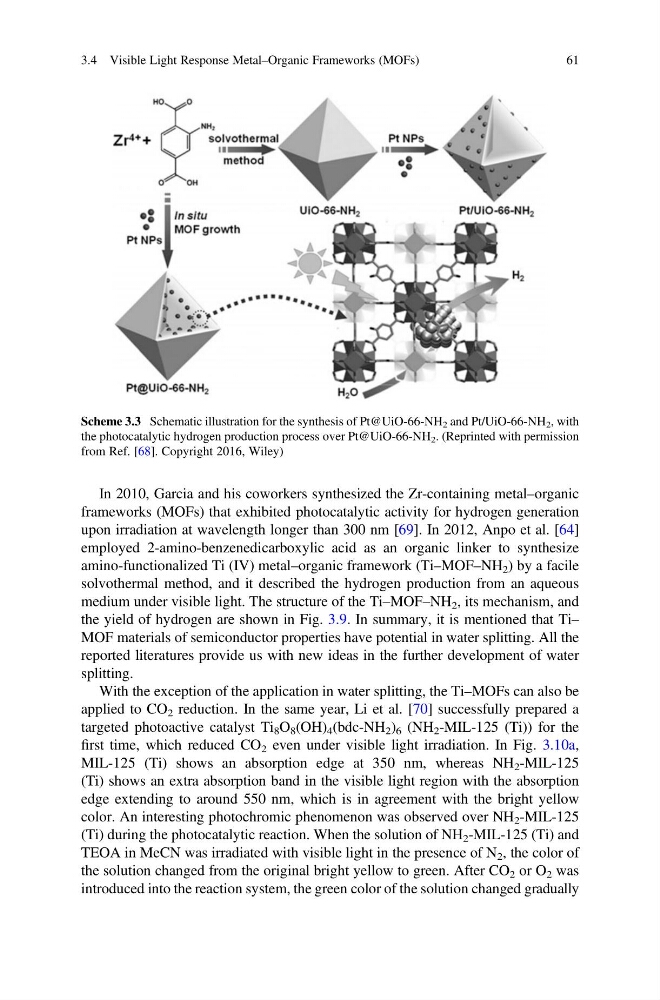
Scheme 3.3 Schematic illustration for the synthesis of Pt@UiO-66-NH 2 and Pt/UiO-66-NH 2 , with
the photocatalytic hydrogen production process over Pt@UiO-66-NH 2 . (Reprinted with permission
from Ref. [68]. Copyright 2016, Wiley)
3.4 Visible Light Response Metal–Organic Frameworks (MOFs)
61
frameworks (MOFs) that exhibited photocatalytic activity for hydrogen generation
upon irradiation at wavelength longer than 300 nm [69]. In 2012, Anpo et al. [64]
employed 2-amino-benzenedicarboxylic acid as an organic linker to synthesize
amino-functionalized Ti (IV) metal–organic framework (Ti–MOF–NH 2 ) by a facile
solvothermal method, and it described the hydrogen production from an aqueous
medium under visible light. The structure of the Ti–MOF–NH 2 , its mechanism, and
the yield of hydrogen are shown in Fig. 3.9. In summary, it is mentioned that Ti–
MOF materials of semiconductor properties have potential in water splitting. All the
reported literatures provide us with new ideas in the further development of water
splitting.
With the exception of the application in water splitting, the Ti–MOFs can also be
applied to CO 2 reduction. In the same year, Li et al. [70] successfully prepared a
targeted photoactive catalyst Ti 8 O 8 (OH) 4 (bdc-NH 2 ) 6 (NH 2 -MIL-125 (Ti)) for the
first time, which reduced CO 2 even under visible light irradiation. In Fig. 3.10a,
MIL-125 (Ti) shows an absorption edge at 350 nm, whereas NH 2 -MIL-125
(Ti) shows an extra absorption band in the visible light region with the absorption
edge extending to around 550 nm, which is in agreement with the bright yellow
color. An interesting photochromic phenomenon was observed over NH 2 -MIL-125
(Ti) during the photocatalytic reaction. When the solution of NH 2 -MIL-125 (Ti) and
TEOA in MeCN was irradiated with visible light in the presence of N 2 , the color of
the solution changed from the original bright yellow to green. After CO 2 or O 2 was
introduced into the reaction system, the green color of the solution changed gradually
Scheme 3.3 Schematic illustration for the synthesis of Pt@UiO-66-NH 2 and Pt/UiO-66-NH 2 , with
the photocatalytic hydrogen production process over Pt@UiO-66-NH 2 . (Reprinted with permission
from Ref. [68]. Copyright 2016, Wiley)
3.4 Visible Light Response Metal–Organic Frameworks (MOFs)
61