

back to the original bright yellow (Fig. 3.10b). The photochromic phenomenon
is ascribed to the presence of the inter-valence electron transfer from the optically
induced hopping of electrons from Ti (III) to Ti (IV) sites in the titanium–oxo
clusters.
Despite water splitting and CO 2 reduction, it was also reported by Garcia and
Majima [71, 72] that the combination between the organic linkers and metal–oxo
clusters would enable the development of dye-sensitized type MOF photocatalysts
operating under visible light illumination. In 2012, Zhang et al. [73] adopted a doping
strategy to tune the gas sorption and photocatalytic properties of a microporous
material ZIF-67. It is worth mention that the Cu-doped phase integrated both structural
Ti-oxo cluster
Linker-to-cluster
charge-transfer (LCCT)
H
+
e
-
4
3
2
1
0
200
300
400
500
600
700
K-W function / a.u.
H
2 evolution rate /
mmol h
-1
Wavelength / nm
H 2
b
c
a
Organic linker
(2-aminoterephthalic acid)
hv
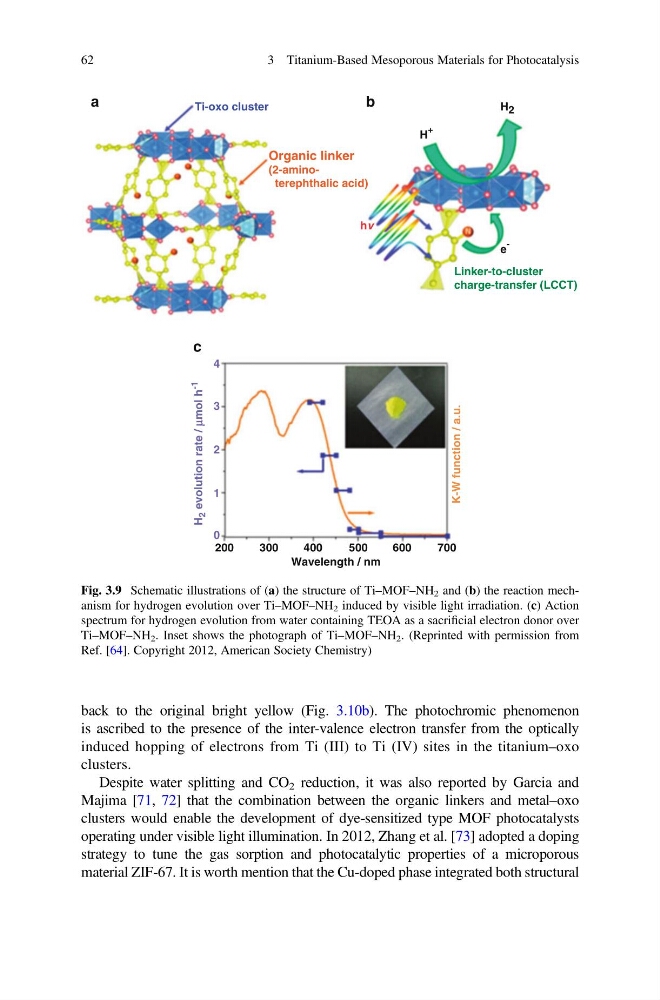
Fig. 3.9 Schematic illustrations of (a) the structure of Ti–MOF–NH 2 and (b) the reaction mechanism for hydrogen evolution over Ti–MOF–NH 2 induced by visible light irradiation. (c) Action
spectrum for hydrogen evolution from water containing TEOA as a sacrificial electron donor over
Ti–MOF–NH 2 . Inset shows the photograph of Ti–MOF–NH 2 . (Reprinted with permission from
Ref. [64]. Copyright 2012, American Society Chemistry)
62
3 Titanium-Based Mesoporous Materials for Photocatalysis
is ascribed to the presence of the inter-valence electron transfer from the optically
induced hopping of electrons from Ti (III) to Ti (IV) sites in the titanium–oxo
clusters.
Despite water splitting and CO 2 reduction, it was also reported by Garcia and
Majima [71, 72] that the combination between the organic linkers and metal–oxo
clusters would enable the development of dye-sensitized type MOF photocatalysts
operating under visible light illumination. In 2012, Zhang et al. [73] adopted a doping
strategy to tune the gas sorption and photocatalytic properties of a microporous
material ZIF-67. It is worth mention that the Cu-doped phase integrated both structural
Ti-oxo cluster
Linker-to-cluster
charge-transfer (LCCT)
H
+
e
-
4
3
2
1
0
200
300
400
500
600
700
K-W function / a.u.
H
2 evolution rate /
mmol h
-1
Wavelength / nm
H 2
b
c
a
Organic linker
(2-aminoterephthalic acid)
hv
Fig. 3.9 Schematic illustrations of (a) the structure of Ti–MOF–NH 2 and (b) the reaction mechanism for hydrogen evolution over Ti–MOF–NH 2 induced by visible light irradiation. (c) Action
spectrum for hydrogen evolution from water containing TEOA as a sacrificial electron donor over
Ti–MOF–NH 2 . Inset shows the photograph of Ti–MOF–NH 2 . (Reprinted with permission from
Ref. [64]. Copyright 2012, American Society Chemistry)
62
3 Titanium-Based Mesoporous Materials for Photocatalysis