

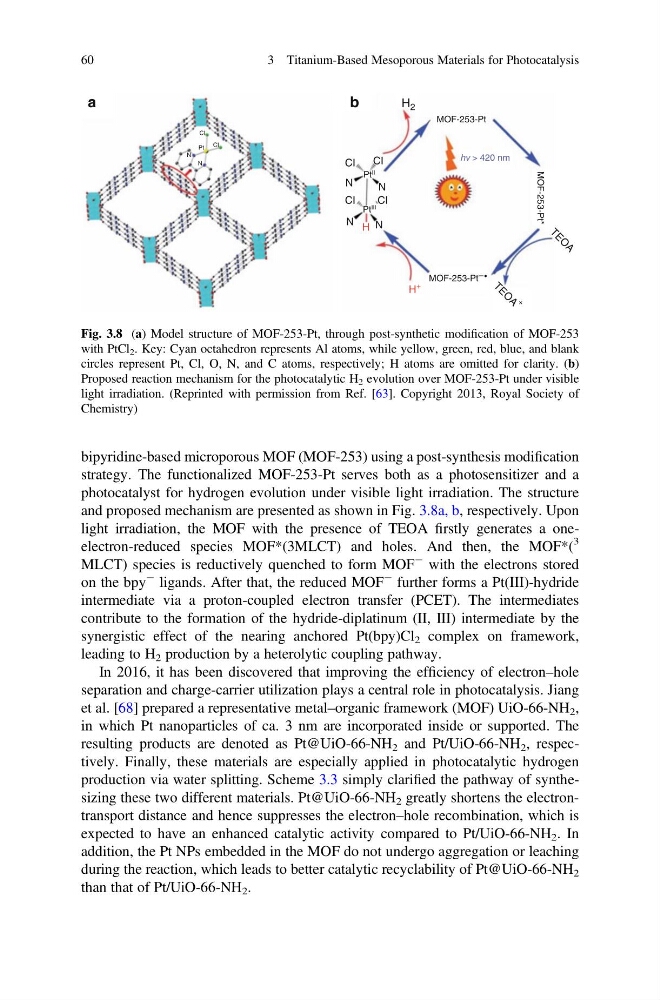
bipyridine-based microporous MOF (MOF-253) using a post-synthesis modification
strategy. The functionalized MOF-253-Pt serves both as a photosensitizer and a
photocatalyst for hydrogen evolution under visible light irradiation. The structure
and proposed mechanism are presented as shown in Fig. 3.8a, b, respectively. Upon
light irradiation, the MOF with the presence of TEOA firstly generates a oneelectron-reduced species MOF*(3MLCT) and holes. And then, the MOF*(
3
MLCT) species is reductively quenched to form MOF
À with the electrons stored
on the bpy
À ligands. After that, the reduced MOF
À further forms a Pt(III)-hydride
intermediate via a proton-coupled electron transfer (PCET). The intermediates
contribute to the formation of the hydride-diplatinum (II, III) intermediate by the
synergistic effect of the nearing anchored Pt(bpy)Cl 2 complex on framework,
leading to H 2 production by a heterolytic coupling pathway.
In 2016, it has been discovered that improving the efficiency of electron–hole
separation and charge-carrier utilization plays a central role in photocatalysis. Jiang
et al. [68] prepared a representative metal–organic framework (MOF) UiO-66-NH 2 ,
in which Pt nanoparticles of ca. 3 nm are incorporated inside or supported. The
resulting products are denoted as Pt@UiO-66-NH 2 and Pt/UiO-66-NH 2 , respectively. Finally, these materials are especially applied in photocatalytic hydrogen
production via water splitting. Scheme 3.3 simply clarified the pathway of synthesizing these two different materials. Pt@UiO-66-NH 2 greatly shortens the electrontransport distance and hence suppresses the electron–hole recombination, which is
expected to have an enhanced catalytic activity compared to Pt/UiO-66-NH 2 . In
addition, the Pt NPs embedded in the MOF do not undergo aggregation or leaching
during the reaction, which leads to better catalytic recyclability of Pt@UiO-66-NH 2
than that of Pt/UiO-66-NH 2 .
MOF-253-Pt
MOF-253-Pt*
MOF-253-Pt –•
CI
CI
CI
CI
N
N
Pt
CI
CI
N
N
N H
H
+
T E O
A
+
T E O
A
N
Pt II
Pt III
hv > 420 nm
H 2
b
a
Fig. 3.8 (a) Model structure of MOF-253-Pt, through post-synthetic modification of MOF-253
with PtCl 2 . Key: Cyan octahedron represents Al atoms, while yellow, green, red, blue, and blank
circles represent Pt, Cl, O, N, and C atoms, respectively; H atoms are omitted for clarity. (b)
Proposed reaction mechanism for the photocatalytic H 2 evolution over MOF-253-Pt under visible
light irradiation. (Reprinted with permission from Ref. [63]. Copyright 2013, Royal Society of
Chemistry)
60
3 Titanium-Based Mesoporous Materials for Photocatalysis
strategy. The functionalized MOF-253-Pt serves both as a photosensitizer and a
photocatalyst for hydrogen evolution under visible light irradiation. The structure
and proposed mechanism are presented as shown in Fig. 3.8a, b, respectively. Upon
light irradiation, the MOF with the presence of TEOA firstly generates a oneelectron-reduced species MOF*(3MLCT) and holes. And then, the MOF*(
3
MLCT) species is reductively quenched to form MOF
À with the electrons stored
on the bpy
À ligands. After that, the reduced MOF
À further forms a Pt(III)-hydride
intermediate via a proton-coupled electron transfer (PCET). The intermediates
contribute to the formation of the hydride-diplatinum (II, III) intermediate by the
synergistic effect of the nearing anchored Pt(bpy)Cl 2 complex on framework,
leading to H 2 production by a heterolytic coupling pathway.
In 2016, it has been discovered that improving the efficiency of electron–hole
separation and charge-carrier utilization plays a central role in photocatalysis. Jiang
et al. [68] prepared a representative metal–organic framework (MOF) UiO-66-NH 2 ,
in which Pt nanoparticles of ca. 3 nm are incorporated inside or supported. The
resulting products are denoted as Pt@UiO-66-NH 2 and Pt/UiO-66-NH 2 , respectively. Finally, these materials are especially applied in photocatalytic hydrogen
production via water splitting. Scheme 3.3 simply clarified the pathway of synthesizing these two different materials. Pt@UiO-66-NH 2 greatly shortens the electrontransport distance and hence suppresses the electron–hole recombination, which is
expected to have an enhanced catalytic activity compared to Pt/UiO-66-NH 2 . In
addition, the Pt NPs embedded in the MOF do not undergo aggregation or leaching
during the reaction, which leads to better catalytic recyclability of Pt@UiO-66-NH 2
than that of Pt/UiO-66-NH 2 .
MOF-253-Pt
MOF-253-Pt*
MOF-253-Pt –•
CI
CI
CI
CI
N
N
Pt
CI
CI
N
N
N H
H
+
T E O
A
+
T E O
A
N
Pt II
Pt III
hv > 420 nm
H 2
b
a
Fig. 3.8 (a) Model structure of MOF-253-Pt, through post-synthetic modification of MOF-253
with PtCl 2 . Key: Cyan octahedron represents Al atoms, while yellow, green, red, blue, and blank
circles represent Pt, Cl, O, N, and C atoms, respectively; H atoms are omitted for clarity. (b)
Proposed reaction mechanism for the photocatalytic H 2 evolution over MOF-253-Pt under visible
light irradiation. (Reprinted with permission from Ref. [63]. Copyright 2013, Royal Society of
Chemistry)
60
3 Titanium-Based Mesoporous Materials for Photocatalysis