

silylation organic agent, NH 4 F is easy to release HF during solvothermal process.
And F ions will be adsorbed onto the MCF under acidic conditions owing to its
mesoporous structure. TiO 2 particles are deposited into MCF’s pore channels,
indicating that the exchange between surface hydroxyl groups on TiO 2 and F ions
to form the Ti–F bonds is effectively promoted. Simultaneously, the F ions adsorbed
in channels also replace the surface hydroxyl groups on SiO 2 to generate the Si–F
bonds. Ti
3+ was generated in the vacuum drying process, which plays an important
role in enhancing its visible light photocatalytic activity. During the degradation of
RhB, the NH 4 F-modified catalyst of 0.4-MCF/TiO 2 exhibited the optimal
photocatalytic activity, indicating that the NH 4 F modification and vacuum activation
are beneficial to improving visible light photoactivity (Fig. 3.5b).
3.3.2.2 Water Splitting
Since the initial photocatalyst for water splitting into hydrogen and oxygen was
developed in 1972 [54]. Various semiconductor-based catalyses either using UV or
visible light have been investigated. As discussed in the above section, TiO 2 –SiO 2
composite materials, which are combined with each other physically as well as
chemically, can enhance photocatalytic activity; thus, these materials attracted
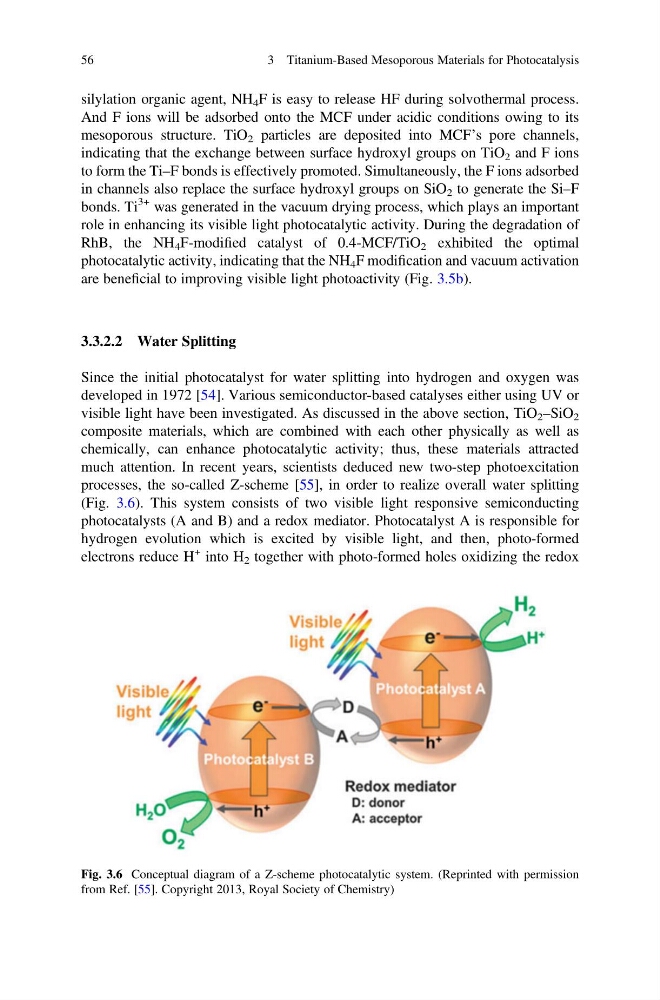
much attention. In recent years, scientists deduced new two-step photoexcitation
processes, the so-called Z-scheme [55], in order to realize overall water splitting
(Fig. 3.6). This system consists of two visible light responsive semiconducting
photocatalysts (A and B) and a redox mediator. Photocatalyst A is responsible for
hydrogen evolution which is excited by visible light, and then, photo-formed
electrons reduce H
+ into H 2 together with photo-formed holes oxidizing the redox
Fig. 3.6 Conceptual diagram of a Z-scheme photocatalytic system. (Reprinted with permission
from Ref. [55]. Copyright 2013, Royal Society of Chemistry)
56
3 Titanium-Based Mesoporous Materials for Photocatalysis
And F ions will be adsorbed onto the MCF under acidic conditions owing to its
mesoporous structure. TiO 2 particles are deposited into MCF’s pore channels,
indicating that the exchange between surface hydroxyl groups on TiO 2 and F ions
to form the Ti–F bonds is effectively promoted. Simultaneously, the F ions adsorbed
in channels also replace the surface hydroxyl groups on SiO 2 to generate the Si–F
bonds. Ti
3+ was generated in the vacuum drying process, which plays an important
role in enhancing its visible light photocatalytic activity. During the degradation of
RhB, the NH 4 F-modified catalyst of 0.4-MCF/TiO 2 exhibited the optimal
photocatalytic activity, indicating that the NH 4 F modification and vacuum activation
are beneficial to improving visible light photoactivity (Fig. 3.5b).
3.3.2.2 Water Splitting
Since the initial photocatalyst for water splitting into hydrogen and oxygen was
developed in 1972 [54]. Various semiconductor-based catalyses either using UV or
visible light have been investigated. As discussed in the above section, TiO 2 –SiO 2
composite materials, which are combined with each other physically as well as
chemically, can enhance photocatalytic activity; thus, these materials attracted
much attention. In recent years, scientists deduced new two-step photoexcitation
processes, the so-called Z-scheme [55], in order to realize overall water splitting
(Fig. 3.6). This system consists of two visible light responsive semiconducting
photocatalysts (A and B) and a redox mediator. Photocatalyst A is responsible for
hydrogen evolution which is excited by visible light, and then, photo-formed
electrons reduce H
+ into H 2 together with photo-formed holes oxidizing the redox
Fig. 3.6 Conceptual diagram of a Z-scheme photocatalytic system. (Reprinted with permission
from Ref. [55]. Copyright 2013, Royal Society of Chemistry)
56
3 Titanium-Based Mesoporous Materials for Photocatalysis