

mediator. At the same time, photocatalyst B is used for the water-oxidation reaction,
during which photo-formed holes oxidize H 2 O to produce O 2 together with photoformed electrons reducing the redox mediator under visible light irradiation. Finally,
water splitting into H 2 and O 2 is attained.
Niphadkar et al. [56] prepared TiO 2 –SiO 2 mesoporous composite photocatalysts
with different proportions of TiO 2 and SiO 2 by loading TiO 2 on as-synthesized Si–
MCM-41 using simple sol–gel method. The photocatalytic evaluation of composite
photocatalysts was carried out in production of hydrogen by water-splitting reaction
under UV light. In 2014, Xing et al. [57] successfully prepared a brown mesoporous
TiO 2Àx /MCF composite with a high fluorine doping concentration (8.01 at%) by
vacuum activation method. It displays an excellent solar absorption, a recordbreaking quantum yield (Φ ¼ 46%) and a high photon–hydrogen energy conversion
efficiency (η ¼ 34%) in solar photocatalytic H 2 production process, which are all
better than that of the black hydrogen-doped TiO 2 (Φ ¼ 35%, η ¼ 24%). Scheme 3.2
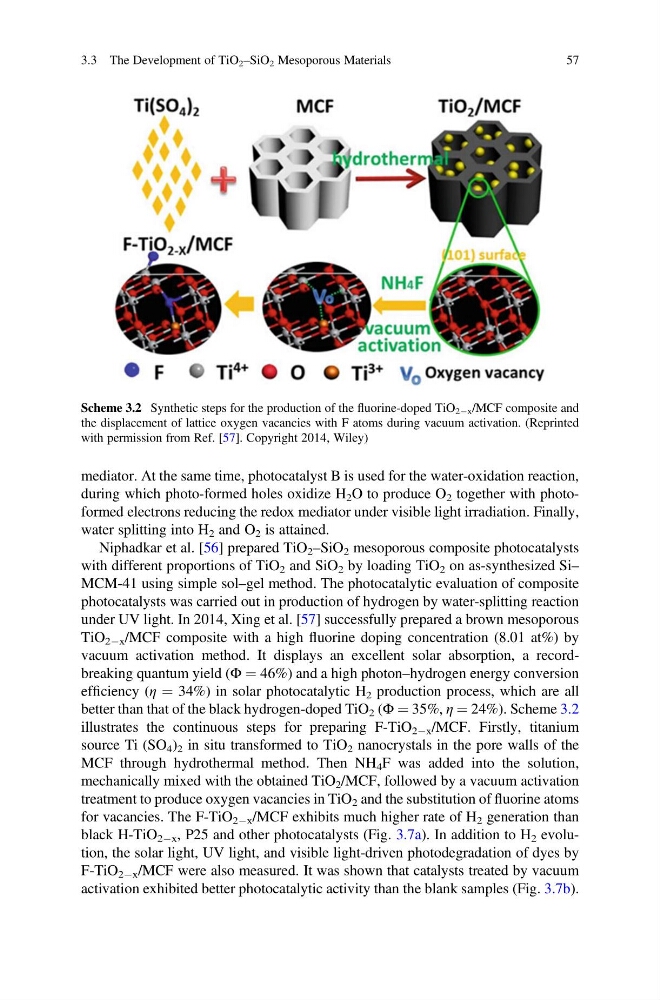
illustrates the continuous steps for preparing F-TiO 2Àx /MCF. Firstly, titanium
source Ti (SO 4 ) 2 in situ transformed to TiO 2 nanocrystals in the pore walls of the
MCF through hydrothermal method. Then NH 4 F was added into the solution,
mechanically mixed with the obtained TiO 2 /MCF, followed by a vacuum activation
treatment to produce oxygen vacancies in TiO 2 and the substitution of fluorine atoms
for vacancies. The F-TiO 2Àx /MCF exhibits much higher rate of H 2 generation than
black H-TiO 2Àx , P25 and other photocatalysts (Fig. 3.7a). In addition to H 2 evolution, the solar light, UV light, and visible light-driven photodegradation of dyes by
F-TiO 2Àx /MCF were also measured. It was shown that catalysts treated by vacuum
activation exhibited better photocatalytic activity than the blank samples (Fig. 3.7b).
Scheme 3.2 Synthetic steps for the production of the fluorine-doped TiO 2Àx /MCF composite and
the displacement of lattice oxygen vacancies with F atoms during vacuum activation. (Reprinted
with permission from Ref. [57]. Copyright 2014, Wiley)
3.3 The Development of TiO 2 –SiO 2 Mesoporous Materials
57
during which photo-formed holes oxidize H 2 O to produce O 2 together with photoformed electrons reducing the redox mediator under visible light irradiation. Finally,
water splitting into H 2 and O 2 is attained.
Niphadkar et al. [56] prepared TiO 2 –SiO 2 mesoporous composite photocatalysts
with different proportions of TiO 2 and SiO 2 by loading TiO 2 on as-synthesized Si–
MCM-41 using simple sol–gel method. The photocatalytic evaluation of composite
photocatalysts was carried out in production of hydrogen by water-splitting reaction
under UV light. In 2014, Xing et al. [57] successfully prepared a brown mesoporous
TiO 2Àx /MCF composite with a high fluorine doping concentration (8.01 at%) by
vacuum activation method. It displays an excellent solar absorption, a recordbreaking quantum yield (Φ ¼ 46%) and a high photon–hydrogen energy conversion
efficiency (η ¼ 34%) in solar photocatalytic H 2 production process, which are all
better than that of the black hydrogen-doped TiO 2 (Φ ¼ 35%, η ¼ 24%). Scheme 3.2
illustrates the continuous steps for preparing F-TiO 2Àx /MCF. Firstly, titanium
source Ti (SO 4 ) 2 in situ transformed to TiO 2 nanocrystals in the pore walls of the
MCF through hydrothermal method. Then NH 4 F was added into the solution,
mechanically mixed with the obtained TiO 2 /MCF, followed by a vacuum activation
treatment to produce oxygen vacancies in TiO 2 and the substitution of fluorine atoms
for vacancies. The F-TiO 2Àx /MCF exhibits much higher rate of H 2 generation than
black H-TiO 2Àx , P25 and other photocatalysts (Fig. 3.7a). In addition to H 2 evolution, the solar light, UV light, and visible light-driven photodegradation of dyes by
F-TiO 2Àx /MCF were also measured. It was shown that catalysts treated by vacuum
activation exhibited better photocatalytic activity than the blank samples (Fig. 3.7b).
Scheme 3.2 Synthetic steps for the production of the fluorine-doped TiO 2Àx /MCF composite and
the displacement of lattice oxygen vacancies with F atoms during vacuum activation. (Reprinted
with permission from Ref. [57]. Copyright 2014, Wiley)
3.3 The Development of TiO 2 –SiO 2 Mesoporous Materials
57