

degrade rhodamine B (RhB) under UV light irradiation. The result shows that the
sample has a comparable photocatalytic activity with Degussa P25, and higher
activity than pure TiO 2 .
In terms of MCF materials, some papers have reported about it. Xing et al. [44]
have obtained super-hydrophobic mesocellular foam (MCF), which is loaded with
nano-sized TiO 2 photocatalysts in its pore channels, through a simple one-step
solvothermal method followed by a low-temperature vacuum activation process to
produce Ti
3+ . And it can be well considered as an extractant for organics. In this
method, NH 4 F is used as hydrophobic modifier, and isopropanol is used as solvent to
synthesize the super-hydrophobic mesoporous MCF loaded with highly dispersed
and Ti
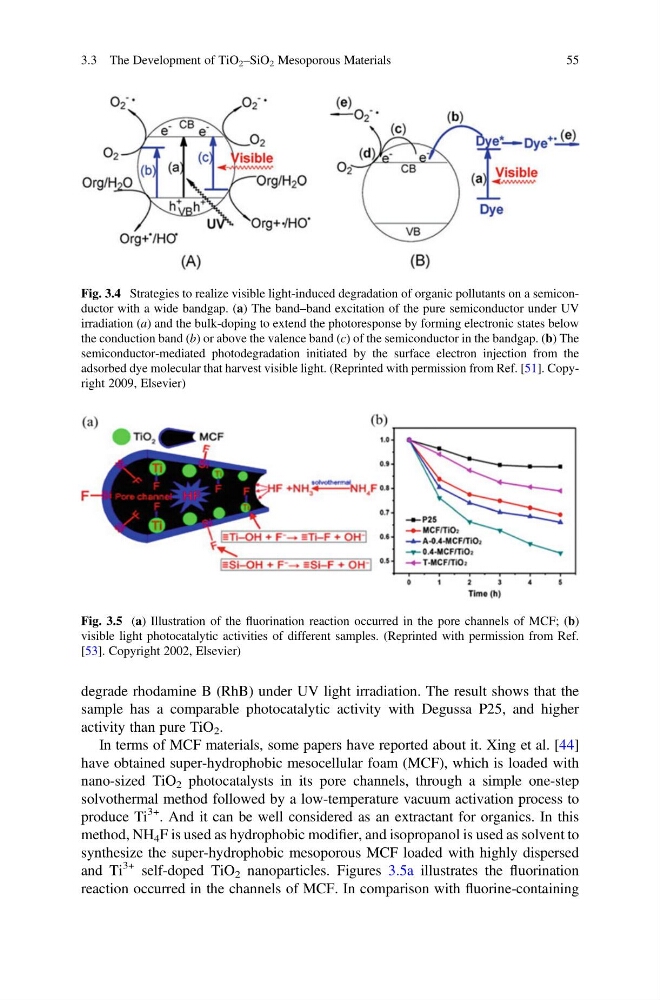
3+ self-doped TiO 2 nanoparticles. Figures 3.5a illustrates the fluorination
reaction occurred in the channels of MCF. In comparison with fluorine-containing
Fig. 3.4 Strategies to realize visible light-induced degradation of organic pollutants on a semiconductor with a wide bandgap. (a) The band–band excitation of the pure semiconductor under UV
irradiation (a) and the bulk-doping to extend the photoresponse by forming electronic states below
the conduction band (b) or above the valence band (c) of the semiconductor in the bandgap. (b) The
semiconductor-mediated photodegradation initiated by the surface electron injection from the
adsorbed dye molecular that harvest visible light. (Reprinted with permission from Ref. [51]. Copyright 2009, Elsevier)
Fig. 3.5 (a) Illustration of the fluorination reaction occurred in the pore channels of MCF; (b)
visible light photocatalytic activities of different samples. (Reprinted with permission from Ref.
[53]. Copyright 2002, Elsevier)
3.3 The Development of TiO 2 –SiO 2 Mesoporous Materials
55
sample has a comparable photocatalytic activity with Degussa P25, and higher
activity than pure TiO 2 .
In terms of MCF materials, some papers have reported about it. Xing et al. [44]
have obtained super-hydrophobic mesocellular foam (MCF), which is loaded with
nano-sized TiO 2 photocatalysts in its pore channels, through a simple one-step
solvothermal method followed by a low-temperature vacuum activation process to
produce Ti
3+ . And it can be well considered as an extractant for organics. In this
method, NH 4 F is used as hydrophobic modifier, and isopropanol is used as solvent to
synthesize the super-hydrophobic mesoporous MCF loaded with highly dispersed
and Ti
3+ self-doped TiO 2 nanoparticles. Figures 3.5a illustrates the fluorination
reaction occurred in the channels of MCF. In comparison with fluorine-containing
Fig. 3.4 Strategies to realize visible light-induced degradation of organic pollutants on a semiconductor with a wide bandgap. (a) The band–band excitation of the pure semiconductor under UV
irradiation (a) and the bulk-doping to extend the photoresponse by forming electronic states below
the conduction band (b) or above the valence band (c) of the semiconductor in the bandgap. (b) The
semiconductor-mediated photodegradation initiated by the surface electron injection from the
adsorbed dye molecular that harvest visible light. (Reprinted with permission from Ref. [51]. Copyright 2009, Elsevier)
Fig. 3.5 (a) Illustration of the fluorination reaction occurred in the pore channels of MCF; (b)
visible light photocatalytic activities of different samples. (Reprinted with permission from Ref.
[53]. Copyright 2002, Elsevier)
3.3 The Development of TiO 2 –SiO 2 Mesoporous Materials
55