

2.5 In Situ NMR and ESR
The detailed structureÀactivity relationship of surface hydroxyl groups and
adsorbed water on the surface of semiconductor is the key to clarifying the holetransfer mechanism for photocatalytic water splitting. Owing to the lack of direct
experimental evidence, the most controversial point concerning the nature of
surface-active sites is whether the surface hydroxyl groups (Ti À OH) of TiO 2 can
trap the photogenerated hole. Using the photocatalytic water splitting by Pt/TiO 2 as
an example, one- (1D) and two-dimensional (2D)
1 H solid-state NMR together with
in situ ESR techniques were employed to identify surface hydroxyl groups and
adsorbed water molecules, as well as their spatial proximity/interaction on the
surface of TiO 2 [38].
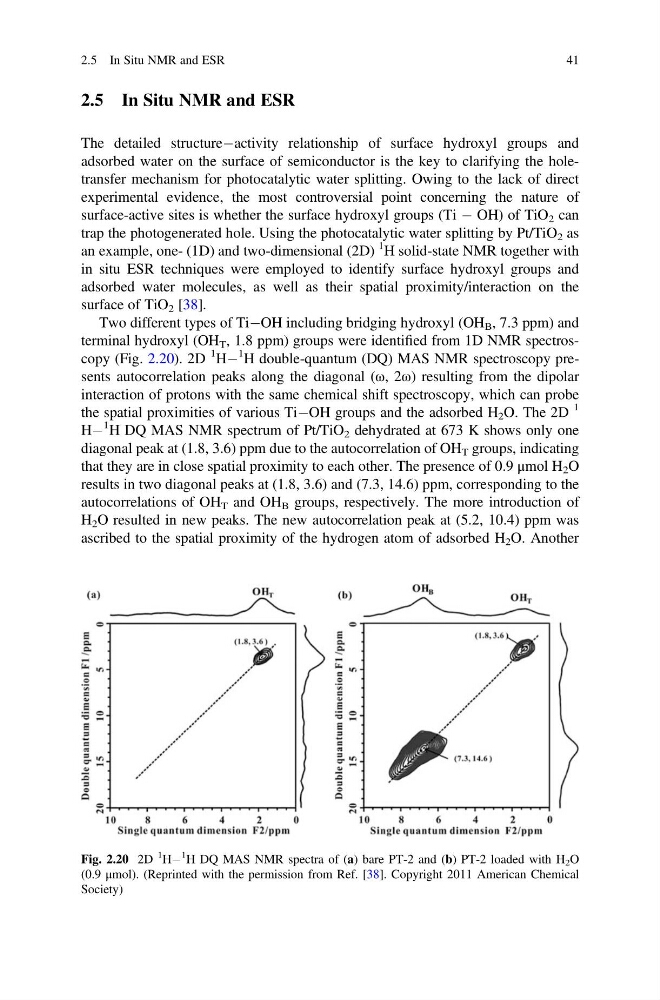
Two different types of TiÀOH including bridging hydroxyl (OH B , 7.3 ppm) and
terminal hydroxyl (OH T , 1.8 ppm) groups were identified from 1D NMR spectroscopy (Fig. 2.20). 2D
1 HÀ
1 H double-quantum (DQ) MAS NMR spectroscopy presents autocorrelation peaks along the diagonal (ω, 2ω) resulting from the dipolar
interaction of protons with the same chemical shift spectroscopy, which can probe
the spatial proximities of various TiÀOH groups and the adsorbed H 2 O. The 2D
1
HÀ
1 H DQ MAS NMR spectrum of Pt/TiO 2 dehydrated at 673 K shows only one
diagonal peak at (1.8, 3.6) ppm due to the autocorrelation of OH T groups, indicating
that they are in close spatial proximity to each other. The presence of 0.9 μmol H 2 O
results in two diagonal peaks at (1.8, 3.6) and (7.3, 14.6) ppm, corresponding to the
autocorrelations of OH T and OH B groups, respectively. The more introduction of
H 2 O resulted in new peaks. The new autocorrelation peak at (5.2, 10.4) ppm was
ascribed to the spatial proximity of the hydrogen atom of adsorbed H 2 O. Another
Fig. 2.20 2D
1
HÀ
1
H DQ MAS NMR spectra of (a) bare PT-2 and (b) PT-2 loaded with H 2 O
(0.9 μmol). (Reprinted with the permission from Ref. [38]. Copyright 2011 American Chemical
Society)
2.5 In Situ NMR and ESR
41
The detailed structureÀactivity relationship of surface hydroxyl groups and
adsorbed water on the surface of semiconductor is the key to clarifying the holetransfer mechanism for photocatalytic water splitting. Owing to the lack of direct
experimental evidence, the most controversial point concerning the nature of
surface-active sites is whether the surface hydroxyl groups (Ti À OH) of TiO 2 can
trap the photogenerated hole. Using the photocatalytic water splitting by Pt/TiO 2 as
an example, one- (1D) and two-dimensional (2D)
1 H solid-state NMR together with
in situ ESR techniques were employed to identify surface hydroxyl groups and
adsorbed water molecules, as well as their spatial proximity/interaction on the
surface of TiO 2 [38].
Two different types of TiÀOH including bridging hydroxyl (OH B , 7.3 ppm) and
terminal hydroxyl (OH T , 1.8 ppm) groups were identified from 1D NMR spectroscopy (Fig. 2.20). 2D
1 HÀ
1 H double-quantum (DQ) MAS NMR spectroscopy presents autocorrelation peaks along the diagonal (ω, 2ω) resulting from the dipolar
interaction of protons with the same chemical shift spectroscopy, which can probe
the spatial proximities of various TiÀOH groups and the adsorbed H 2 O. The 2D
1
HÀ
1 H DQ MAS NMR spectrum of Pt/TiO 2 dehydrated at 673 K shows only one
diagonal peak at (1.8, 3.6) ppm due to the autocorrelation of OH T groups, indicating
that they are in close spatial proximity to each other. The presence of 0.9 μmol H 2 O
results in two diagonal peaks at (1.8, 3.6) and (7.3, 14.6) ppm, corresponding to the
autocorrelations of OH T and OH B groups, respectively. The more introduction of
H 2 O resulted in new peaks. The new autocorrelation peak at (5.2, 10.4) ppm was
ascribed to the spatial proximity of the hydrogen atom of adsorbed H 2 O. Another
Fig. 2.20 2D
1
HÀ
1
H DQ MAS NMR spectra of (a) bare PT-2 and (b) PT-2 loaded with H 2 O
(0.9 μmol). (Reprinted with the permission from Ref. [38]. Copyright 2011 American Chemical
Society)
2.5 In Situ NMR and ESR
41