

new autocorrelation peak appeared at (6.9, 13.8) ppm, and it grew with the consumption of the autocorrelation peak at (7.3, 14.6) ppm when the H 2 O loading was
gradually increased. The signal at 6.9 ppm was assigned to the
1 H signal of OH B in
hydrogen-bonding interaction with surface-adsorbed H 2 O. Besides the autocorrelation peaks, the intense off-diagonal peak pair at (5.2, 12.1) and (6.9, 12.1) ppm
correspond to the spatial correlation between H 2 O and OH B . All these findings
demonstrated that H 2 O only adsorbs on OH B groups through hydrogen-bonding
interaction, forming hydrated OH B groups.
The in situ
1 H and
13
C NMR studies of the photocatalytic reaction on TiO 2 with
different TiÀOH groups and different H 2 O loadings illustrated that the enhanced
activity was closely correlated to the amount of hydrated OH B groups. The in situ
ESR experiments performed with variable H 2 O loading revealed that the hydrated
OH B offer a channel for the transfer of photogenerated holes in the photocatalytic
reaction, and the adsorbed H 2 O has a synergistic effect with the neighboring OH B
group to facilitate the formation and evolution of active paramagnetic intermediates.
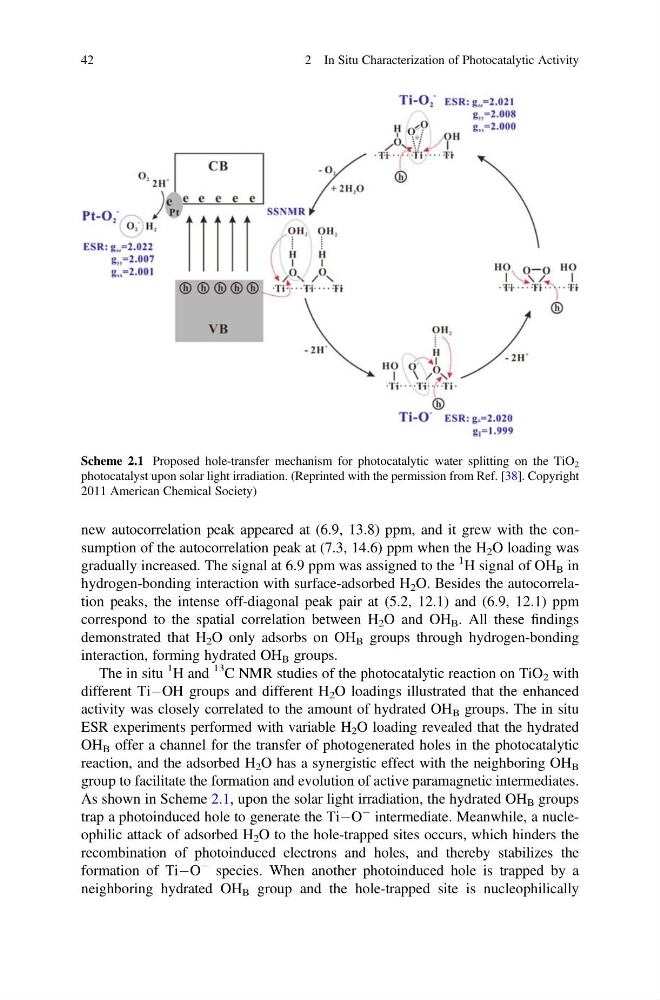
As shown in Scheme 2.1, upon the solar light irradiation, the hydrated OH B groups
trap a photoinduced hole to generate the TiÀO
À intermediate. Meanwhile, a nucleophilic attack of adsorbed H 2 O to the hole-trapped sites occurs, which hinders the
recombination of photoinduced electrons and holes, and thereby stabilizes the
formation of TiÀO
À species. When another photoinduced hole is trapped by a
neighboring hydrated OH B group and the hole-trapped site is nucleophilically
Scheme 2.1 Proposed hole-transfer mechanism for photocatalytic water splitting on the TiO 2
photocatalyst upon solar light irradiation. (Reprinted with the permission from Ref. [38]. Copyright
2011 American Chemical Society)
42
2 In Situ Characterization of Photocatalytic Activity
gradually increased. The signal at 6.9 ppm was assigned to the
1 H signal of OH B in
hydrogen-bonding interaction with surface-adsorbed H 2 O. Besides the autocorrelation peaks, the intense off-diagonal peak pair at (5.2, 12.1) and (6.9, 12.1) ppm
correspond to the spatial correlation between H 2 O and OH B . All these findings
demonstrated that H 2 O only adsorbs on OH B groups through hydrogen-bonding
interaction, forming hydrated OH B groups.
The in situ
1 H and
13
C NMR studies of the photocatalytic reaction on TiO 2 with
different TiÀOH groups and different H 2 O loadings illustrated that the enhanced
activity was closely correlated to the amount of hydrated OH B groups. The in situ
ESR experiments performed with variable H 2 O loading revealed that the hydrated
OH B offer a channel for the transfer of photogenerated holes in the photocatalytic
reaction, and the adsorbed H 2 O has a synergistic effect with the neighboring OH B
group to facilitate the formation and evolution of active paramagnetic intermediates.
As shown in Scheme 2.1, upon the solar light irradiation, the hydrated OH B groups
trap a photoinduced hole to generate the TiÀO
À intermediate. Meanwhile, a nucleophilic attack of adsorbed H 2 O to the hole-trapped sites occurs, which hinders the
recombination of photoinduced electrons and holes, and thereby stabilizes the
formation of TiÀO
À species. When another photoinduced hole is trapped by a
neighboring hydrated OH B group and the hole-trapped site is nucleophilically
Scheme 2.1 Proposed hole-transfer mechanism for photocatalytic water splitting on the TiO 2
photocatalyst upon solar light irradiation. (Reprinted with the permission from Ref. [38]. Copyright
2011 American Chemical Society)
42
2 In Situ Characterization of Photocatalytic Activity