

Blodgett technique. The closely packed sensor film contains high density of sub-nm
gaps between sharp edges of Ag nanoparticles, which created large local electromagnetic fields that serve as “hot spots” for SERS enhancement. The SERS substrate
was then coated with a thin layer of alumina by atomic layer deposition to prevent
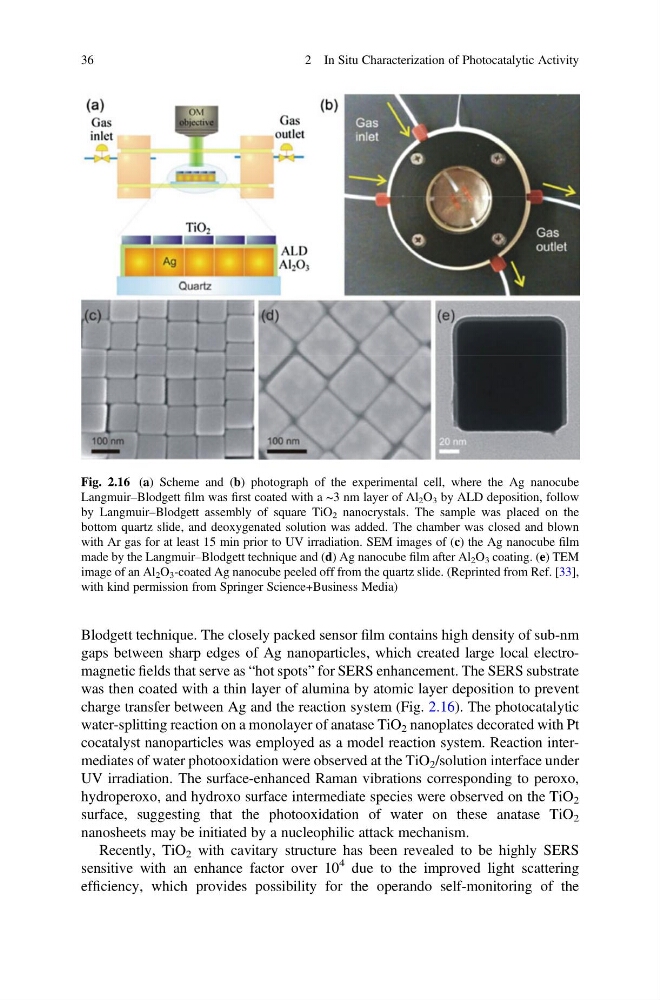
charge transfer between Ag and the reaction system (Fig. 2.16). The photocatalytic
water-splitting reaction on a monolayer of anatase TiO 2 nanoplates decorated with Pt
cocatalyst nanoparticles was employed as a model reaction system. Reaction intermediates of water photooxidation were observed at the TiO 2 /solution interface under
UV irradiation. The surface-enhanced Raman vibrations corresponding to peroxo,
hydroperoxo, and hydroxo surface intermediate species were observed on the TiO 2
surface, suggesting that the photooxidation of water on these anatase TiO 2
nanosheets may be initiated by a nucleophilic attack mechanism.
Recently, TiO 2 with cavitary structure has been revealed to be highly SERS
sensitive with an enhance factor over 10
4 due to the improved light scattering
efficiency, which provides possibility for the operando self-monitoring of the
Fig. 2.16 (a) Scheme and (b) photograph of the experimental cell, where the Ag nanocube
Langmuir–Blodgett film was first coated with a ~3 nm layer of Al 2 O 3 by ALD deposition, follow
by Langmuir–Blodgett assembly of square TiO 2 nanocrystals. The sample was placed on the
bottom quartz slide, and deoxygenated solution was added. The chamber was closed and blown
with Ar gas for at least 15 min prior to UV irradiation. SEM images of (c) the Ag nanocube film
made by the Langmuir–Blodgett technique and (d) Ag nanocube film after Al 2 O 3 coating. (e) TEM
image of an Al 2 O 3 -coated Ag nanocube peeled off from the quartz slide. (Reprinted from Ref. [33],
with kind permission from Springer Science+Business Media)
36
2 In Situ Characterization of Photocatalytic Activity
gaps between sharp edges of Ag nanoparticles, which created large local electromagnetic fields that serve as “hot spots” for SERS enhancement. The SERS substrate
was then coated with a thin layer of alumina by atomic layer deposition to prevent
charge transfer between Ag and the reaction system (Fig. 2.16). The photocatalytic
water-splitting reaction on a monolayer of anatase TiO 2 nanoplates decorated with Pt
cocatalyst nanoparticles was employed as a model reaction system. Reaction intermediates of water photooxidation were observed at the TiO 2 /solution interface under
UV irradiation. The surface-enhanced Raman vibrations corresponding to peroxo,
hydroperoxo, and hydroxo surface intermediate species were observed on the TiO 2
surface, suggesting that the photooxidation of water on these anatase TiO 2
nanosheets may be initiated by a nucleophilic attack mechanism.
Recently, TiO 2 with cavitary structure has been revealed to be highly SERS
sensitive with an enhance factor over 10
4 due to the improved light scattering
efficiency, which provides possibility for the operando self-monitoring of the
Fig. 2.16 (a) Scheme and (b) photograph of the experimental cell, where the Ag nanocube
Langmuir–Blodgett film was first coated with a ~3 nm layer of Al 2 O 3 by ALD deposition, follow
by Langmuir–Blodgett assembly of square TiO 2 nanocrystals. The sample was placed on the
bottom quartz slide, and deoxygenated solution was added. The chamber was closed and blown
with Ar gas for at least 15 min prior to UV irradiation. SEM images of (c) the Ag nanocube film
made by the Langmuir–Blodgett technique and (d) Ag nanocube film after Al 2 O 3 coating. (e) TEM
image of an Al 2 O 3 -coated Ag nanocube peeled off from the quartz slide. (Reprinted from Ref. [33],
with kind permission from Springer Science+Business Media)
36
2 In Situ Characterization of Photocatalytic Activity