

photocatalysis reaction [34]. The utilization of the fingerprint spectrum for the
operando monitoring of a photocatalytic process is extremely desired to accurately
understand the reaction mechanism but long remains challenging. Ordered
macroporous TiO 2 that is concomitantly photocatalytically active and highly
SERS sensitive was employed to self-track the photocatalytic reaction using the
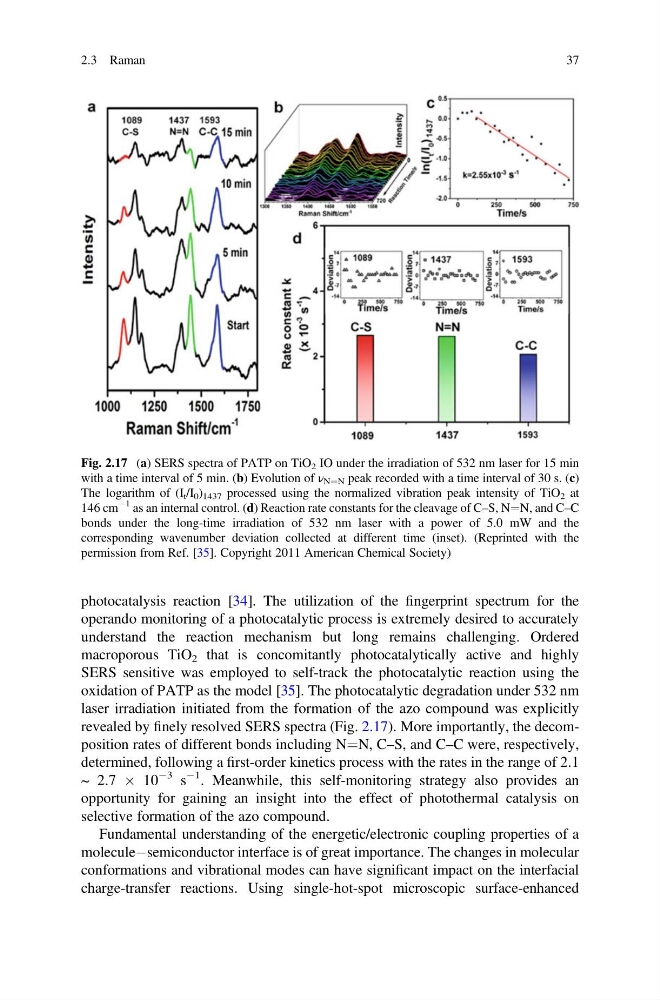
oxidation of PATP as the model [35]. The photocatalytic degradation under 532 nm
laser irradiation initiated from the formation of the azo compound was explicitly
revealed by finely resolved SERS spectra (Fig. 2.17). More importantly, the decomposition rates of different bonds including N¼N, C–S, and C–C were, respectively,
determined, following a first-order kinetics process with the rates in the range of 2.1
~ 2.7 Â 10
À3 s
À1 . Meanwhile, this self-monitoring strategy also provides an
opportunity for gaining an insight into the effect of photothermal catalysis on
selective formation of the azo compound.
Fundamental understanding of the energetic/electronic coupling properties of a
moleculeÀsemiconductor interface is of great importance. The changes in molecular
conformations and vibrational modes can have significant impact on the interfacial
charge-transfer reactions. Using single-hot-spot microscopic surface-enhanced
Fig. 2.17 (a) SERS spectra of PATP on TiO 2 IO under the irradiation of 532 nm laser for 15 min
with a time interval of 5 min. (b) Evolution of ν N¼N peak recorded with a time interval of 30 s. (c)
The logarithm of (I t /I 0 ) 1437 processed using the normalized vibration peak intensity of TiO 2 at
146 cm
À1 as an internal control. (d) Reaction rate constants for the cleavage of C–S, N¼N, and C–C
bonds under the long-time irradiation of 532 nm laser with a power of 5.0 mW and the
corresponding wavenumber deviation collected at different time (inset). (Reprinted with the
permission from Ref. [35]. Copyright 2011 American Chemical Society)
2.3 Raman
37
operando monitoring of a photocatalytic process is extremely desired to accurately
understand the reaction mechanism but long remains challenging. Ordered
macroporous TiO 2 that is concomitantly photocatalytically active and highly
SERS sensitive was employed to self-track the photocatalytic reaction using the
oxidation of PATP as the model [35]. The photocatalytic degradation under 532 nm
laser irradiation initiated from the formation of the azo compound was explicitly
revealed by finely resolved SERS spectra (Fig. 2.17). More importantly, the decomposition rates of different bonds including N¼N, C–S, and C–C were, respectively,
determined, following a first-order kinetics process with the rates in the range of 2.1
~ 2.7 Â 10
À3 s
À1 . Meanwhile, this self-monitoring strategy also provides an
opportunity for gaining an insight into the effect of photothermal catalysis on
selective formation of the azo compound.
Fundamental understanding of the energetic/electronic coupling properties of a
moleculeÀsemiconductor interface is of great importance. The changes in molecular
conformations and vibrational modes can have significant impact on the interfacial
charge-transfer reactions. Using single-hot-spot microscopic surface-enhanced
Fig. 2.17 (a) SERS spectra of PATP on TiO 2 IO under the irradiation of 532 nm laser for 15 min
with a time interval of 5 min. (b) Evolution of ν N¼N peak recorded with a time interval of 30 s. (c)
The logarithm of (I t /I 0 ) 1437 processed using the normalized vibration peak intensity of TiO 2 at
146 cm
À1 as an internal control. (d) Reaction rate constants for the cleavage of C–S, N¼N, and C–C
bonds under the long-time irradiation of 532 nm laser with a power of 5.0 mW and the
corresponding wavenumber deviation collected at different time (inset). (Reprinted with the
permission from Ref. [35]. Copyright 2011 American Chemical Society)
2.3 Raman
37