

Although catalytic processes mediated by SPR excitation have emerged as a new
frontier in catalysis, the selectivity of these processes remains poorly understood.
The selectivity of the SPR-mediated oxidation of PATP employing Au NPs as
catalysts was controlled by the choice of catalysts (Au or TiO 2 -Au NPs) and by
the modulation of the charge transfer from UV-excited TiO 2 to Au [28]. When Au
NPs were employed as catalyst, the SPR-mediated oxidation of PATP yielded
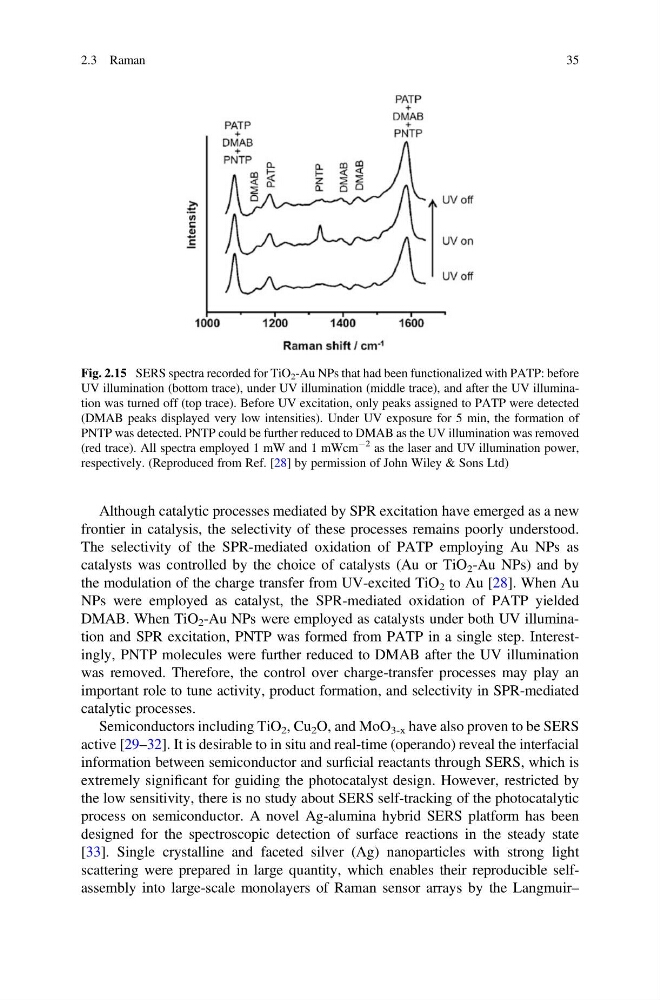
DMAB. When TiO 2 -Au NPs were employed as catalysts under both UV illumination and SPR excitation, PNTP was formed from PATP in a single step. Interestingly, PNTP molecules were further reduced to DMAB after the UV illumination
was removed. Therefore, the control over charge-transfer processes may play an
important role to tune activity, product formation, and selectivity in SPR-mediated
catalytic processes.
Semiconductors including TiO 2 , Cu 2 O, and MoO 3-x have also proven to be SERS
active [29–32]. It is desirable to in situ and real-time (operando) reveal the interfacial
information between semiconductor and surficial reactants through SERS, which is
extremely significant for guiding the photocatalyst design. However, restricted by
the low sensitivity, there is no study about SERS self-tracking of the photocatalytic
process on semiconductor. A novel Ag-alumina hybrid SERS platform has been
designed for the spectroscopic detection of surface reactions in the steady state
[33]. Single crystalline and faceted silver (Ag) nanoparticles with strong light
scattering were prepared in large quantity, which enables their reproducible selfassembly into large-scale monolayers of Raman sensor arrays by the Langmuir–
Fig. 2.15 SERS spectra recorded for TiO 2 -Au NPs that had been functionalized with PATP: before
UV illumination (bottom trace), under UV illumination (middle trace), and after the UV illumination was turned off (top trace). Before UV excitation, only peaks assigned to PATP were detected
(DMAB peaks displayed very low intensities). Under UV exposure for 5 min, the formation of
PNTP was detected. PNTP could be further reduced to DMAB as the UV illumination was removed
(red trace). All spectra employed 1 mW and 1 mWcm
À2 as the laser and UV illumination power,
respectively. (Reproduced from Ref. [28] by permission of John Wiley & Sons Ltd)
2.3 Raman
35
frontier in catalysis, the selectivity of these processes remains poorly understood.
The selectivity of the SPR-mediated oxidation of PATP employing Au NPs as
catalysts was controlled by the choice of catalysts (Au or TiO 2 -Au NPs) and by
the modulation of the charge transfer from UV-excited TiO 2 to Au [28]. When Au
NPs were employed as catalyst, the SPR-mediated oxidation of PATP yielded
DMAB. When TiO 2 -Au NPs were employed as catalysts under both UV illumination and SPR excitation, PNTP was formed from PATP in a single step. Interestingly, PNTP molecules were further reduced to DMAB after the UV illumination
was removed. Therefore, the control over charge-transfer processes may play an
important role to tune activity, product formation, and selectivity in SPR-mediated
catalytic processes.
Semiconductors including TiO 2 , Cu 2 O, and MoO 3-x have also proven to be SERS
active [29–32]. It is desirable to in situ and real-time (operando) reveal the interfacial
information between semiconductor and surficial reactants through SERS, which is
extremely significant for guiding the photocatalyst design. However, restricted by
the low sensitivity, there is no study about SERS self-tracking of the photocatalytic
process on semiconductor. A novel Ag-alumina hybrid SERS platform has been
designed for the spectroscopic detection of surface reactions in the steady state
[33]. Single crystalline and faceted silver (Ag) nanoparticles with strong light
scattering were prepared in large quantity, which enables their reproducible selfassembly into large-scale monolayers of Raman sensor arrays by the Langmuir–
Fig. 2.15 SERS spectra recorded for TiO 2 -Au NPs that had been functionalized with PATP: before
UV illumination (bottom trace), under UV illumination (middle trace), and after the UV illumination was turned off (top trace). Before UV excitation, only peaks assigned to PATP were detected
(DMAB peaks displayed very low intensities). Under UV exposure for 5 min, the formation of
PNTP was detected. PNTP could be further reduced to DMAB as the UV illumination was removed
(red trace). All spectra employed 1 mW and 1 mWcm
À2 as the laser and UV illumination power,
respectively. (Reproduced from Ref. [28] by permission of John Wiley & Sons Ltd)
2.3 Raman
35