

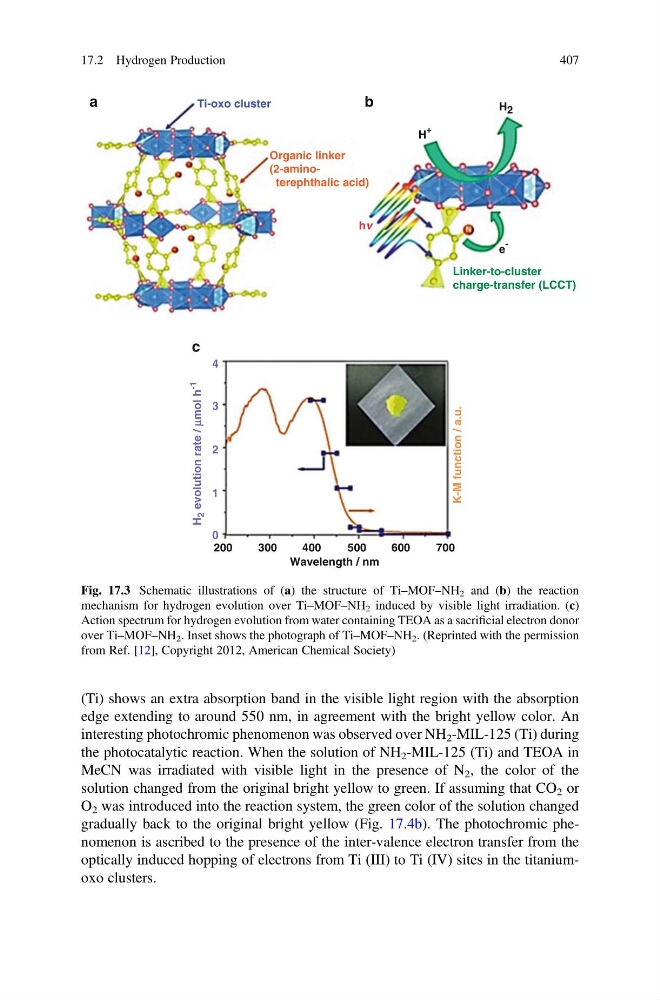
(Ti) shows an extra absorption band in the visible light region with the absorption
edge extending to around 550 nm, in agreement with the bright yellow color. An
interesting photochromic phenomenon was observed over NH 2 -MIL-125 (Ti) during
the photocatalytic reaction. When the solution of NH 2 -MIL-125 (Ti) and TEOA in
MeCN was irradiated with visible light in the presence of N 2 , the color of the
solution changed from the original bright yellow to green. If assuming that CO 2 or
O 2 was introduced into the reaction system, the green color of the solution changed
gradually back to the original bright yellow (Fig. 17.4b). The photochromic phenomenon is ascribed to the presence of the inter-valence electron transfer from the
optically induced hopping of electrons from Ti (III) to Ti (IV) sites in the titaniumoxo clusters.
Ti-oxo cluster
Linker-to-cluster
charge-transfer (LCCT)
H
+
e
-
4
3
2
1
0
200
300
400
500
600
700
K-M function / a.u.
H
2 evolution rate /
mmol h
-1
Wavelength / nm
H 2
b
c
a
Organic linker
(2-aminoterephthalic acid)
hv
Fig. 17.3 Schematic illustrations of (a) the structure of Ti–MOF–NH 2 and (b) the reaction
mechanism for hydrogen evolution over Ti–MOF–NH 2 induced by visible light irradiation. (c)
Action spectrum for hydrogen evolution from water containing TEOA as a sacrificial electron donor
over Ti–MOF–NH 2 . Inset shows the photograph of Ti–MOF–NH 2 . (Reprinted with the permission
from Ref. [12], Copyright 2012, American Chemical Society)
17.2 Hydrogen Production
407
edge extending to around 550 nm, in agreement with the bright yellow color. An
interesting photochromic phenomenon was observed over NH 2 -MIL-125 (Ti) during
the photocatalytic reaction. When the solution of NH 2 -MIL-125 (Ti) and TEOA in
MeCN was irradiated with visible light in the presence of N 2 , the color of the
solution changed from the original bright yellow to green. If assuming that CO 2 or
O 2 was introduced into the reaction system, the green color of the solution changed
gradually back to the original bright yellow (Fig. 17.4b). The photochromic phenomenon is ascribed to the presence of the inter-valence electron transfer from the
optically induced hopping of electrons from Ti (III) to Ti (IV) sites in the titaniumoxo clusters.
Ti-oxo cluster
Linker-to-cluster
charge-transfer (LCCT)
H
+
e
-
4
3
2
1
0
200
300
400
500
600
700
K-M function / a.u.
H
2 evolution rate /
mmol h
-1
Wavelength / nm
H 2
b
c
a
Organic linker
(2-aminoterephthalic acid)
hv
Fig. 17.3 Schematic illustrations of (a) the structure of Ti–MOF–NH 2 and (b) the reaction
mechanism for hydrogen evolution over Ti–MOF–NH 2 induced by visible light irradiation. (c)
Action spectrum for hydrogen evolution from water containing TEOA as a sacrificial electron donor
over Ti–MOF–NH 2 . Inset shows the photograph of Ti–MOF–NH 2 . (Reprinted with the permission
from Ref. [12], Copyright 2012, American Chemical Society)
17.2 Hydrogen Production
407