

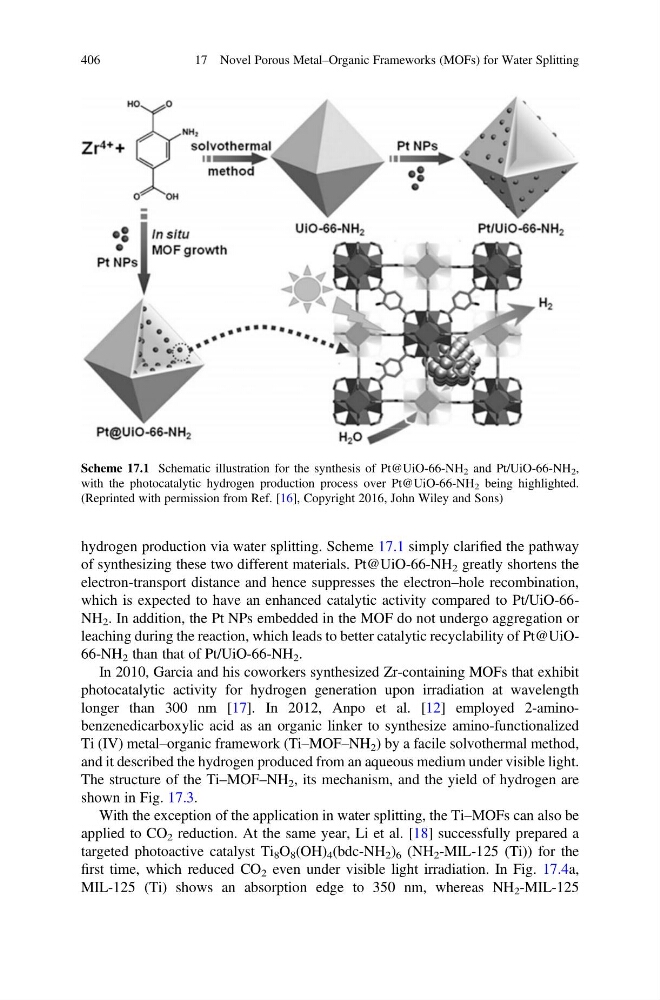
hydrogen production via water splitting. Scheme 17.1 simply clarified the pathway
of synthesizing these two different materials. Pt@UiO-66-NH 2 greatly shortens the
electron-transport distance and hence suppresses the electron–hole recombination,
which is expected to have an enhanced catalytic activity compared to Pt/UiO-66NH 2 . In addition, the Pt NPs embedded in the MOF do not undergo aggregation or
leaching during the reaction, which leads to better catalytic recyclability of Pt@UiO66-NH 2 than that of Pt/UiO-66-NH 2 .
In 2010, Garcia and his coworkers synthesized Zr-containing MOFs that exhibit
photocatalytic activity for hydrogen generation upon irradiation at wavelength
longer than 300 nm [17]. In 2012, Anpo et al. [12] employed 2-aminobenzenedicarboxylic acid as an organic linker to synthesize amino-functionalized
Ti (IV) metal–organic framework (Ti–MOF–NH 2 ) by a facile solvothermal method,
and it described the hydrogen produced from an aqueous medium under visible light.
The structure of the Ti–MOF–NH 2 , its mechanism, and the yield of hydrogen are
shown in Fig. 17.3.
With the exception of the application in water splitting, the Ti–MOFs can also be
applied to CO 2 reduction. At the same year, Li et al. [18] successfully prepared a
targeted photoactive catalyst Ti 8 O 8 (OH) 4 (bdc-NH 2 ) 6 (NH 2 -MIL-125 (Ti)) for the
first time, which reduced CO 2 even under visible light irradiation. In Fig. 17.4a,
MIL-125 (Ti) shows an absorption edge to 350 nm, whereas NH 2 -MIL-125
Scheme 17.1 Schematic illustration for the synthesis of Pt@UiO-66-NH 2 and Pt/UiO-66-NH 2 ,
with the photocatalytic hydrogen production process over Pt@UiO-66-NH 2 being highlighted.
(Reprinted with permission from Ref. [16], Copyright 2016, John Wiley and Sons)
406
17 Novel Porous Metal–Organic Frameworks (MOFs) for Water Splitting
of synthesizing these two different materials. Pt@UiO-66-NH 2 greatly shortens the
electron-transport distance and hence suppresses the electron–hole recombination,
which is expected to have an enhanced catalytic activity compared to Pt/UiO-66NH 2 . In addition, the Pt NPs embedded in the MOF do not undergo aggregation or
leaching during the reaction, which leads to better catalytic recyclability of Pt@UiO66-NH 2 than that of Pt/UiO-66-NH 2 .
In 2010, Garcia and his coworkers synthesized Zr-containing MOFs that exhibit
photocatalytic activity for hydrogen generation upon irradiation at wavelength
longer than 300 nm [17]. In 2012, Anpo et al. [12] employed 2-aminobenzenedicarboxylic acid as an organic linker to synthesize amino-functionalized
Ti (IV) metal–organic framework (Ti–MOF–NH 2 ) by a facile solvothermal method,
and it described the hydrogen produced from an aqueous medium under visible light.
The structure of the Ti–MOF–NH 2 , its mechanism, and the yield of hydrogen are
shown in Fig. 17.3.
With the exception of the application in water splitting, the Ti–MOFs can also be
applied to CO 2 reduction. At the same year, Li et al. [18] successfully prepared a
targeted photoactive catalyst Ti 8 O 8 (OH) 4 (bdc-NH 2 ) 6 (NH 2 -MIL-125 (Ti)) for the
first time, which reduced CO 2 even under visible light irradiation. In Fig. 17.4a,
MIL-125 (Ti) shows an absorption edge to 350 nm, whereas NH 2 -MIL-125
Scheme 17.1 Schematic illustration for the synthesis of Pt@UiO-66-NH 2 and Pt/UiO-66-NH 2 ,
with the photocatalytic hydrogen production process over Pt@UiO-66-NH 2 being highlighted.
(Reprinted with permission from Ref. [16], Copyright 2016, John Wiley and Sons)
406
17 Novel Porous Metal–Organic Frameworks (MOFs) for Water Splitting