

17.3 Conclusions
In summary, as abovementioned, the Ti-based MOFs or other metal-based MOFs are
able to photo-generate hydrogen from water. Meanwhile, if precious metals are
loaded on MOFs, higher efficiency will be exhibited under visible light, which
possess enormous potential in developing visible light-responsive MOFs in water
splitting. All the reported literatures provide us with new ideas in the further
development of hydrogen production.
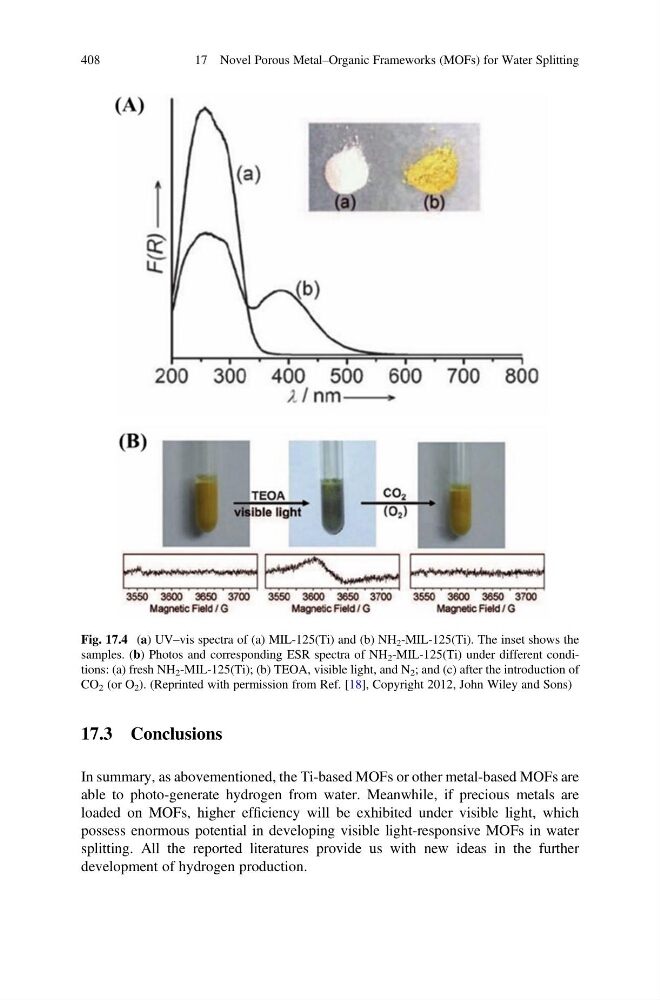
Fig. 17.4 (a) UV–vis spectra of (a) MIL-125(Ti) and (b) NH 2 -MIL-125(Ti). The inset shows the
samples. (b) Photos and corresponding ESR spectra of NH 2 -MIL-125(Ti) under different conditions: (a) fresh NH 2 -MIL-125(Ti); (b) TEOA, visible light, and N 2 ; and (c) after the introduction of
CO 2 (or O 2 ). (Reprinted with permission from Ref. [18], Copyright 2012, John Wiley and Sons)
408
17 Novel Porous Metal–Organic Frameworks (MOFs) for Water Splitting
In summary, as abovementioned, the Ti-based MOFs or other metal-based MOFs are
able to photo-generate hydrogen from water. Meanwhile, if precious metals are
loaded on MOFs, higher efficiency will be exhibited under visible light, which
possess enormous potential in developing visible light-responsive MOFs in water
splitting. All the reported literatures provide us with new ideas in the further
development of hydrogen production.
Fig. 17.4 (a) UV–vis spectra of (a) MIL-125(Ti) and (b) NH 2 -MIL-125(Ti). The inset shows the
samples. (b) Photos and corresponding ESR spectra of NH 2 -MIL-125(Ti) under different conditions: (a) fresh NH 2 -MIL-125(Ti); (b) TEOA, visible light, and N 2 ; and (c) after the introduction of
CO 2 (or O 2 ). (Reprinted with permission from Ref. [18], Copyright 2012, John Wiley and Sons)
408
17 Novel Porous Metal–Organic Frameworks (MOFs) for Water Splitting