

16.4.3.2 Cobalt Phosphides As Cocatalyst
Traditional Cd-based materials (CdS, CdSe) are attractive visible light-active
photocatalysts due to their wide light absorption range and high photocatalytic
activity. However, they offer suffer photocorrosion, which leads to inactivation of
catalysts.
Zhang’s group developed a novel and robust Cd x Zn 1Àx Se/CoP photocatalyst
[73]. In this case, CoP nanoparticles are anchored on the surface of Cd x Zn 1Àx Se
hollow nanobelts through an easy physical mixed method (Fig. 16.13a–d). Through
adjusting the molar ratio of Cd/Zn, we can obtain Cd 0.25 Zn 0.75 Se nanobelts with the
most negative conductive band position. That is, the photo-generated electrons with
the strongest reduction potential can be trapped by CoP, which achieves the
highest photocatalytic hydrogen evolution activity (Fig. 16.13e). It is noted that the
Cd 0.25 Zn 0.75 Se/CoP catalyst shows a high hydrogen evolution rate at 36.6 mmolÁg
À1
Áh
À1 in photocatalytic splitting artificial seawater (Fig. 16.13f). Moreover, when it
was exposed to solar light, the bubbles can be observed obviously, which
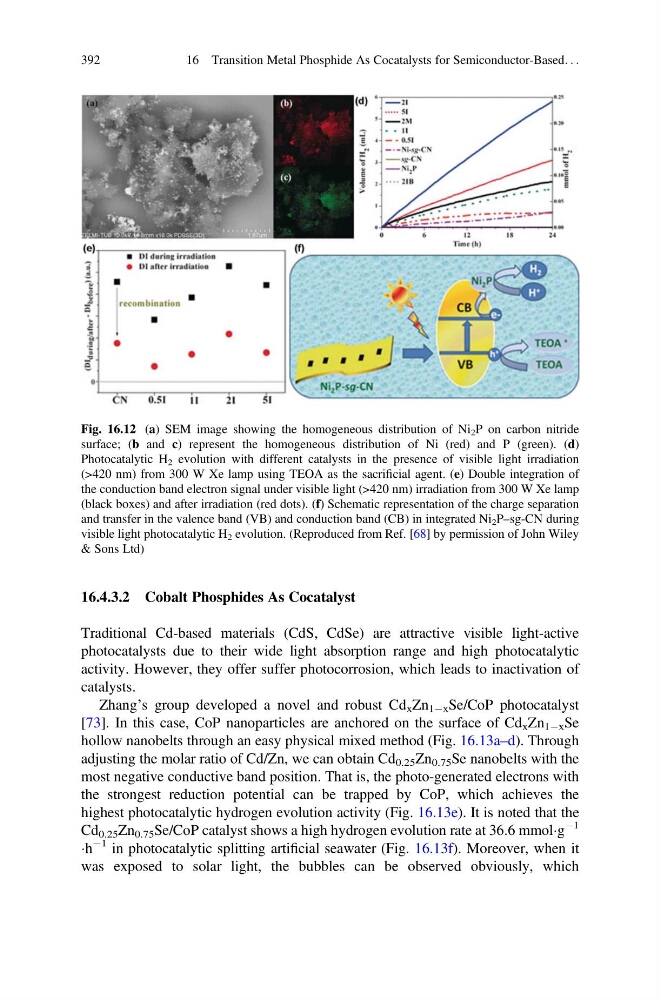
Fig. 16.12 (a) SEM image showing the homogeneous distribution of Ni 2 P on carbon nitride
surface; (b and c) represent the homogeneous distribution of Ni (red) and P (green). (d)
Photocatalytic H 2 evolution with different catalysts in the presence of visible light irradiation
(>420 nm) from 300 W Xe lamp using TEOA as the sacrificial agent. (e) Double integration of
the conduction band electron signal under visible light (>420 nm) irradiation from 300 W Xe lamp
(black boxes) and after irradiation (red dots). (f) Schematic representation of the charge separation
and transfer in the valence band (VB) and conduction band (CB) in integrated Ni 2 P–sg-CN during
visible light photocatalytic H 2 evolution. (Reproduced from Ref. [68] by permission of John Wiley
& Sons Ltd)
392
16 Transition Metal Phosphide As Cocatalysts for Semiconductor-Based. . .
Traditional Cd-based materials (CdS, CdSe) are attractive visible light-active
photocatalysts due to their wide light absorption range and high photocatalytic
activity. However, they offer suffer photocorrosion, which leads to inactivation of
catalysts.
Zhang’s group developed a novel and robust Cd x Zn 1Àx Se/CoP photocatalyst
[73]. In this case, CoP nanoparticles are anchored on the surface of Cd x Zn 1Àx Se
hollow nanobelts through an easy physical mixed method (Fig. 16.13a–d). Through
adjusting the molar ratio of Cd/Zn, we can obtain Cd 0.25 Zn 0.75 Se nanobelts with the
most negative conductive band position. That is, the photo-generated electrons with
the strongest reduction potential can be trapped by CoP, which achieves the
highest photocatalytic hydrogen evolution activity (Fig. 16.13e). It is noted that the
Cd 0.25 Zn 0.75 Se/CoP catalyst shows a high hydrogen evolution rate at 36.6 mmolÁg
À1
Áh
À1 in photocatalytic splitting artificial seawater (Fig. 16.13f). Moreover, when it
was exposed to solar light, the bubbles can be observed obviously, which
Fig. 16.12 (a) SEM image showing the homogeneous distribution of Ni 2 P on carbon nitride
surface; (b and c) represent the homogeneous distribution of Ni (red) and P (green). (d)
Photocatalytic H 2 evolution with different catalysts in the presence of visible light irradiation
(>420 nm) from 300 W Xe lamp using TEOA as the sacrificial agent. (e) Double integration of
the conduction band electron signal under visible light (>420 nm) irradiation from 300 W Xe lamp
(black boxes) and after irradiation (red dots). (f) Schematic representation of the charge separation
and transfer in the valence band (VB) and conduction band (CB) in integrated Ni 2 P–sg-CN during
visible light photocatalytic H 2 evolution. (Reproduced from Ref. [68] by permission of John Wiley
& Sons Ltd)
392
16 Transition Metal Phosphide As Cocatalysts for Semiconductor-Based. . .