

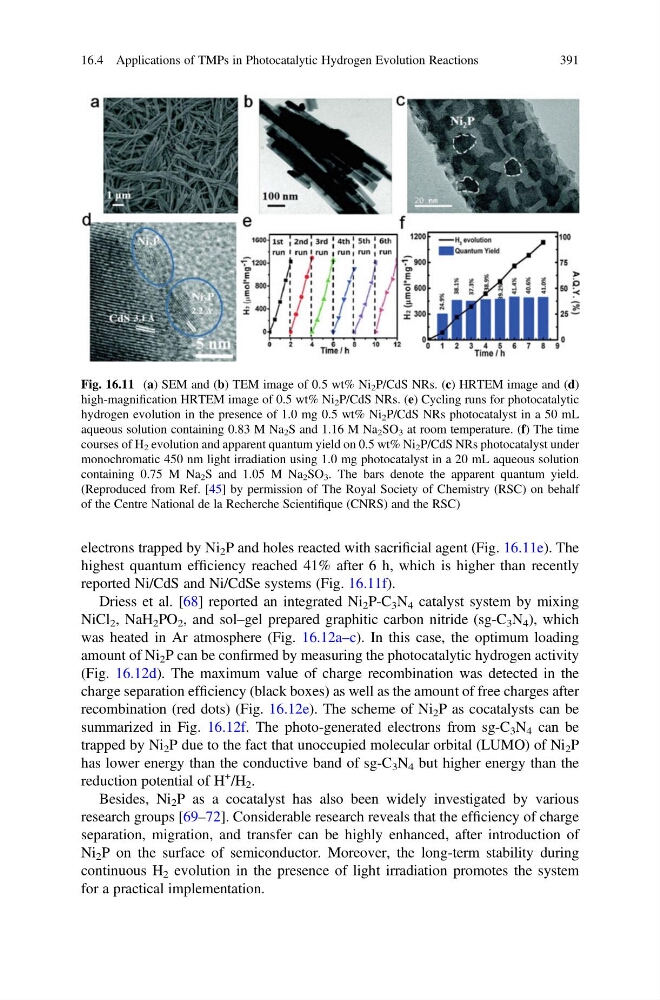
electrons trapped by Ni 2 P and holes reacted with sacrificial agent (Fig. 16.11e). The
highest quantum efficiency reached 41% after 6 h, which is higher than recently
reported Ni/CdS and Ni/CdSe systems (Fig. 16.11f).
Driess et al. [68] reported an integrated Ni 2 P-C 3 N 4 catalyst system by mixing
NiCl 2 , NaH 2 PO 2 , and sol–gel prepared graphitic carbon nitride (sg-C 3 N 4 ), which
was heated in Ar atmosphere (Fig. 16.12a–c). In this case, the optimum loading
amount of Ni 2 P can be confirmed by measuring the photocatalytic hydrogen activity
(Fig. 16.12d). The maximum value of charge recombination was detected in the
charge separation efficiency (black boxes) as well as the amount of free charges after
recombination (red dots) (Fig. 16.12e). The scheme of Ni 2 P as cocatalysts can be
summarized in Fig. 16.12f. The photo-generated electrons from sg-C 3 N 4 can be
trapped by Ni 2 P due to the fact that unoccupied molecular orbital (LUMO) of Ni 2 P
has lower energy than the conductive band of sg-C 3 N 4 but higher energy than the
reduction potential of H
+ /H 2 .
Besides, Ni 2 P as a cocatalyst has also been widely investigated by various
research groups [69–72]. Considerable research reveals that the efficiency of charge
separation, migration, and transfer can be highly enhanced, after introduction of
Ni 2 P on the surface of semiconductor. Moreover, the long-term stability during
continuous H 2 evolution in the presence of light irradiation promotes the system
for a practical implementation.
Fig. 16.11 (a) SEM and (b) TEM image of 0.5 wt% Ni 2 P/CdS NRs. (c) HRTEM image and (d)
high-magnification HRTEM image of 0.5 wt% Ni 2 P/CdS NRs. (e) Cycling runs for photocatalytic
hydrogen evolution in the presence of 1.0 mg 0.5 wt% Ni 2 P/CdS NRs photocatalyst in a 50 mL
aqueous solution containing 0.83 M Na 2 S and 1.16 M Na 2 SO 3 at room temperature. (f) The time
courses of H 2 evolution and apparent quantum yield on 0.5 wt% Ni 2 P/CdS NRs photocatalyst under
monochromatic 450 nm light irradiation using 1.0 mg photocatalyst in a 20 mL aqueous solution
containing 0.75 M Na 2 S and 1.05 M Na 2 SO 3 . The bars denote the apparent quantum yield.
(Reproduced from Ref. [45] by permission of The Royal Society of Chemistry (RSC) on behalf
of the Centre National de la Recherche Scientifique (CNRS) and the RSC)
16.4 Applications of TMPs in Photocatalytic Hydrogen Evolution Reactions
391
highest quantum efficiency reached 41% after 6 h, which is higher than recently
reported Ni/CdS and Ni/CdSe systems (Fig. 16.11f).
Driess et al. [68] reported an integrated Ni 2 P-C 3 N 4 catalyst system by mixing
NiCl 2 , NaH 2 PO 2 , and sol–gel prepared graphitic carbon nitride (sg-C 3 N 4 ), which
was heated in Ar atmosphere (Fig. 16.12a–c). In this case, the optimum loading
amount of Ni 2 P can be confirmed by measuring the photocatalytic hydrogen activity
(Fig. 16.12d). The maximum value of charge recombination was detected in the
charge separation efficiency (black boxes) as well as the amount of free charges after
recombination (red dots) (Fig. 16.12e). The scheme of Ni 2 P as cocatalysts can be
summarized in Fig. 16.12f. The photo-generated electrons from sg-C 3 N 4 can be
trapped by Ni 2 P due to the fact that unoccupied molecular orbital (LUMO) of Ni 2 P
has lower energy than the conductive band of sg-C 3 N 4 but higher energy than the
reduction potential of H
+ /H 2 .
Besides, Ni 2 P as a cocatalyst has also been widely investigated by various
research groups [69–72]. Considerable research reveals that the efficiency of charge
separation, migration, and transfer can be highly enhanced, after introduction of
Ni 2 P on the surface of semiconductor. Moreover, the long-term stability during
continuous H 2 evolution in the presence of light irradiation promotes the system
for a practical implementation.
Fig. 16.11 (a) SEM and (b) TEM image of 0.5 wt% Ni 2 P/CdS NRs. (c) HRTEM image and (d)
high-magnification HRTEM image of 0.5 wt% Ni 2 P/CdS NRs. (e) Cycling runs for photocatalytic
hydrogen evolution in the presence of 1.0 mg 0.5 wt% Ni 2 P/CdS NRs photocatalyst in a 50 mL
aqueous solution containing 0.83 M Na 2 S and 1.16 M Na 2 SO 3 at room temperature. (f) The time
courses of H 2 evolution and apparent quantum yield on 0.5 wt% Ni 2 P/CdS NRs photocatalyst under
monochromatic 450 nm light irradiation using 1.0 mg photocatalyst in a 20 mL aqueous solution
containing 0.75 M Na 2 S and 1.05 M Na 2 SO 3 . The bars denote the apparent quantum yield.
(Reproduced from Ref. [45] by permission of The Royal Society of Chemistry (RSC) on behalf
of the Centre National de la Recherche Scientifique (CNRS) and the RSC)
16.4 Applications of TMPs in Photocatalytic Hydrogen Evolution Reactions
391