

nanodots, have demonstrated to be satisfied performance. In photocatalysis, the
morphology of Ni x P mainly focused on nanodots due to its high surface area and
easy loading properties [67]. Du et al. [45] reported a one-pot hydrothermal method
to in situ deposit Ni 2 P nanoparticles on CdS nanorods (Fig. 16.11a–d). They found
that Ni 2 P nanoparticles can act as cocatalyst to improve the photocatalytic hydrogen
evolution activity under visible light irradiation. Furthermore, after loading Ni 2 P, the
catalyst showed highly stable photocatalytic activity due to the photo-generated
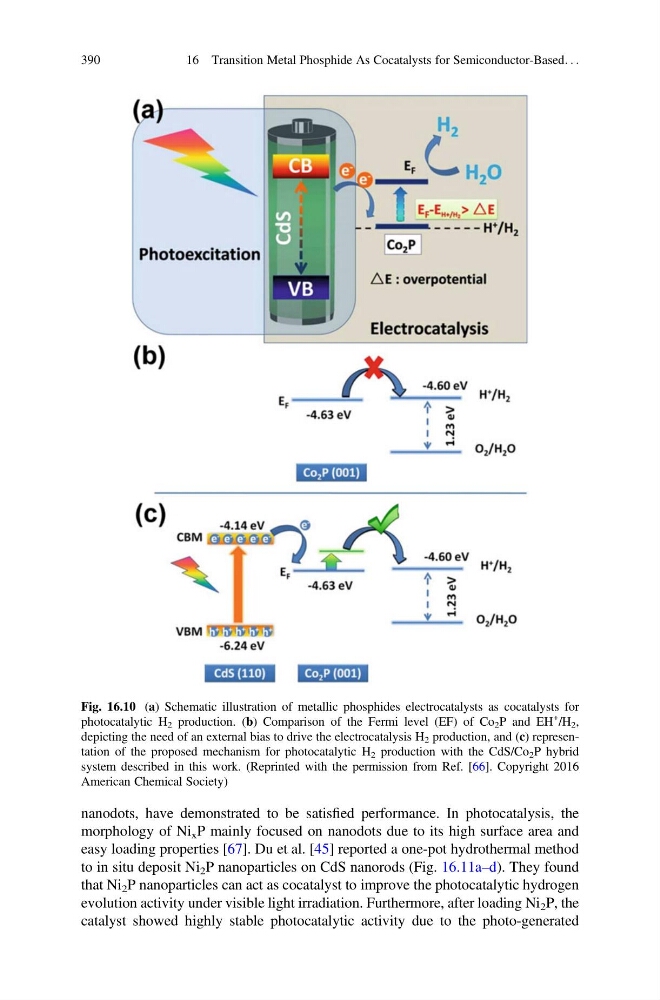
Fig. 16.10 (a) Schematic illustration of metallic phosphides electrocatalysts as cocatalysts for
photocatalytic H 2 production. (b) Comparison of the Fermi level (EF) of Co 2 P and EH
+ /H 2 ,
depicting the need of an external bias to drive the electrocatalysis H 2 production, and (c) representation of the proposed mechanism for photocatalytic H 2 production with the CdS/Co 2 P hybrid
system described in this work. (Reprinted with the permission from Ref. [66]. Copyright 2016
American Chemical Society)
390
16 Transition Metal Phosphide As Cocatalysts for Semiconductor-Based. . .
morphology of Ni x P mainly focused on nanodots due to its high surface area and
easy loading properties [67]. Du et al. [45] reported a one-pot hydrothermal method
to in situ deposit Ni 2 P nanoparticles on CdS nanorods (Fig. 16.11a–d). They found
that Ni 2 P nanoparticles can act as cocatalyst to improve the photocatalytic hydrogen
evolution activity under visible light irradiation. Furthermore, after loading Ni 2 P, the
catalyst showed highly stable photocatalytic activity due to the photo-generated
Fig. 16.10 (a) Schematic illustration of metallic phosphides electrocatalysts as cocatalysts for
photocatalytic H 2 production. (b) Comparison of the Fermi level (EF) of Co 2 P and EH
+ /H 2 ,
depicting the need of an external bias to drive the electrocatalysis H 2 production, and (c) representation of the proposed mechanism for photocatalytic H 2 production with the CdS/Co 2 P hybrid
system described in this work. (Reprinted with the permission from Ref. [66]. Copyright 2016
American Chemical Society)
390
16 Transition Metal Phosphide As Cocatalysts for Semiconductor-Based. . .