

separation and provide the dominated active sites for hydrogen proton reduction,
thus addressing the long-standing controversy on the role of electrocatalysts in
photocatalysis (Fig. 16.10a). More specifically, as shown in Fig. 16.10b, an additional bias voltage was required to raise the energy of Fermi lever (E F ) of Co 2 P, thus
providing the external driving force to splitting water in electrocatalysis. However,
in photocatalysis, since the energy value of E F is lower than the conductive band
value of CdS, photo-generated electrons from CdS can be transferred to Co 2 P. More
importantly, the injection of photo-generated electrons into TMPs can upshift the
position of E F , which is similar to noble metals (Fig. 16.10c).
16.4.3 Semiconductors Motivated by TMPs for Photocatalytic
Hydrogen Evolution
16.4.3.1 Nickel Phosphides As Cocatalyst
In electrocatalysis, a series of nickel phosphides (Ni x P) with different morphologies
and dimensionality, such as nanorod, nanowires, nanoplates, nanospheres, and
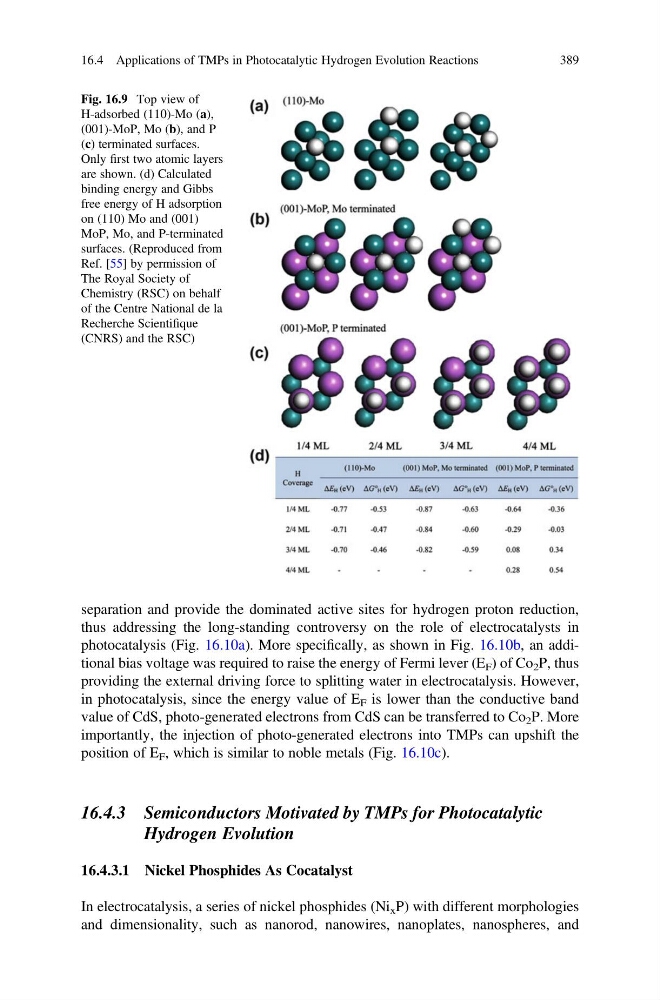
Fig. 16.9 Top view of
H-adsorbed (110)-Mo (a),
(001)-MoP, Mo (b), and P
(c) terminated surfaces.
Only first two atomic layers
are shown. (d) Calculated
binding energy and Gibbs
free energy of H adsorption
on (110) Mo and (001)
MoP, Mo, and P-terminated
surfaces. (Reproduced from
Ref. [55] by permission of
The Royal Society of
Chemistry (RSC) on behalf
of the Centre National de la
Recherche Scientifique
(CNRS) and the RSC)
16.4 Applications of TMPs in Photocatalytic Hydrogen Evolution Reactions
389
thus addressing the long-standing controversy on the role of electrocatalysts in
photocatalysis (Fig. 16.10a). More specifically, as shown in Fig. 16.10b, an additional bias voltage was required to raise the energy of Fermi lever (E F ) of Co 2 P, thus
providing the external driving force to splitting water in electrocatalysis. However,
in photocatalysis, since the energy value of E F is lower than the conductive band
value of CdS, photo-generated electrons from CdS can be transferred to Co 2 P. More
importantly, the injection of photo-generated electrons into TMPs can upshift the
position of E F , which is similar to noble metals (Fig. 16.10c).
16.4.3 Semiconductors Motivated by TMPs for Photocatalytic
Hydrogen Evolution
16.4.3.1 Nickel Phosphides As Cocatalyst
In electrocatalysis, a series of nickel phosphides (Ni x P) with different morphologies
and dimensionality, such as nanorod, nanowires, nanoplates, nanospheres, and
Fig. 16.9 Top view of
H-adsorbed (110)-Mo (a),
(001)-MoP, Mo (b), and P
(c) terminated surfaces.
Only first two atomic layers
are shown. (d) Calculated
binding energy and Gibbs
free energy of H adsorption
on (110) Mo and (001)
MoP, Mo, and P-terminated
surfaces. (Reproduced from
Ref. [55] by permission of
The Royal Society of
Chemistry (RSC) on behalf
of the Centre National de la
Recherche Scientifique
(CNRS) and the RSC)
16.4 Applications of TMPs in Photocatalytic Hydrogen Evolution Reactions
389