

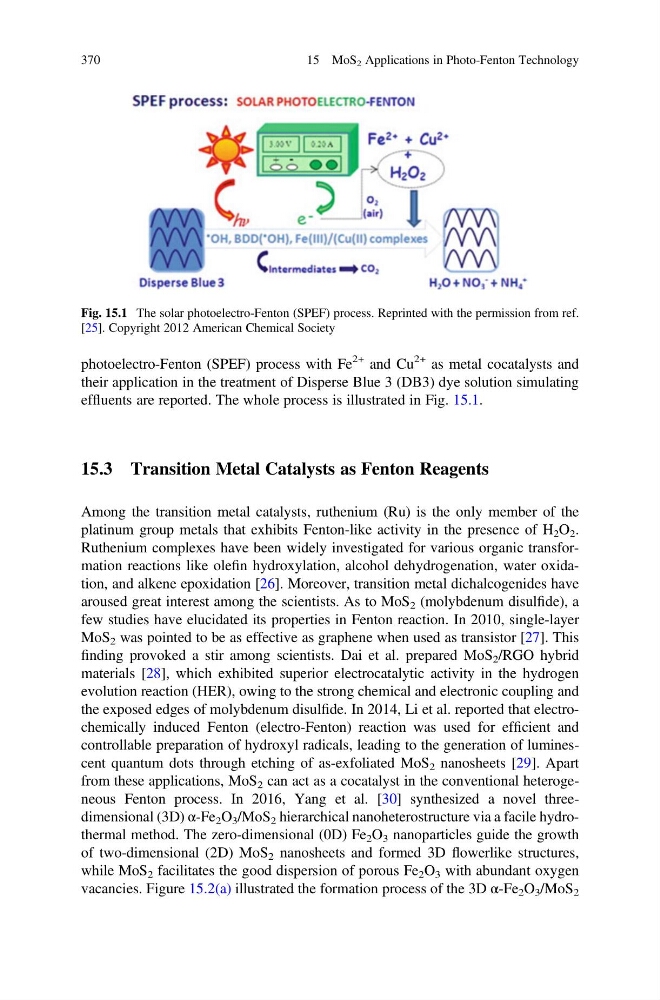
photoelectro-Fenton (SPEF) process with Fe
2+ and Cu
2+ as metal cocatalysts and
their application in the treatment of Disperse Blue 3 (DB3) dye solution simulating
effluents are reported. The whole process is illustrated in Fig. 15.1.
15.3 Transition Metal Catalysts as Fenton Reagents
Among the transition metal catalysts, ruthenium (Ru) is the only member of the
platinum group metals that exhibits Fenton-like activity in the presence of H 2 O 2 .
Ruthenium complexes have been widely investigated for various organic transformation reactions like olefin hydroxylation, alcohol dehydrogenation, water oxidation, and alkene epoxidation [26]. Moreover, transition metal dichalcogenides have
aroused great interest among the scientists. As to MoS 2 (molybdenum disulfide), a
few studies have elucidated its properties in Fenton reaction. In 2010, single-layer
MoS 2 was pointed to be as effective as graphene when used as transistor [27]. This
finding provoked a stir among scientists. Dai et al. prepared MoS 2 /RGO hybrid
materials [28], which exhibited superior electrocatalytic activity in the hydrogen
evolution reaction (HER), owing to the strong chemical and electronic coupling and
the exposed edges of molybdenum disulfide. In 2014, Li et al. reported that electrochemically induced Fenton (electro-Fenton) reaction was used for efficient and
controllable preparation of hydroxyl radicals, leading to the generation of luminescent quantum dots through etching of as-exfoliated MoS 2 nanosheets [29]. Apart
from these applications, MoS 2 can act as a cocatalyst in the conventional heterogeneous Fenton process. In 2016, Yang et al. [30] synthesized a novel threedimensional (3D) α-Fe 2 O 3 /MoS 2 hierarchical nanoheterostructure via a facile hydrothermal method. The zero-dimensional (0D) Fe 2 O 3 nanoparticles guide the growth
of two-dimensional (2D) MoS 2 nanosheets and formed 3D flowerlike structures,
while MoS 2 facilitates the good dispersion of porous Fe 2 O 3 with abundant oxygen
vacancies. Figure 15.2(a) illustrated the formation process of the 3D α-Fe 2 O 3 /MoS 2
Fig. 15.1 The solar photoelectro-Fenton (SPEF) process. Reprinted with the permission from ref.
[25]. Copyright 2012 American Chemical Society
370
15 MoS 2 Applications in Photo-Fenton Technology
2+ and Cu
2+ as metal cocatalysts and
their application in the treatment of Disperse Blue 3 (DB3) dye solution simulating
effluents are reported. The whole process is illustrated in Fig. 15.1.
15.3 Transition Metal Catalysts as Fenton Reagents
Among the transition metal catalysts, ruthenium (Ru) is the only member of the
platinum group metals that exhibits Fenton-like activity in the presence of H 2 O 2 .
Ruthenium complexes have been widely investigated for various organic transformation reactions like olefin hydroxylation, alcohol dehydrogenation, water oxidation, and alkene epoxidation [26]. Moreover, transition metal dichalcogenides have
aroused great interest among the scientists. As to MoS 2 (molybdenum disulfide), a
few studies have elucidated its properties in Fenton reaction. In 2010, single-layer
MoS 2 was pointed to be as effective as graphene when used as transistor [27]. This
finding provoked a stir among scientists. Dai et al. prepared MoS 2 /RGO hybrid
materials [28], which exhibited superior electrocatalytic activity in the hydrogen
evolution reaction (HER), owing to the strong chemical and electronic coupling and
the exposed edges of molybdenum disulfide. In 2014, Li et al. reported that electrochemically induced Fenton (electro-Fenton) reaction was used for efficient and
controllable preparation of hydroxyl radicals, leading to the generation of luminescent quantum dots through etching of as-exfoliated MoS 2 nanosheets [29]. Apart
from these applications, MoS 2 can act as a cocatalyst in the conventional heterogeneous Fenton process. In 2016, Yang et al. [30] synthesized a novel threedimensional (3D) α-Fe 2 O 3 /MoS 2 hierarchical nanoheterostructure via a facile hydrothermal method. The zero-dimensional (0D) Fe 2 O 3 nanoparticles guide the growth
of two-dimensional (2D) MoS 2 nanosheets and formed 3D flowerlike structures,
while MoS 2 facilitates the good dispersion of porous Fe 2 O 3 with abundant oxygen
vacancies. Figure 15.2(a) illustrated the formation process of the 3D α-Fe 2 O 3 /MoS 2
Fig. 15.1 The solar photoelectro-Fenton (SPEF) process. Reprinted with the permission from ref.
[25]. Copyright 2012 American Chemical Society
370
15 MoS 2 Applications in Photo-Fenton Technology