

light irradiations. Besides the organic pollutants, in our daily life, coffee is necessary
for many people. At the same time, coffee effluent contains a large amount of dark
brown pigments. When coffee effluent is released in aquatic system, it cuts off light
and affects photosynthesis due to its intense dark brown color. Furthermore, its high
organic load causes eutrophication. Interestingly, Masahiro Tokumura et al. [20]
investigated the influence of various operating parameters on the color removal of
coffee effluents and found that the UV/Fe
2+ /H 2 O 2 system is very efficient.
15.2.2 Visible Light-Assisted Fenton Process
In previous published work, it is well known that the oxidizing power of the Fentontype systems can be enhanced by visible light. Zhao et al. [21] examined the PhotoFenton process of malachite green (MG) under irradiation by visible light. It was
found that the Fenton degradation of dyes could be accelerated greatly by visible
irradiation because of strong absorbance of visible light. This possibly provides
another good approach to the treatment of dyes pollutants. Furthermore, Zhao et al.
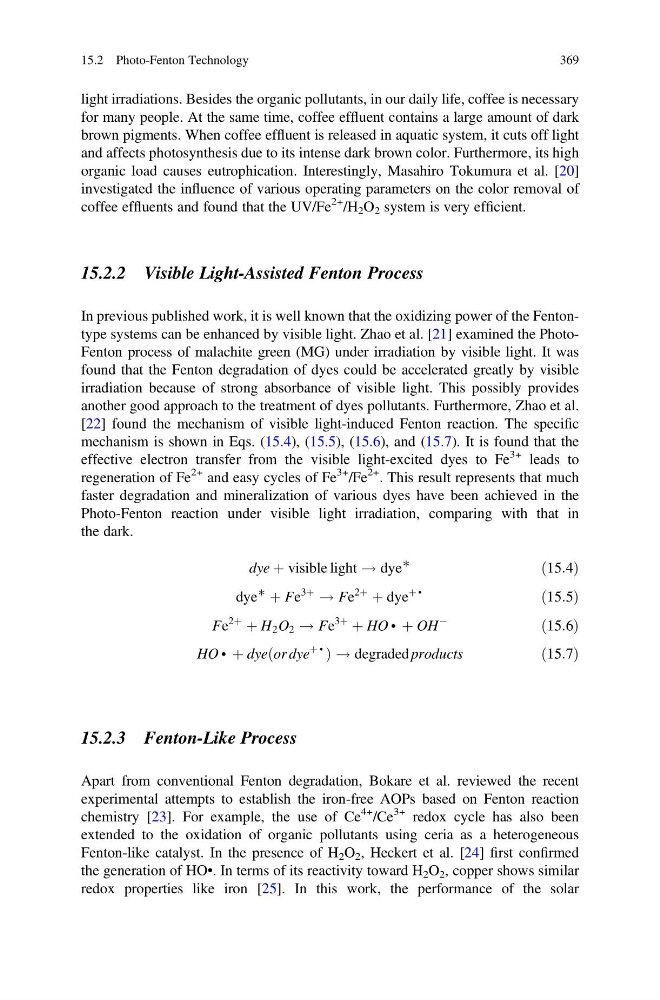
[22] found the mechanism of visible light-induced Fenton reaction. The specific
mechanism is shown in Eqs. (15.4), (15.5), (15.6), and (15.7). It is found that the
effective electron transfer from the visible light-excited dyes to Fe
3+ leads to
regeneration of Fe
2+ and easy cycles of Fe
3+ /Fe
2+ . This result represents that much
faster degradation and mineralization of various dyes have been achieved in the
Photo-Fenton reaction under visible light irradiation, comparing with that in
the dark.
dye þ visible light ! dye
∗
ð15:4Þ
dye
∗
þ Fe
3þ
! Fe
2þ
þ dye
þ •
ð15:5Þ
Fe
2þ
þ H 2 O 2 ! Fe
3þ
þ HO • þ OH
À
ð15:6Þ
HO • þ dye or dye
þ •
ð
Þ!degraded products
ð15:7Þ
15.2.3 Fenton-Like Process
Apart from conventional Fenton degradation, Bokare et al. reviewed the recent
experimental attempts to establish the iron-free AOPs based on Fenton reaction
chemistry [23]. For example, the use of Ce
4+ /Ce
3+ redox cycle has also been
extended to the oxidation of organic pollutants using ceria as a heterogeneous
Fenton-like catalyst. In the presence of H 2 O 2 , Heckert et al. [24] first confirmed
the generation of HO•. In terms of its reactivity toward H 2 O 2 , copper shows similar
redox properties like iron [25]. In this work, the performance of the solar
15.2 Photo-Fenton Technology
369
for many people. At the same time, coffee effluent contains a large amount of dark
brown pigments. When coffee effluent is released in aquatic system, it cuts off light
and affects photosynthesis due to its intense dark brown color. Furthermore, its high
organic load causes eutrophication. Interestingly, Masahiro Tokumura et al. [20]
investigated the influence of various operating parameters on the color removal of
coffee effluents and found that the UV/Fe
2+ /H 2 O 2 system is very efficient.
15.2.2 Visible Light-Assisted Fenton Process
In previous published work, it is well known that the oxidizing power of the Fentontype systems can be enhanced by visible light. Zhao et al. [21] examined the PhotoFenton process of malachite green (MG) under irradiation by visible light. It was
found that the Fenton degradation of dyes could be accelerated greatly by visible
irradiation because of strong absorbance of visible light. This possibly provides
another good approach to the treatment of dyes pollutants. Furthermore, Zhao et al.
[22] found the mechanism of visible light-induced Fenton reaction. The specific
mechanism is shown in Eqs. (15.4), (15.5), (15.6), and (15.7). It is found that the
effective electron transfer from the visible light-excited dyes to Fe
3+ leads to
regeneration of Fe
2+ and easy cycles of Fe
3+ /Fe
2+ . This result represents that much
faster degradation and mineralization of various dyes have been achieved in the
Photo-Fenton reaction under visible light irradiation, comparing with that in
the dark.
dye þ visible light ! dye
∗
ð15:4Þ
dye
∗
þ Fe
3þ
! Fe
2þ
þ dye
þ •
ð15:5Þ
Fe
2þ
þ H 2 O 2 ! Fe
3þ
þ HO • þ OH
À
ð15:6Þ
HO • þ dye or dye
þ •
ð
Þ!degraded products
ð15:7Þ
15.2.3 Fenton-Like Process
Apart from conventional Fenton degradation, Bokare et al. reviewed the recent
experimental attempts to establish the iron-free AOPs based on Fenton reaction
chemistry [23]. For example, the use of Ce
4+ /Ce
3+ redox cycle has also been
extended to the oxidation of organic pollutants using ceria as a heterogeneous
Fenton-like catalyst. In the presence of H 2 O 2 , Heckert et al. [24] first confirmed
the generation of HO•. In terms of its reactivity toward H 2 O 2 , copper shows similar
redox properties like iron [25]. In this work, the performance of the solar
15.2 Photo-Fenton Technology
369