

1960s [11]. Commonly, the accepted Fenton mechanism is presented by Eqs. (15.1),
(15.2), and (15.3), and its reaction rates were well reported in the literature [12].
Fe
2þ
þ H 2 O 2 ! Fe
3þ
þ OH
À
þ • OHk 1 ¼ 40e80L Á mol
À1
Á s
À1
À
Á
ð15:1Þ
Fe
3þ
þ H 2 O 2 ! Fe
2þ
þ • O 2 H þ H
þ k 2 ¼ 9:1 Â 10
À7 L Á mol
À1
Á s
À1
À
Á ð15:2Þ
Fe
3þ
þ • O 2 H ! Fe
2þ
þ O 2 þ H
þ k 3 ¼ 0:33e2:1 Â 10
6 L Á mol
À1
Á s
À1
À
Á ð15:3Þ
Typically, Eq. (15.1) is considered as the core step in Fenton chemistry and
implies the oxidation of ferrous to ferric ions to decompose H 2 O 2 into hydroxyl
radicals. Eq. (15.2) is usually called Fenton-like reaction. This step allows Fe
2+
regeneration in an effective cyclic mechanism. Apart from ferrous ion regeneration,
hydroperoxyl radicals (
. O 2 H) are also produced.
15.2 Photo-Fenton Technology
15.2.1 UV Light-Assisted Fenton Process
Photo-Fenton process has attracted much attention among researchers. Several
studies have reported that Photo-Fenton process has good influence on degradation
of organic pollutants under UV irradiation, for instance, anisole [13], phenols [14–
16], Orange II [17], and xylidine [18]. Because the majority of sunlight is visible
light, therefore, it must be of great importance in the environmental field to utilize
visible light for the degradation of pollutants.
In 2000, Chen et al. reported the photodegradation of methyl orange in methylated solution under both UV and visible irradiations in the presence of ferric ions and
H 2 O 2 [19]. It was found that different radicals were generated under UV and visible
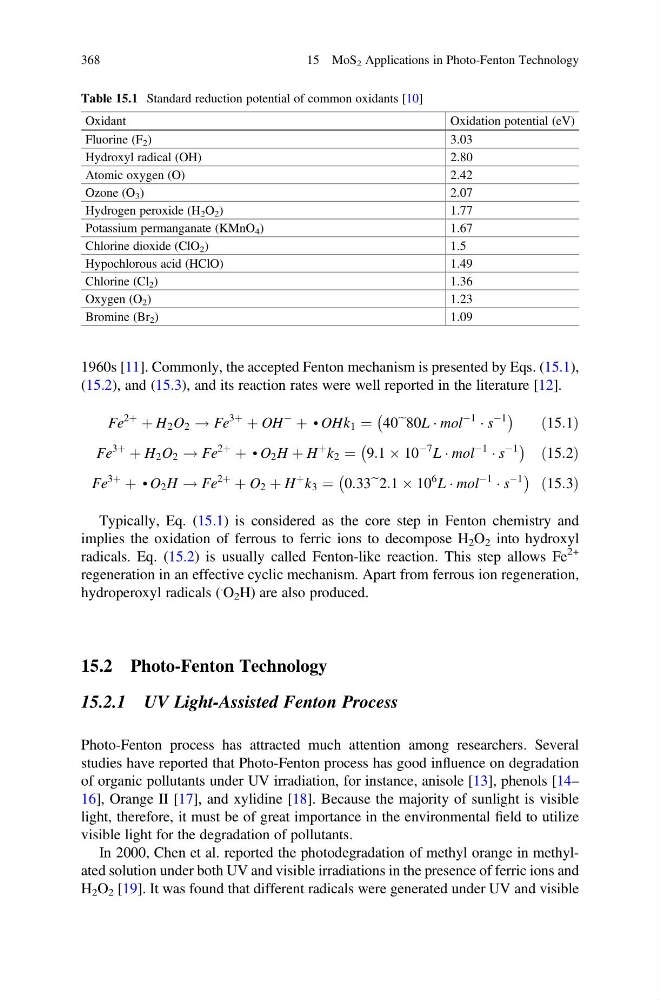
Table 15.1 Standard reduction potential of common oxidants [10]
Oxidant
Oxidation potential (eV)
Fluorine (F 2 )
3.03
Hydroxyl radical (OH)
2.80
Atomic oxygen (O)
2.42
Ozone (O 3 )
2.07
Hydrogen peroxide (H 2 O 2 )
1.77
Potassium permanganate (KMnO 4 )
1.67
Chlorine dioxide (ClO 2 )
1.5
Hypochlorous acid (HClO)
1.49
Chlorine (Cl 2 )
1.36
Oxygen (O 2 )
1.23
Bromine (Br 2 )
1.09
368
15 MoS 2 Applications in Photo-Fenton Technology
(15.2), and (15.3), and its reaction rates were well reported in the literature [12].
Fe
2þ
þ H 2 O 2 ! Fe
3þ
þ OH
À
þ • OHk 1 ¼ 40e80L Á mol
À1
Á s
À1
À
Á
ð15:1Þ
Fe
3þ
þ H 2 O 2 ! Fe
2þ
þ • O 2 H þ H
þ k 2 ¼ 9:1 Â 10
À7 L Á mol
À1
Á s
À1
À
Á ð15:2Þ
Fe
3þ
þ • O 2 H ! Fe
2þ
þ O 2 þ H
þ k 3 ¼ 0:33e2:1 Â 10
6 L Á mol
À1
Á s
À1
À
Á ð15:3Þ
Typically, Eq. (15.1) is considered as the core step in Fenton chemistry and
implies the oxidation of ferrous to ferric ions to decompose H 2 O 2 into hydroxyl
radicals. Eq. (15.2) is usually called Fenton-like reaction. This step allows Fe
2+
regeneration in an effective cyclic mechanism. Apart from ferrous ion regeneration,
hydroperoxyl radicals (
. O 2 H) are also produced.
15.2 Photo-Fenton Technology
15.2.1 UV Light-Assisted Fenton Process
Photo-Fenton process has attracted much attention among researchers. Several
studies have reported that Photo-Fenton process has good influence on degradation
of organic pollutants under UV irradiation, for instance, anisole [13], phenols [14–
16], Orange II [17], and xylidine [18]. Because the majority of sunlight is visible
light, therefore, it must be of great importance in the environmental field to utilize
visible light for the degradation of pollutants.
In 2000, Chen et al. reported the photodegradation of methyl orange in methylated solution under both UV and visible irradiations in the presence of ferric ions and
H 2 O 2 [19]. It was found that different radicals were generated under UV and visible
Table 15.1 Standard reduction potential of common oxidants [10]
Oxidant
Oxidation potential (eV)
Fluorine (F 2 )
3.03
Hydroxyl radical (OH)
2.80
Atomic oxygen (O)
2.42
Ozone (O 3 )
2.07
Hydrogen peroxide (H 2 O 2 )
1.77
Potassium permanganate (KMnO 4 )
1.67
Chlorine dioxide (ClO 2 )
1.5
Hypochlorous acid (HClO)
1.49
Chlorine (Cl 2 )
1.36
Oxygen (O 2 )
1.23
Bromine (Br 2 )
1.09
368
15 MoS 2 Applications in Photo-Fenton Technology