

results indicated that the efficient electron transfer between excited EY molecules
and MCN was realized. The mechanism for photocatalytic H 2 evolution on the
EY-MCN photocatalyst is shown in Fig. 14.15c. Moreover, the mesoporous structure and high surface area of the MCN material facilitated the adsorption of EY
molecules on the surface, thus promoting the photocatalytic activity via improved
light harvesting [39].
Markus Antonietti et al. carried out a research on the spectral sensitization of
MCN catalyst by depositing magnesium phthalocyanine (MgPc) to extend the
absorption wavelength to that longer than those of the original MCN. The obtained
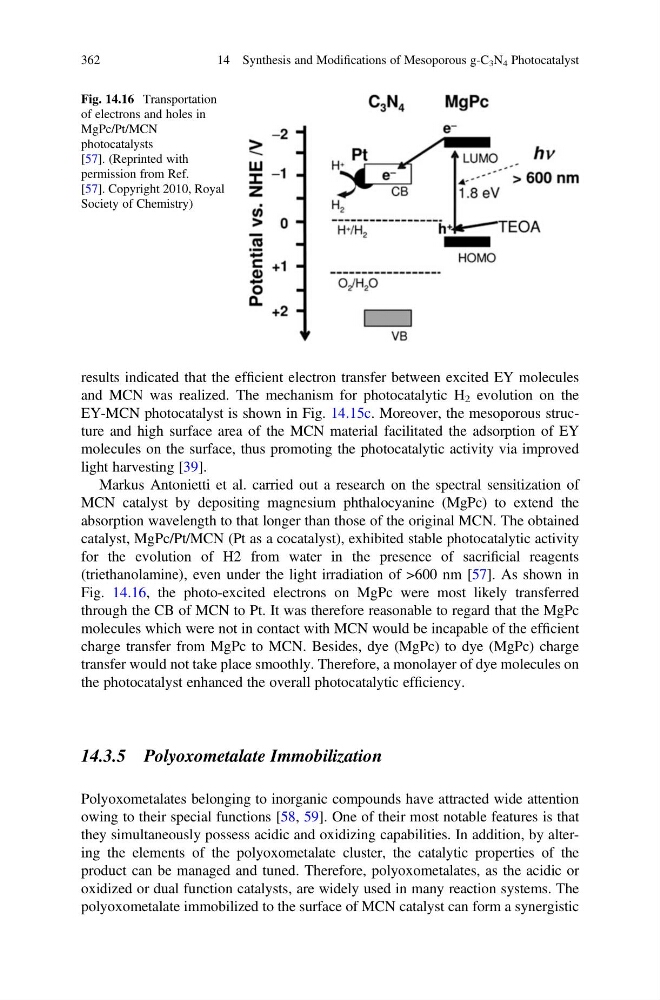
catalyst, MgPc/Pt/MCN (Pt as a cocatalyst), exhibited stable photocatalytic activity
for the evolution of H2 from water in the presence of sacrificial reagents
(triethanolamine), even under the light irradiation of >600 nm [57]. As shown in
Fig. 14.16, the photo-excited electrons on MgPc were most likely transferred
through the CB of MCN to Pt. It was therefore reasonable to regard that the MgPc
molecules which were not in contact with MCN would be incapable of the efficient
charge transfer from MgPc to MCN. Besides, dye (MgPc) to dye (MgPc) charge
transfer would not take place smoothly. Therefore, a monolayer of dye molecules on
the photocatalyst enhanced the overall photocatalytic efficiency.
14.3.5 Polyoxometalate Immobilization
Polyoxometalates belonging to inorganic compounds have attracted wide attention
owing to their special functions [58, 59]. One of their most notable features is that
they simultaneously possess acidic and oxidizing capabilities. In addition, by altering the elements of the polyoxometalate cluster, the catalytic properties of the
product can be managed and tuned. Therefore, polyoxometalates, as the acidic or
oxidized or dual function catalysts, are widely used in many reaction systems. The
polyoxometalate immobilized to the surface of MCN catalyst can form a synergistic
Fig. 14.16 Transportation
of electrons and holes in
MgPc/Pt/MCN
photocatalysts
[57]. (Reprinted with
permission from Ref.
[57]. Copyright 2010, Royal
Society of Chemistry)
362
14 Synthesis and Modifications of Mesoporous g-C 3 N 4 Photocatalyst
and MCN was realized. The mechanism for photocatalytic H 2 evolution on the
EY-MCN photocatalyst is shown in Fig. 14.15c. Moreover, the mesoporous structure and high surface area of the MCN material facilitated the adsorption of EY
molecules on the surface, thus promoting the photocatalytic activity via improved
light harvesting [39].
Markus Antonietti et al. carried out a research on the spectral sensitization of
MCN catalyst by depositing magnesium phthalocyanine (MgPc) to extend the
absorption wavelength to that longer than those of the original MCN. The obtained
catalyst, MgPc/Pt/MCN (Pt as a cocatalyst), exhibited stable photocatalytic activity
for the evolution of H2 from water in the presence of sacrificial reagents
(triethanolamine), even under the light irradiation of >600 nm [57]. As shown in
Fig. 14.16, the photo-excited electrons on MgPc were most likely transferred
through the CB of MCN to Pt. It was therefore reasonable to regard that the MgPc
molecules which were not in contact with MCN would be incapable of the efficient
charge transfer from MgPc to MCN. Besides, dye (MgPc) to dye (MgPc) charge
transfer would not take place smoothly. Therefore, a monolayer of dye molecules on
the photocatalyst enhanced the overall photocatalytic efficiency.
14.3.5 Polyoxometalate Immobilization
Polyoxometalates belonging to inorganic compounds have attracted wide attention
owing to their special functions [58, 59]. One of their most notable features is that
they simultaneously possess acidic and oxidizing capabilities. In addition, by altering the elements of the polyoxometalate cluster, the catalytic properties of the
product can be managed and tuned. Therefore, polyoxometalates, as the acidic or
oxidized or dual function catalysts, are widely used in many reaction systems. The
polyoxometalate immobilized to the surface of MCN catalyst can form a synergistic
Fig. 14.16 Transportation
of electrons and holes in
MgPc/Pt/MCN
photocatalysts
[57]. (Reprinted with
permission from Ref.
[57]. Copyright 2010, Royal
Society of Chemistry)
362
14 Synthesis and Modifications of Mesoporous g-C 3 N 4 Photocatalyst