

effect from the combination of catalytic merits of polyoxometalates and MCN,
greatly enhancing the photocatalytic performance.
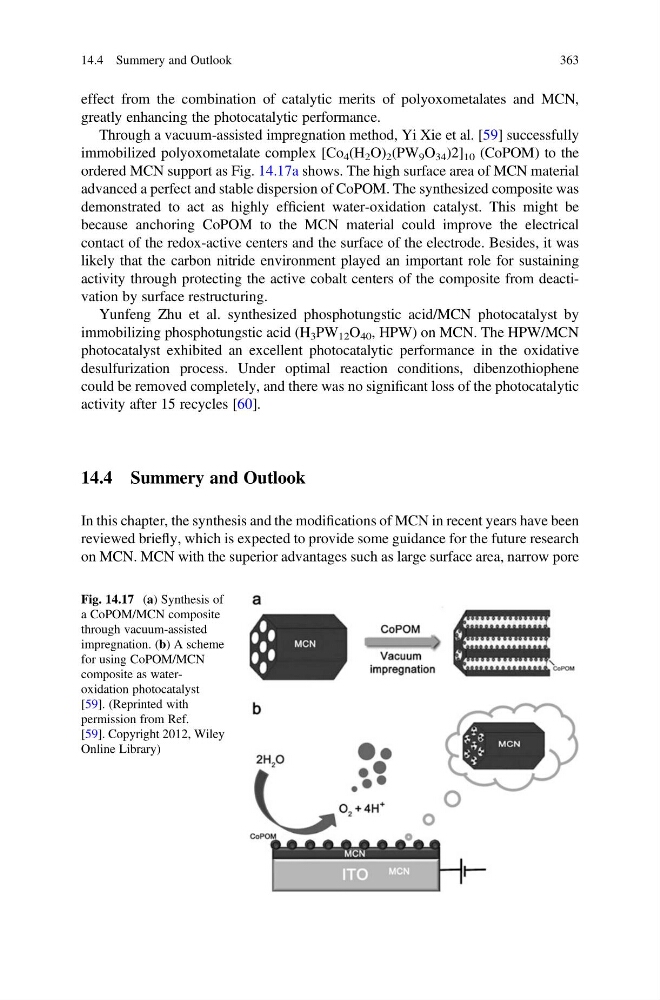
Through a vacuum-assisted impregnation method, Yi Xie et al. [59] successfully
immobilized polyoxometalate complex [Co 4 (H 2 O) 2 (PW 9 O 34 )2] 10 (CoPOM) to the
ordered MCN support as Fig. 14.17a shows. The high surface area of MCN material
advanced a perfect and stable dispersion of CoPOM. The synthesized composite was
demonstrated to act as highly efficient water-oxidation catalyst. This might be
because anchoring CoPOM to the MCN material could improve the electrical
contact of the redox-active centers and the surface of the electrode. Besides, it was
likely that the carbon nitride environment played an important role for sustaining
activity through protecting the active cobalt centers of the composite from deactivation by surface restructuring.
Yunfeng Zhu et al. synthesized phosphotungstic acid/MCN photocatalyst by
immobilizing phosphotungstic acid (H 3 PW 12 O 40 , HPW) on MCN. The HPW/MCN
photocatalyst exhibited an excellent photocatalytic performance in the oxidative
desulfurization process. Under optimal reaction conditions, dibenzothiophene
could be removed completely, and there was no significant loss of the photocatalytic
activity after 15 recycles [60].
14.4 Summery and Outlook
In this chapter, the synthesis and the modifications of MCN in recent years have been
reviewed briefly, which is expected to provide some guidance for the future research
on MCN. MCN with the superior advantages such as large surface area, narrow pore
Fig. 14.17 (a) Synthesis of
a CoPOM/MCN composite
through vacuum-assisted
impregnation. (b) A scheme
for using CoPOM/MCN
composite as wateroxidation photocatalyst
[59]. (Reprinted with
permission from Ref.
[59]. Copyright 2012, Wiley
Online Library)
14.4 Summery and Outlook
363
greatly enhancing the photocatalytic performance.
Through a vacuum-assisted impregnation method, Yi Xie et al. [59] successfully
immobilized polyoxometalate complex [Co 4 (H 2 O) 2 (PW 9 O 34 )2] 10 (CoPOM) to the
ordered MCN support as Fig. 14.17a shows. The high surface area of MCN material
advanced a perfect and stable dispersion of CoPOM. The synthesized composite was
demonstrated to act as highly efficient water-oxidation catalyst. This might be
because anchoring CoPOM to the MCN material could improve the electrical
contact of the redox-active centers and the surface of the electrode. Besides, it was
likely that the carbon nitride environment played an important role for sustaining
activity through protecting the active cobalt centers of the composite from deactivation by surface restructuring.
Yunfeng Zhu et al. synthesized phosphotungstic acid/MCN photocatalyst by
immobilizing phosphotungstic acid (H 3 PW 12 O 40 , HPW) on MCN. The HPW/MCN
photocatalyst exhibited an excellent photocatalytic performance in the oxidative
desulfurization process. Under optimal reaction conditions, dibenzothiophene
could be removed completely, and there was no significant loss of the photocatalytic
activity after 15 recycles [60].
14.4 Summery and Outlook
In this chapter, the synthesis and the modifications of MCN in recent years have been
reviewed briefly, which is expected to provide some guidance for the future research
on MCN. MCN with the superior advantages such as large surface area, narrow pore
Fig. 14.17 (a) Synthesis of
a CoPOM/MCN composite
through vacuum-assisted
impregnation. (b) A scheme
for using CoPOM/MCN
composite as wateroxidation photocatalyst
[59]. (Reprinted with
permission from Ref.
[59]. Copyright 2012, Wiley
Online Library)
14.4 Summery and Outlook
363