

3. The excited dye molecules transfer electrons into the CB of the photocatalyst.
If the CB energy level of semiconductor is more positive than the oxidation level
of dye molecules, dye molecules in excited states can transfer electrons to the CB of
the semiconductor. Then semiconductor can correspondingly accept an electron
from the excited dye molecule, followed by transferring it to the O 2 adsorbed on
the surface to produce active species. Through the above processes, the semiconductor obtains the enhanced photocatalytic activity.
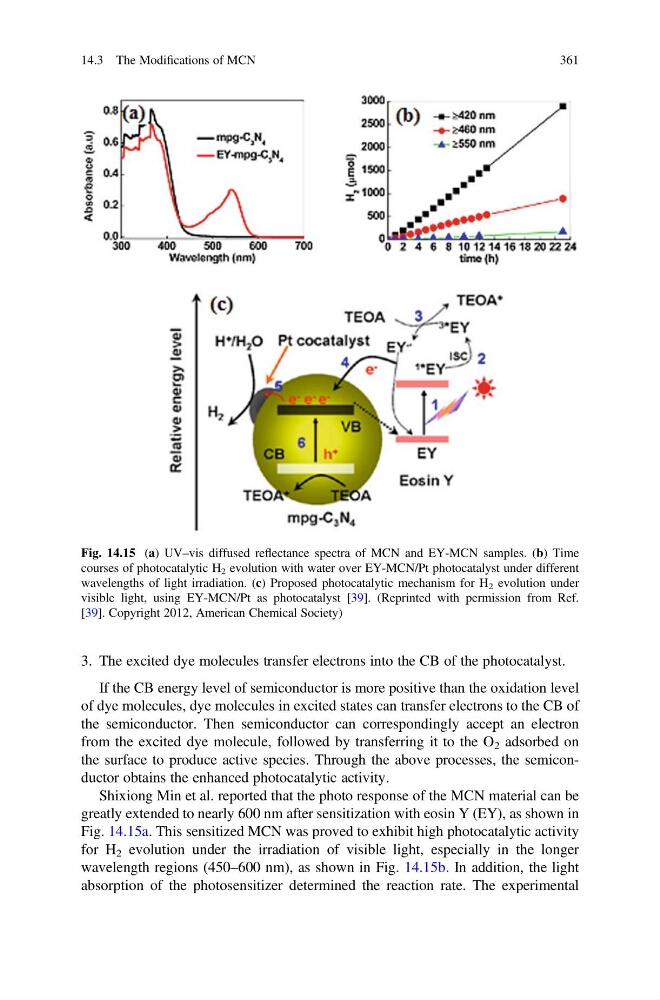
Shixiong Min et al. reported that the photo response of the MCN material can be
greatly extended to nearly 600 nm after sensitization with eosin Y (EY), as shown in
Fig. 14.15a. This sensitized MCN was proved to exhibit high photocatalytic activity
for H 2 evolution under the irradiation of visible light, especially in the longer
wavelength regions (450–600 nm), as shown in Fig. 14.15b. In addition, the light
absorption of the photosensitizer determined the reaction rate. The experimental
Fig. 14.15 (a) UV–vis diffused reflectance spectra of MCN and EY-MCN samples. (b) Time
courses of photocatalytic H 2 evolution with water over EY-MCN/Pt photocatalyst under different
wavelengths of light irradiation. (c) Proposed photocatalytic mechanism for H 2 evolution under
visible light, using EY-MCN/Pt as photocatalyst [39]. (Reprinted with permission from Ref.
[39]. Copyright 2012, American Chemical Society)
14.3 The Modifications of MCN
361
If the CB energy level of semiconductor is more positive than the oxidation level
of dye molecules, dye molecules in excited states can transfer electrons to the CB of
the semiconductor. Then semiconductor can correspondingly accept an electron
from the excited dye molecule, followed by transferring it to the O 2 adsorbed on
the surface to produce active species. Through the above processes, the semiconductor obtains the enhanced photocatalytic activity.
Shixiong Min et al. reported that the photo response of the MCN material can be
greatly extended to nearly 600 nm after sensitization with eosin Y (EY), as shown in
Fig. 14.15a. This sensitized MCN was proved to exhibit high photocatalytic activity
for H 2 evolution under the irradiation of visible light, especially in the longer
wavelength regions (450–600 nm), as shown in Fig. 14.15b. In addition, the light
absorption of the photosensitizer determined the reaction rate. The experimental
Fig. 14.15 (a) UV–vis diffused reflectance spectra of MCN and EY-MCN samples. (b) Time
courses of photocatalytic H 2 evolution with water over EY-MCN/Pt photocatalyst under different
wavelengths of light irradiation. (c) Proposed photocatalytic mechanism for H 2 evolution under
visible light, using EY-MCN/Pt as photocatalyst [39]. (Reprinted with permission from Ref.
[39]. Copyright 2012, American Chemical Society)
14.3 The Modifications of MCN
361