

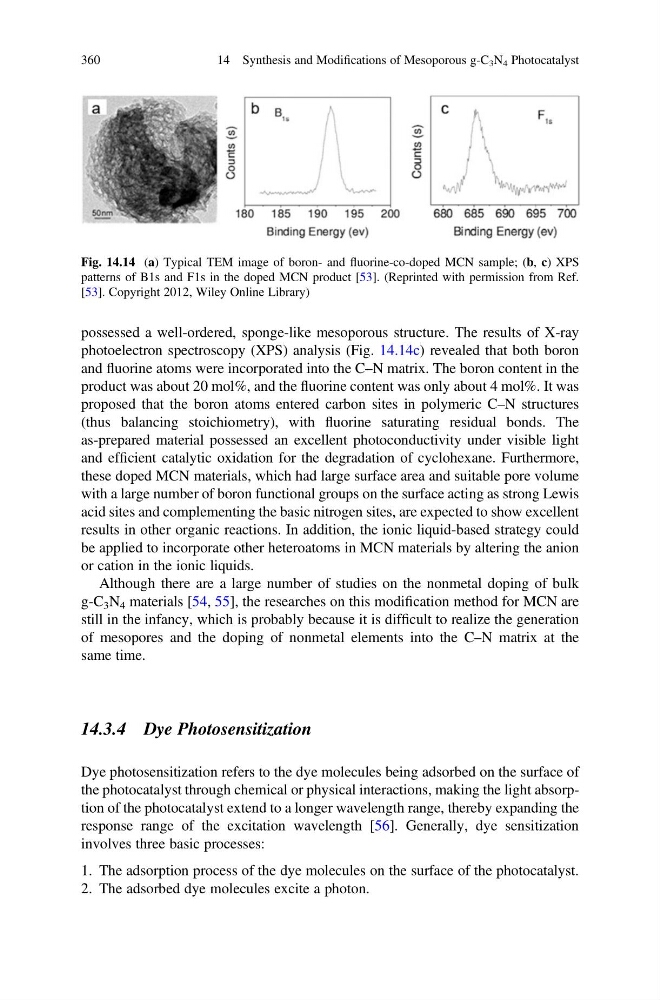
possessed a well-ordered, sponge-like mesoporous structure. The results of X-ray
photoelectron spectroscopy (XPS) analysis (Fig. 14.14c) revealed that both boron
and fluorine atoms were incorporated into the C–N matrix. The boron content in the
product was about 20 mol%, and the fluorine content was only about 4 mol%. It was
proposed that the boron atoms entered carbon sites in polymeric C–N structures
(thus balancing stoichiometry), with fluorine saturating residual bonds. The
as-prepared material possessed an excellent photoconductivity under visible light
and efficient catalytic oxidation for the degradation of cyclohexane. Furthermore,
these doped MCN materials, which had large surface area and suitable pore volume
with a large number of boron functional groups on the surface acting as strong Lewis
acid sites and complementing the basic nitrogen sites, are expected to show excellent
results in other organic reactions. In addition, the ionic liquid-based strategy could
be applied to incorporate other heteroatoms in MCN materials by altering the anion
or cation in the ionic liquids.
Although there are a large number of studies on the nonmetal doping of bulk
g-C 3 N 4 materials [54, 55], the researches on this modification method for MCN are
still in the infancy, which is probably because it is difficult to realize the generation
of mesopores and the doping of nonmetal elements into the C–N matrix at the
same time.
14.3.4 Dye Photosensitization
Dye photosensitization refers to the dye molecules being adsorbed on the surface of
the photocatalyst through chemical or physical interactions, making the light absorption of the photocatalyst extend to a longer wavelength range, thereby expanding the
response range of the excitation wavelength [56]. Generally, dye sensitization
involves three basic processes:
1. The adsorption process of the dye molecules on the surface of the photocatalyst.
2. The adsorbed dye molecules excite a photon.
Fig. 14.14 (a) Typical TEM image of boron- and fluorine-co-doped MCN sample; (b, c) XPS
patterns of B1s and F1s in the doped MCN product [53]. (Reprinted with permission from Ref.
[53]. Copyright 2012, Wiley Online Library)
360
14 Synthesis and Modifications of Mesoporous g-C 3 N 4 Photocatalyst
photoelectron spectroscopy (XPS) analysis (Fig. 14.14c) revealed that both boron
and fluorine atoms were incorporated into the C–N matrix. The boron content in the
product was about 20 mol%, and the fluorine content was only about 4 mol%. It was
proposed that the boron atoms entered carbon sites in polymeric C–N structures
(thus balancing stoichiometry), with fluorine saturating residual bonds. The
as-prepared material possessed an excellent photoconductivity under visible light
and efficient catalytic oxidation for the degradation of cyclohexane. Furthermore,
these doped MCN materials, which had large surface area and suitable pore volume
with a large number of boron functional groups on the surface acting as strong Lewis
acid sites and complementing the basic nitrogen sites, are expected to show excellent
results in other organic reactions. In addition, the ionic liquid-based strategy could
be applied to incorporate other heteroatoms in MCN materials by altering the anion
or cation in the ionic liquids.
Although there are a large number of studies on the nonmetal doping of bulk
g-C 3 N 4 materials [54, 55], the researches on this modification method for MCN are
still in the infancy, which is probably because it is difficult to realize the generation
of mesopores and the doping of nonmetal elements into the C–N matrix at the
same time.
14.3.4 Dye Photosensitization
Dye photosensitization refers to the dye molecules being adsorbed on the surface of
the photocatalyst through chemical or physical interactions, making the light absorption of the photocatalyst extend to a longer wavelength range, thereby expanding the
response range of the excitation wavelength [56]. Generally, dye sensitization
involves three basic processes:
1. The adsorption process of the dye molecules on the surface of the photocatalyst.
2. The adsorbed dye molecules excite a photon.
Fig. 14.14 (a) Typical TEM image of boron- and fluorine-co-doped MCN sample; (b, c) XPS
patterns of B1s and F1s in the doped MCN product [53]. (Reprinted with permission from Ref.
[53]. Copyright 2012, Wiley Online Library)
360
14 Synthesis and Modifications of Mesoporous g-C 3 N 4 Photocatalyst