

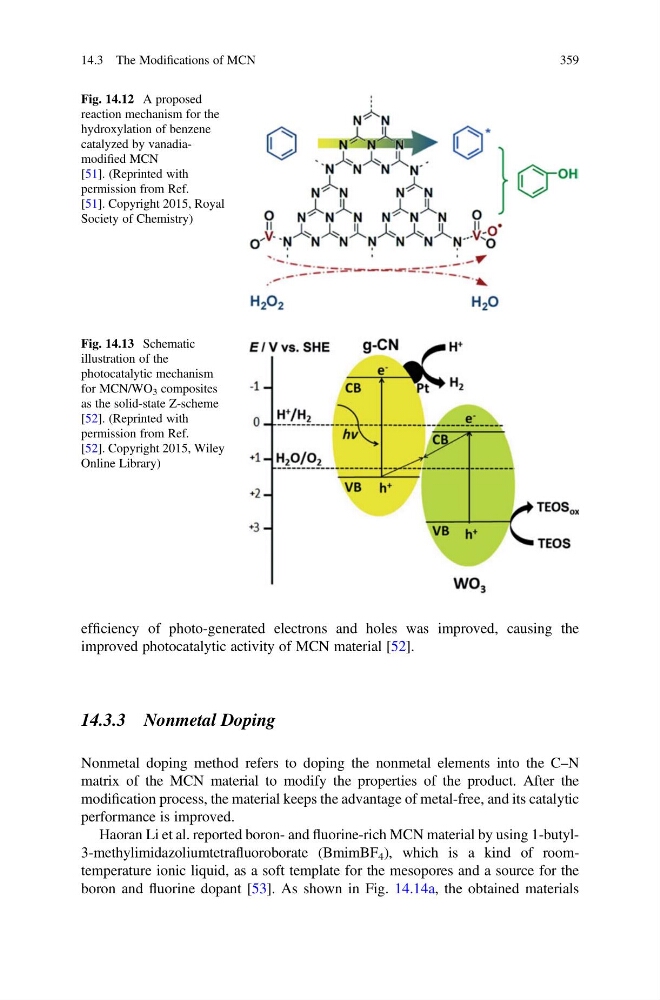
efficiency of photo-generated electrons and holes was improved, causing the
improved photocatalytic activity of MCN material [52].
14.3.3 Nonmetal Doping
Nonmetal doping method refers to doping the nonmetal elements into the C–N
matrix of the MCN material to modify the properties of the product. After the
modification process, the material keeps the advantage of metal-free, and its catalytic
performance is improved.
Haoran Li et al. reported boron- and fluorine-rich MCN material by using 1-butyl3-methylimidazoliumtetrafluoroborate (BmimBF 4 ), which is a kind of roomtemperature ionic liquid, as a soft template for the mesopores and a source for the
boron and fluorine dopant [53]. As shown in Fig. 14.14a, the obtained materials
Fig. 14.12 A proposed
reaction mechanism for the
hydroxylation of benzene
catalyzed by vanadiamodified MCN
[51]. (Reprinted with
permission from Ref.
[51]. Copyright 2015, Royal
Society of Chemistry)
Fig. 14.13 Schematic
illustration of the
photocatalytic mechanism
for MCN/WO 3 composites
as the solid-state Z-scheme
[52]. (Reprinted with
permission from Ref.
[52]. Copyright 2015, Wiley
Online Library)
14.3 The Modifications of MCN
359
improved photocatalytic activity of MCN material [52].
14.3.3 Nonmetal Doping
Nonmetal doping method refers to doping the nonmetal elements into the C–N
matrix of the MCN material to modify the properties of the product. After the
modification process, the material keeps the advantage of metal-free, and its catalytic
performance is improved.
Haoran Li et al. reported boron- and fluorine-rich MCN material by using 1-butyl3-methylimidazoliumtetrafluoroborate (BmimBF 4 ), which is a kind of roomtemperature ionic liquid, as a soft template for the mesopores and a source for the
boron and fluorine dopant [53]. As shown in Fig. 14.14a, the obtained materials
Fig. 14.12 A proposed
reaction mechanism for the
hydroxylation of benzene
catalyzed by vanadiamodified MCN
[51]. (Reprinted with
permission from Ref.
[51]. Copyright 2015, Royal
Society of Chemistry)
Fig. 14.13 Schematic
illustration of the
photocatalytic mechanism
for MCN/WO 3 composites
as the solid-state Z-scheme
[52]. (Reprinted with
permission from Ref.
[52]. Copyright 2015, Wiley
Online Library)
14.3 The Modifications of MCN
359