

when MCN is applied to the field of photocatalysis as a photocatalyst, proper
modifications can greatly improve its photocatalytic activity. The modifications
can not only reduce the recombination rate of photo-generated electron and hole
pairs, which can improve the quantum efficiency of the photocatalysis, but also make
the absorption wavelength have a redshift and thus extend the absorption spectrometry, leading to better absorption and utilization of solar light. Nowadays, the
modification methods for MCN are rich. The representative and typical modification
methods include noble metal deposition, metallic oxide loading, nonmetal doping,
dye photosensitization, as well as polyoxometalate immobilization.
14.3.1 Noble Metal Deposition
Noble metal deposition can change the distribution and transmission of electrons in
the MCN catalyst, which is because it has different Fermi level from MCN. After the
two substances noble metal and MCN contact with each other, electrons can transfer
from MCN with the higher Fermi level to the noble metal whose Fermi level is
relatively lower, and the holes can transfer from noble metal to MCN to balance the
Fermi levels. So the photo-generated electrons and holes concentrate on noble metal
and MCN surface, respectively. Then the photo-generated electrons and holes can be
used for promoting different redox reactions.
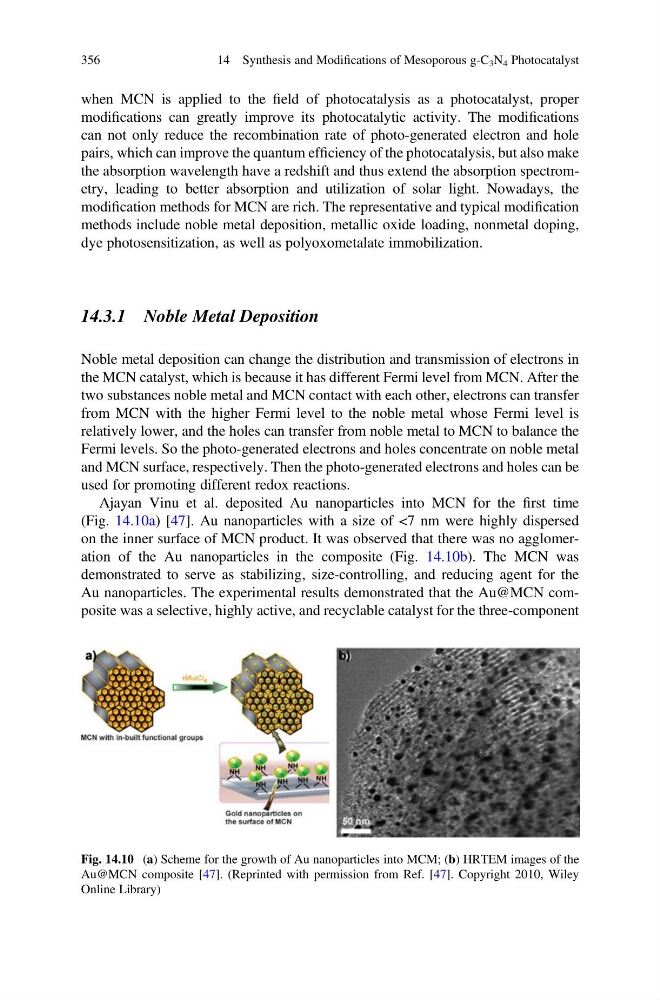
Ajayan Vinu et al. deposited Au nanoparticles into MCN for the first time
(Fig. 14.10a) [47]. Au nanoparticles with a size of <7 nm were highly dispersed
on the inner surface of MCN product. It was observed that there was no agglomeration of the Au nanoparticles in the composite (Fig. 14.10b). The MCN was
demonstrated to serve as stabilizing, size-controlling, and reducing agent for the
Au nanoparticles. The experimental results demonstrated that the Au@MCN composite was a selective, highly active, and recyclable catalyst for the three-component
Fig. 14.10 (a) Scheme for the growth of Au nanoparticles into MCM; (b) HRTEM images of the
Au@MCN composite [47]. (Reprinted with permission from Ref. [47]. Copyright 2010, Wiley
Online Library)
356
14 Synthesis and Modifications of Mesoporous g-C 3 N 4 Photocatalyst
modifications can greatly improve its photocatalytic activity. The modifications
can not only reduce the recombination rate of photo-generated electron and hole
pairs, which can improve the quantum efficiency of the photocatalysis, but also make
the absorption wavelength have a redshift and thus extend the absorption spectrometry, leading to better absorption and utilization of solar light. Nowadays, the
modification methods for MCN are rich. The representative and typical modification
methods include noble metal deposition, metallic oxide loading, nonmetal doping,
dye photosensitization, as well as polyoxometalate immobilization.
14.3.1 Noble Metal Deposition
Noble metal deposition can change the distribution and transmission of electrons in
the MCN catalyst, which is because it has different Fermi level from MCN. After the
two substances noble metal and MCN contact with each other, electrons can transfer
from MCN with the higher Fermi level to the noble metal whose Fermi level is
relatively lower, and the holes can transfer from noble metal to MCN to balance the
Fermi levels. So the photo-generated electrons and holes concentrate on noble metal
and MCN surface, respectively. Then the photo-generated electrons and holes can be
used for promoting different redox reactions.
Ajayan Vinu et al. deposited Au nanoparticles into MCN for the first time
(Fig. 14.10a) [47]. Au nanoparticles with a size of <7 nm were highly dispersed
on the inner surface of MCN product. It was observed that there was no agglomeration of the Au nanoparticles in the composite (Fig. 14.10b). The MCN was
demonstrated to serve as stabilizing, size-controlling, and reducing agent for the
Au nanoparticles. The experimental results demonstrated that the Au@MCN composite was a selective, highly active, and recyclable catalyst for the three-component
Fig. 14.10 (a) Scheme for the growth of Au nanoparticles into MCM; (b) HRTEM images of the
Au@MCN composite [47]. (Reprinted with permission from Ref. [47]. Copyright 2010, Wiley
Online Library)
356
14 Synthesis and Modifications of Mesoporous g-C 3 N 4 Photocatalyst