

coupling reaction of piperidine, benzaldehyde, and phenylacetylene for the synthesis
of propargylamine.
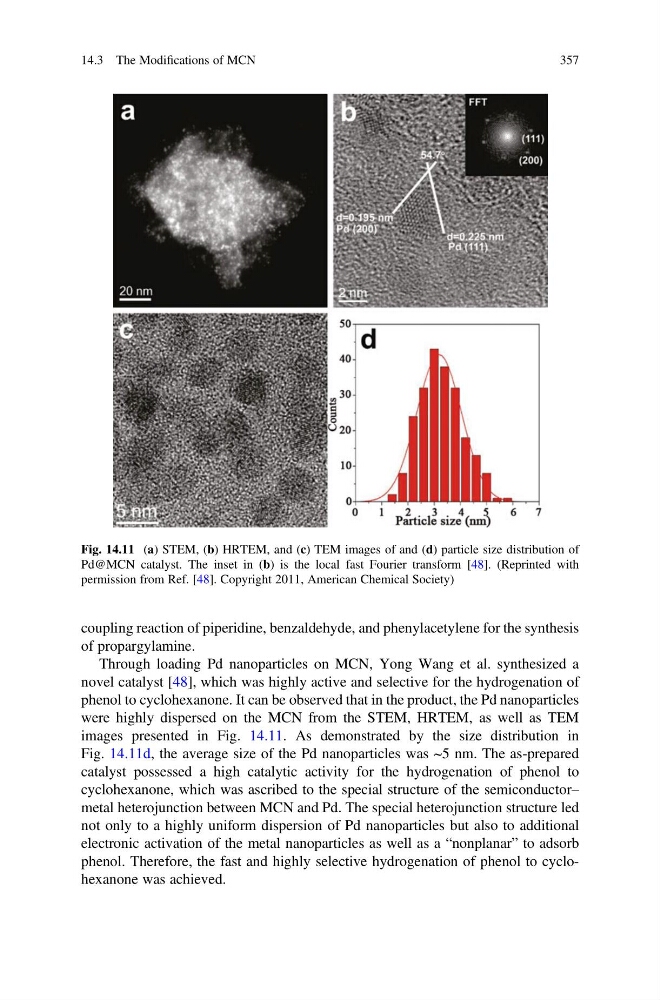
Through loading Pd nanoparticles on MCN, Yong Wang et al. synthesized a
novel catalyst [48], which was highly active and selective for the hydrogenation of
phenol to cyclohexanone. It can be observed that in the product, the Pd nanoparticles
were highly dispersed on the MCN from the STEM, HRTEM, as well as TEM
images presented in Fig. 14.11. As demonstrated by the size distribution in
Fig. 14.11d, the average size of the Pd nanoparticles was ~5 nm. The as-prepared
catalyst possessed a high catalytic activity for the hydrogenation of phenol to
cyclohexanone, which was ascribed to the special structure of the semiconductor–
metal heterojunction between MCN and Pd. The special heterojunction structure led
not only to a highly uniform dispersion of Pd nanoparticles but also to additional
electronic activation of the metal nanoparticles as well as a “nonplanar” to adsorb
phenol. Therefore, the fast and highly selective hydrogenation of phenol to cyclohexanone was achieved.
Fig. 14.11 (a) STEM, (b) HRTEM, and (c) TEM images of and (d) particle size distribution of
Pd@MCN catalyst. The inset in (b) is the local fast Fourier transform [48]. (Reprinted with
permission from Ref. [48]. Copyright 2011, American Chemical Society)
14.3 The Modifications of MCN
357
of propargylamine.
Through loading Pd nanoparticles on MCN, Yong Wang et al. synthesized a
novel catalyst [48], which was highly active and selective for the hydrogenation of
phenol to cyclohexanone. It can be observed that in the product, the Pd nanoparticles
were highly dispersed on the MCN from the STEM, HRTEM, as well as TEM
images presented in Fig. 14.11. As demonstrated by the size distribution in
Fig. 14.11d, the average size of the Pd nanoparticles was ~5 nm. The as-prepared
catalyst possessed a high catalytic activity for the hydrogenation of phenol to
cyclohexanone, which was ascribed to the special structure of the semiconductor–
metal heterojunction between MCN and Pd. The special heterojunction structure led
not only to a highly uniform dispersion of Pd nanoparticles but also to additional
electronic activation of the metal nanoparticles as well as a “nonplanar” to adsorb
phenol. Therefore, the fast and highly selective hydrogenation of phenol to cyclohexanone was achieved.
Fig. 14.11 (a) STEM, (b) HRTEM, and (c) TEM images of and (d) particle size distribution of
Pd@MCN catalyst. The inset in (b) is the local fast Fourier transform [48]. (Reprinted with
permission from Ref. [48]. Copyright 2011, American Chemical Society)
14.3 The Modifications of MCN
357