

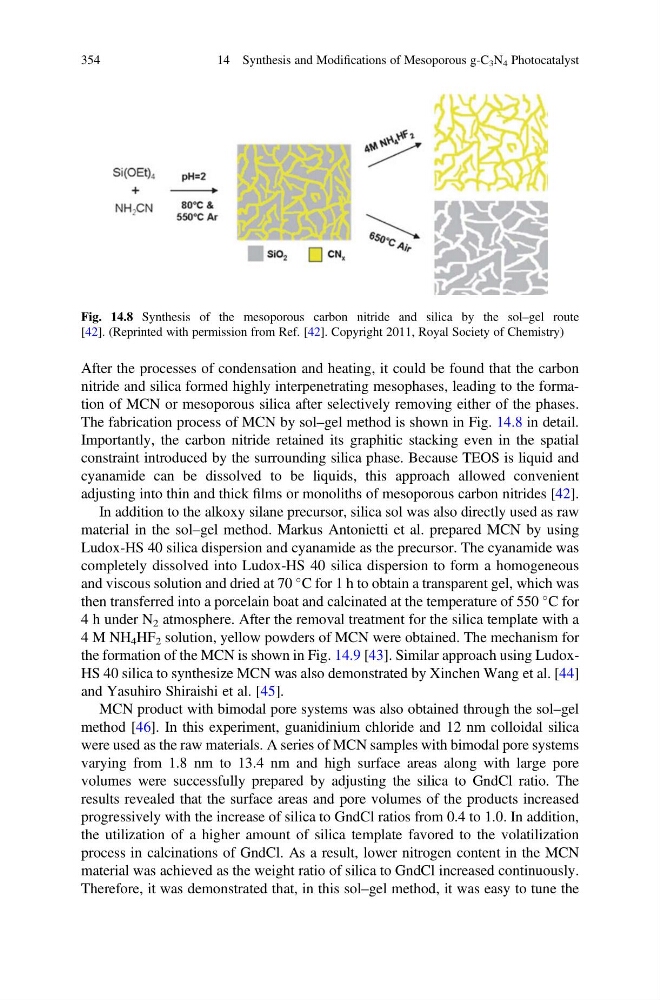
After the processes of condensation and heating, it could be found that the carbon
nitride and silica formed highly interpenetrating mesophases, leading to the formation of MCN or mesoporous silica after selectively removing either of the phases.
The fabrication process of MCN by sol–gel method is shown in Fig. 14.8 in detail.
Importantly, the carbon nitride retained its graphitic stacking even in the spatial
constraint introduced by the surrounding silica phase. Because TEOS is liquid and
cyanamide can be dissolved to be liquids, this approach allowed convenient
adjusting into thin and thick films or monoliths of mesoporous carbon nitrides [42].
In addition to the alkoxy silane precursor, silica sol was also directly used as raw
material in the sol–gel method. Markus Antonietti et al. prepared MCN by using
Ludox-HS 40 silica dispersion and cyanamide as the precursor. The cyanamide was
completely dissolved into Ludox-HS 40 silica dispersion to form a homogeneous
and viscous solution and dried at 70
C for 1 h to obtain a transparent gel, which was
then transferred into a porcelain boat and calcinated at the temperature of 550
C for
4 h under N 2 atmosphere. After the removal treatment for the silica template with a
4 M NH 4 HF 2 solution, yellow powders of MCN were obtained. The mechanism for
the formation of the MCN is shown in Fig. 14.9 [43]. Similar approach using LudoxHS 40 silica to synthesize MCN was also demonstrated by Xinchen Wang et al. [44]
and Yasuhiro Shiraishi et al. [45].
MCN product with bimodal pore systems was also obtained through the sol–gel
method [46]. In this experiment, guanidinium chloride and 12 nm colloidal silica
were used as the raw materials. A series of MCN samples with bimodal pore systems
varying from 1.8 nm to 13.4 nm and high surface areas along with large pore
volumes were successfully prepared by adjusting the silica to GndCl ratio. The
results revealed that the surface areas and pore volumes of the products increased
progressively with the increase of silica to GndCl ratios from 0.4 to 1.0. In addition,
the utilization of a higher amount of silica template favored to the volatilization
process in calcinations of GndCl. As a result, lower nitrogen content in the MCN
material was achieved as the weight ratio of silica to GndCl increased continuously.
Therefore, it was demonstrated that, in this sol–gel method, it was easy to tune the
Fig. 14.8 Synthesis of the mesoporous carbon nitride and silica by the sol–gel route
[42]. (Reprinted with permission from Ref. [42]. Copyright 2011, Royal Society of Chemistry)
354
14 Synthesis and Modifications of Mesoporous g-C 3 N 4 Photocatalyst
nitride and silica formed highly interpenetrating mesophases, leading to the formation of MCN or mesoporous silica after selectively removing either of the phases.
The fabrication process of MCN by sol–gel method is shown in Fig. 14.8 in detail.
Importantly, the carbon nitride retained its graphitic stacking even in the spatial
constraint introduced by the surrounding silica phase. Because TEOS is liquid and
cyanamide can be dissolved to be liquids, this approach allowed convenient
adjusting into thin and thick films or monoliths of mesoporous carbon nitrides [42].
In addition to the alkoxy silane precursor, silica sol was also directly used as raw
material in the sol–gel method. Markus Antonietti et al. prepared MCN by using
Ludox-HS 40 silica dispersion and cyanamide as the precursor. The cyanamide was
completely dissolved into Ludox-HS 40 silica dispersion to form a homogeneous
and viscous solution and dried at 70
C for 1 h to obtain a transparent gel, which was
then transferred into a porcelain boat and calcinated at the temperature of 550
C for
4 h under N 2 atmosphere. After the removal treatment for the silica template with a
4 M NH 4 HF 2 solution, yellow powders of MCN were obtained. The mechanism for
the formation of the MCN is shown in Fig. 14.9 [43]. Similar approach using LudoxHS 40 silica to synthesize MCN was also demonstrated by Xinchen Wang et al. [44]
and Yasuhiro Shiraishi et al. [45].
MCN product with bimodal pore systems was also obtained through the sol–gel
method [46]. In this experiment, guanidinium chloride and 12 nm colloidal silica
were used as the raw materials. A series of MCN samples with bimodal pore systems
varying from 1.8 nm to 13.4 nm and high surface areas along with large pore
volumes were successfully prepared by adjusting the silica to GndCl ratio. The
results revealed that the surface areas and pore volumes of the products increased
progressively with the increase of silica to GndCl ratios from 0.4 to 1.0. In addition,
the utilization of a higher amount of silica template favored to the volatilization
process in calcinations of GndCl. As a result, lower nitrogen content in the MCN
material was achieved as the weight ratio of silica to GndCl increased continuously.
Therefore, it was demonstrated that, in this sol–gel method, it was easy to tune the
Fig. 14.8 Synthesis of the mesoporous carbon nitride and silica by the sol–gel route
[42]. (Reprinted with permission from Ref. [42]. Copyright 2011, Royal Society of Chemistry)
354
14 Synthesis and Modifications of Mesoporous g-C 3 N 4 Photocatalyst