

kind of environment-friendly method. Therefore, it is a kind of simple and green
synthesis method. However, there are still some shortcomings in template-free
method. For examples, similar to the soft-template method, the mesopore structure
in the products prepared by this method cannot achieve a high degree of order, and it
is also difficult to design and tune the properties of the pores. In addition, there are
more stringent requirements in the calcination process and the selection of raw
materials.
14.2.4 Sol–Gel Method
Sol–gel method is a commonly used method for the synthesis of nanomaterials. The
precursors of g-C 3 N 4 are usually mixed with the precursor of silica or a sol of silica
in the sol–gel method for the synthesis of MCN. After those processes including
consecutive sol mixing, gel formation, calcinated polymerization, and silica
removal, the target MCN materials can be obtained. Similar to the hard-template
method, this method requires a procedure for removing the template. But the silica
template is formed in the preparation process of g-C 3 N 4 rather than pre-synthesized,
which is different from the hard-template method.
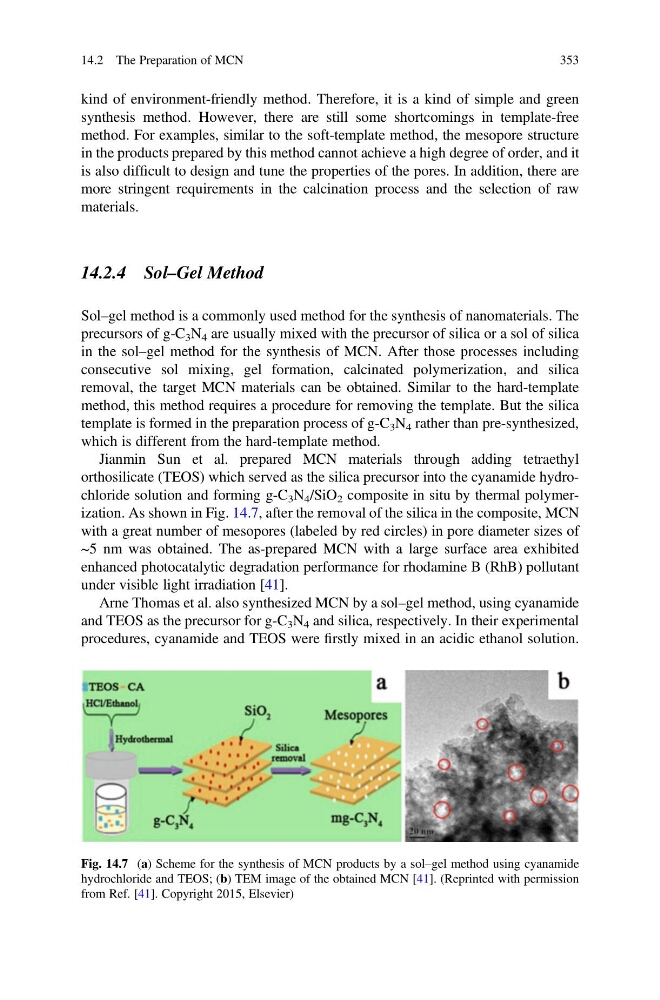
Jianmin Sun et al. prepared MCN materials through adding tetraethyl
orthosilicate (TEOS) which served as the silica precursor into the cyanamide hydrochloride solution and forming g-C 3 N 4 /SiO 2 composite in situ by thermal polymerization. As shown in Fig. 14.7, after the removal of the silica in the composite, MCN
with a great number of mesopores (labeled by red circles) in pore diameter sizes of
~5 nm was obtained. The as-prepared MCN with a large surface area exhibited
enhanced photocatalytic degradation performance for rhodamine B (RhB) pollutant
under visible light irradiation [41].
Arne Thomas et al. also synthesized MCN by a sol–gel method, using cyanamide
and TEOS as the precursor for g-C 3 N 4 and silica, respectively. In their experimental
procedures, cyanamide and TEOS were firstly mixed in an acidic ethanol solution.
Fig. 14.7 (a) Scheme for the synthesis of MCN products by a sol–gel method using cyanamide
hydrochloride and TEOS; (b) TEM image of the obtained MCN [41]. (Reprinted with permission
from Ref. [41]. Copyright 2015, Elsevier)
14.2 The Preparation of MCN
353
synthesis method. However, there are still some shortcomings in template-free
method. For examples, similar to the soft-template method, the mesopore structure
in the products prepared by this method cannot achieve a high degree of order, and it
is also difficult to design and tune the properties of the pores. In addition, there are
more stringent requirements in the calcination process and the selection of raw
materials.
14.2.4 Sol–Gel Method
Sol–gel method is a commonly used method for the synthesis of nanomaterials. The
precursors of g-C 3 N 4 are usually mixed with the precursor of silica or a sol of silica
in the sol–gel method for the synthesis of MCN. After those processes including
consecutive sol mixing, gel formation, calcinated polymerization, and silica
removal, the target MCN materials can be obtained. Similar to the hard-template
method, this method requires a procedure for removing the template. But the silica
template is formed in the preparation process of g-C 3 N 4 rather than pre-synthesized,
which is different from the hard-template method.
Jianmin Sun et al. prepared MCN materials through adding tetraethyl
orthosilicate (TEOS) which served as the silica precursor into the cyanamide hydrochloride solution and forming g-C 3 N 4 /SiO 2 composite in situ by thermal polymerization. As shown in Fig. 14.7, after the removal of the silica in the composite, MCN
with a great number of mesopores (labeled by red circles) in pore diameter sizes of
~5 nm was obtained. The as-prepared MCN with a large surface area exhibited
enhanced photocatalytic degradation performance for rhodamine B (RhB) pollutant
under visible light irradiation [41].
Arne Thomas et al. also synthesized MCN by a sol–gel method, using cyanamide
and TEOS as the precursor for g-C 3 N 4 and silica, respectively. In their experimental
procedures, cyanamide and TEOS were firstly mixed in an acidic ethanol solution.
Fig. 14.7 (a) Scheme for the synthesis of MCN products by a sol–gel method using cyanamide
hydrochloride and TEOS; (b) TEM image of the obtained MCN [41]. (Reprinted with permission
from Ref. [41]. Copyright 2015, Elsevier)
14.2 The Preparation of MCN
353