

photocatalytic performance for degrading RhB was enhanced about 300 times.
Moreover, Yu et al. prepared H 2 WO 4 ÁH 2 O/Ag/AgCl composite nanoplates by a
one-step ionic reaction between Ag 8 W 4 O 16 /Ag nanorods and HCl aqueous solution
[119]. The photocatalytic experiments indicated that the H 2 WO 4 ÁH 2 O/Ag/AgCl
composite nanoplates exhibited a much higher photocatalytic activity than the
one-component (H 2 WO 4 ÁH 2 O) or two-component (such as Ag/AgCl and
H 2 WO 4 ÁH 2 O/Ag) photocatalysts.
2. Type B
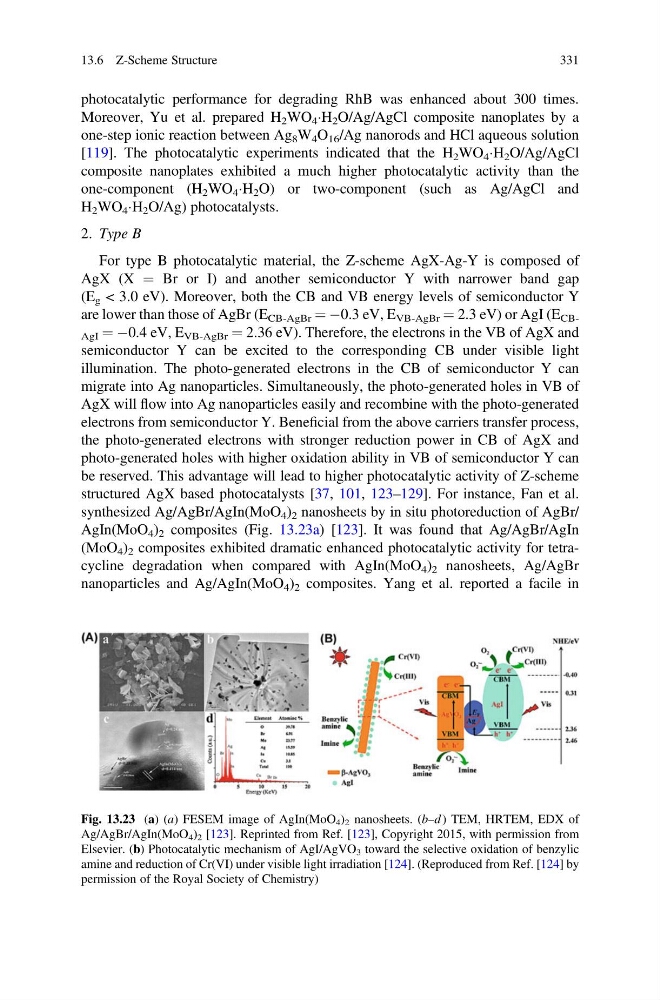
For type B photocatalytic material, the Z-scheme AgX-Ag-Y is composed of
AgX (X ¼ Br or I) and another semiconductor Y with narrower band gap
(E g < 3.0 eV). Moreover, both the CB and VB energy levels of semiconductor Y
are lower than those of AgBr (E CB-AgBr ¼ À0.3 eV, E VB-AgBr ¼ 2.3 eV) or AgI (E CBAgI ¼ À0.4 eV, E VB-AgBr ¼ 2.36 eV). Therefore, the electrons in the VB of AgX and
semiconductor Y can be excited to the corresponding CB under visible light
illumination. The photo-generated electrons in the CB of semiconductor Y can
migrate into Ag nanoparticles. Simultaneously, the photo-generated holes in VB of
AgX will flow into Ag nanoparticles easily and recombine with the photo-generated
electrons from semiconductor Y. Beneficial from the above carriers transfer process,
the photo-generated electrons with stronger reduction power in CB of AgX and
photo-generated holes with higher oxidation ability in VB of semiconductor Y can
be reserved. This advantage will lead to higher photocatalytic activity of Z-scheme
structured AgX based photocatalysts [37, 101, 123–129]. For instance, Fan et al.
synthesized Ag/AgBr/AgIn(MoO 4 ) 2 nanosheets by in situ photoreduction of AgBr/
AgIn(MoO 4 ) 2 composites (Fig. 13.23a) [123]. It was found that Ag/AgBr/AgIn
(MoO 4 ) 2 composites exhibited dramatic enhanced photocatalytic activity for tetracycline degradation when compared with AgIn(MoO 4 ) 2 nanosheets, Ag/AgBr
nanoparticles and Ag/AgIn(MoO 4 ) 2 composites. Yang et al. reported a facile in
Fig. 13.23 (a) (a) FESEM image of AgIn(MoO 4 ) 2 nanosheets. (b–d ) TEM, HRTEM, EDX of
Ag/AgBr/AgIn(MoO 4 ) 2 [123]. Reprinted from Ref. [123], Copyright 2015, with permission from
Elsevier. (b) Photocatalytic mechanism of AgI/AgVO 3 toward the selective oxidation of benzylic
amine and reduction of Cr(VI) under visible light irradiation [124]. (Reproduced from Ref. [124] by
permission of the Royal Society of Chemistry)
13.6 Z-Scheme Structure
331
Moreover, Yu et al. prepared H 2 WO 4 ÁH 2 O/Ag/AgCl composite nanoplates by a
one-step ionic reaction between Ag 8 W 4 O 16 /Ag nanorods and HCl aqueous solution
[119]. The photocatalytic experiments indicated that the H 2 WO 4 ÁH 2 O/Ag/AgCl
composite nanoplates exhibited a much higher photocatalytic activity than the
one-component (H 2 WO 4 ÁH 2 O) or two-component (such as Ag/AgCl and
H 2 WO 4 ÁH 2 O/Ag) photocatalysts.
2. Type B
For type B photocatalytic material, the Z-scheme AgX-Ag-Y is composed of
AgX (X ¼ Br or I) and another semiconductor Y with narrower band gap
(E g < 3.0 eV). Moreover, both the CB and VB energy levels of semiconductor Y
are lower than those of AgBr (E CB-AgBr ¼ À0.3 eV, E VB-AgBr ¼ 2.3 eV) or AgI (E CBAgI ¼ À0.4 eV, E VB-AgBr ¼ 2.36 eV). Therefore, the electrons in the VB of AgX and
semiconductor Y can be excited to the corresponding CB under visible light
illumination. The photo-generated electrons in the CB of semiconductor Y can
migrate into Ag nanoparticles. Simultaneously, the photo-generated holes in VB of
AgX will flow into Ag nanoparticles easily and recombine with the photo-generated
electrons from semiconductor Y. Beneficial from the above carriers transfer process,
the photo-generated electrons with stronger reduction power in CB of AgX and
photo-generated holes with higher oxidation ability in VB of semiconductor Y can
be reserved. This advantage will lead to higher photocatalytic activity of Z-scheme
structured AgX based photocatalysts [37, 101, 123–129]. For instance, Fan et al.
synthesized Ag/AgBr/AgIn(MoO 4 ) 2 nanosheets by in situ photoreduction of AgBr/
AgIn(MoO 4 ) 2 composites (Fig. 13.23a) [123]. It was found that Ag/AgBr/AgIn
(MoO 4 ) 2 composites exhibited dramatic enhanced photocatalytic activity for tetracycline degradation when compared with AgIn(MoO 4 ) 2 nanosheets, Ag/AgBr
nanoparticles and Ag/AgIn(MoO 4 ) 2 composites. Yang et al. reported a facile in
Fig. 13.23 (a) (a) FESEM image of AgIn(MoO 4 ) 2 nanosheets. (b–d ) TEM, HRTEM, EDX of
Ag/AgBr/AgIn(MoO 4 ) 2 [123]. Reprinted from Ref. [123], Copyright 2015, with permission from
Elsevier. (b) Photocatalytic mechanism of AgI/AgVO 3 toward the selective oxidation of benzylic
amine and reduction of Cr(VI) under visible light irradiation [124]. (Reproduced from Ref. [124] by
permission of the Royal Society of Chemistry)
13.6 Z-Scheme Structure
331